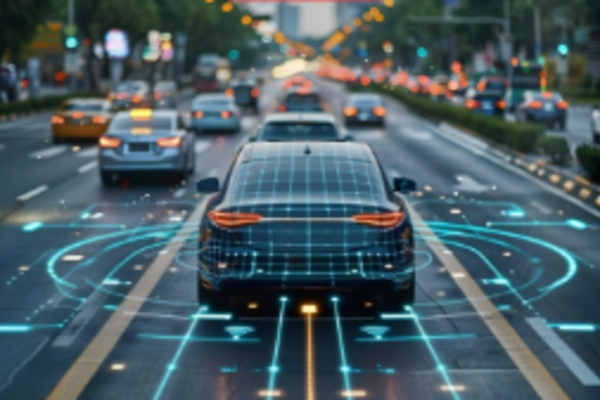
Vehicle to Everything communication, or V2X, is moving from concept to real infrastructure in India, where it could help vehicles, roads, pedestrians, and networks exchange data in real time. In simple terms, it gives cars a way to “see” beyond cameras and radar, which is why it is drawing attention as a road safety and traffic management tool.
V2X is a connected mobility system that lets a vehicle communicate with other vehicles, traffic signals, road sensors, pedestrians, and broader network systems. The technology is built around several layers, including vehicle to vehicle, vehicle to infrastructure, vehicle to pedestrian, and vehicle to network communication.
Unlike conventional driver assistance systems that depend only on onboard sensors, V2X can share live information such as speed, location, braking, and direction. That makes it useful in situations where a driver or sensor cannot directly detect danger, such as a vehicle approaching from a blind spot or a sudden slowdown around a bend.
Public discussions around V2X in India
India’s road network is busy, mixed, and unpredictable, with cars, buses, trucks, two wheelers, pedestrians, and animals often sharing the same space. That complexity makes connected safety systems especially relevant, particularly in dense city traffic, foggy highways, and accident-prone corridors.
Public discussions around V2X in India have focused heavily on reducing accidents and improving traffic flow. Reports cited in the current policy debate suggest that India records roughly 5 lakh road accidents and 1.8 lakh deaths a year, which is why policymakers are exploring V2X as a serious safety layer rather than just a futuristic feature.
How The System Works
In a V2X setup, vehicles use on board units to exchange messages many times per second. Those messages can include braking status, position, acceleration, steering angle, and speed, allowing nearby vehicles and roadside systems to react faster than a human driver could.
The strongest appeal of the technology is its ability to warn of danger before it becomes visible. If a vehicle ahead brakes suddenly, the warning can travel instantly to following vehicles, giving them time to slow down, even in low visibility or in traffic where line of sight is blocked.
India’s Regulatory Push
India has already started formal work on a V2X framework. TRAI released a consultation paper on the technology, and the Department of Telecommunications has moved to open spectrum in the 5.9 GHz band for direct vehicle communication.
That matters because spectrum is the backbone of any connected transport system. The current direction points to a cellular based C V2X model, with 30 MHz in the 5875 to 5905 MHz range made available for vehicle communication, while additional bandwidth has been discussed for future intelligent transport applications.
Role Of 5G And Infrastructure
For V2X to work at scale, India will need more than just vehicles with communication modules. It will need roadside units, signal integration, backend systems, cybersecurity safeguards, and compatibility across automakers and telecom networks.
That is why the 5G ecosystem is important. A cellular based model can support low latency messaging, broader coverage, and future software upgrades, which makes it easier to integrate V2X into existing mobility infrastructure instead of building an entirely separate network from scratch.
India faces several technical, infrastructure, regulatory and human factors that make V2X rollout far more complex than in many other countries.
Key challenges
- Mixed traffic complexity increases false positives and limits effectiveness. India’s roads carry cars, buses, trucks, two wheelers, rickshaws, pedestrians and animals in the same lane, which makes V2X alerts harder to interpret and act on reliably.
- Partial penetration reduces safety benefits. V2X safety relies on a high proportion of equipped vehicles and roadside units; until a critical mass is reached, the system will miss many participants and produce uneven protection across regions.
- Standardization and interoperability uncertainty. Policy debate continues over DSRC versus Cellular V2X and which protocols manufacturers must follow, creating risk for automakers and suppliers and slowing procurement decisions.
- Spectrum and network constraints. Assigning clean, contiguous spectrum and ensuring low latency communications in the 5.9 GHz band and over cellular networks is essential, yet spectrum allocation, de licensing and coexistence with other users remain policy challenges.
- Limited digital infrastructure on roads. Effective V2X needs roadside units, traffic signal integration, backend servers and mapping updates; many Indian corridors lack the fixed infrastructure required for end to end operation.
- 5G coverage and latency gaps. While cellular V2X can leverage 4G and 5G, inconsistent 5G roll out and coverage especially outside metros will limit range and reliability for latency sensitive safety messages.
- Cybersecurity and privacy risks. Continuous exchange of vehicle telemetry raises attack surfaces for spoofing, jamming, false alerts and unauthorized tracking, requiring strong authentication, encryption and governance frameworks.
- Cost and retrofit economics. Retrofitting older vehicles and two wheelers common in India is expensive; the upfront cost of on board units and roadside deployment may slow adoption without subsidies or mandates.
- User behavior and acceptance. Drivers and riders may ignore or misinterpret warnings, and commercial drivers may lack training to respond appropriately; human factors will shape real world effectiveness.
- Legal and liability questions. Determining fault when automated warnings, ADAS interventions and human action intersect requires clear regulatory and judicial guidance that is still evolving.
- Mapping and localisation challenges. High precision positioning (including NavIC integration) is needed for lane level awareness, but urban canyons, poor map coverage and inconsistent GNSS performance complicate localisation.
Short examples of how these play out on Indian roads
- A two wheeler without V2X enters between stopped cars; the system cannot warn that rider because penetration is low and the rider has no OBU.
- A sudden cattle crossing on a rural highway triggers conflicting alerts from roadside sensors and vehicles, creating noisy messages that drivers may ignore.
- A pilot corridor with roadside units in a smart city works well, but the same system fails on a state highway lacking connectivity and traffic signal integration.
Use Cases For Indian Roads
- The most immediate use case is collision warning. On crowded urban roads, V2X could alert drivers to sudden braking, wrong way movement, blind spot traffic, and fast approaching emergency vehicles.
- It could also help with congestion management and signal coordination. If traffic lights and vehicles exchange timing data, city traffic systems can become more responsive, while ambulances and other emergency vehicles may move through intersections more efficiently.
- For India, this matters across many driving conditions, from packed city roads to highways where fog, poor lane discipline, and mixed traffic make accidents more likely. In that sense, V2X is not just a premium car technology but a public safety system with wide utility.
- Phased, corridor-based rollouts starting with high fatality highways and major metros to build momentum and demonstrable benefits.
- Adopt a clear standard and interoperability mandate (preferably C V2X with backwards compatibility layers) to reduce vendor fragmentation.
- Subsidies or incentives to equip public fleets, buses and emergency vehicles early to raise effective penetration quickly.
- Invest in roadside units, traffic signal integration and secure back-end platforms as part of national smart corridor programs.
- Tight cybersecurity, authentication and data governance rules tailored to transport telemetry.
- Public awareness campaigns and driver education targeted at commercial drivers and two-wheeler users.
- Leverage NavIC plus multi GNSS for improved positioning and mandate map update standards for lane level services.
Use Cases for Indian Roads
The most immediate use case is collision warning. On crowded urban roads, V2X could alert drivers to sudden braking, wrong way movement, blind spot traffic, and fast approaching emergency vehicles.
It could also help with congestion management and signal coordination. If traffic lights and vehicles exchange timing data, city traffic systems can become more responsive, while ambulances and other emergency vehicles may move through intersections more efficiently.
For India, this matters across many driving conditions, from packed city roads to highways where fog, poor lane discipline, and mixed traffic make accidents more likely. In that sense, V2X is not just a premium car technology but a public safety system with wide utility.
Outlook In India
Automakers, telecom operators, road authorities, and technology suppliers are now looking at how V2X will fit into India’s mobility future. The likely rollout path starts with new vehicles and selected corridors before expanding more broadly, especially as standards, spectrum use, and interoperability mature.
For Indian markets, the potential is significant. V2X could support safer highways, smarter cities, better fleet management, and more capable connected vehicles, while also creating new demand for semiconductors, sensors, telematics, embedded software, and telecom infrastructure across the country.