The transition toward cleaner commercial transportation is accelerating worldwide as governments, fleet operators, and logistics companies invest in zero-emission mobility solutions. Growing environmental commitments, rapid electrification of commercial vehicle fleets, and continuous advancements in battery technologies are transforming how goods are transported, creating significant opportunities across the global Electric Truck Market.
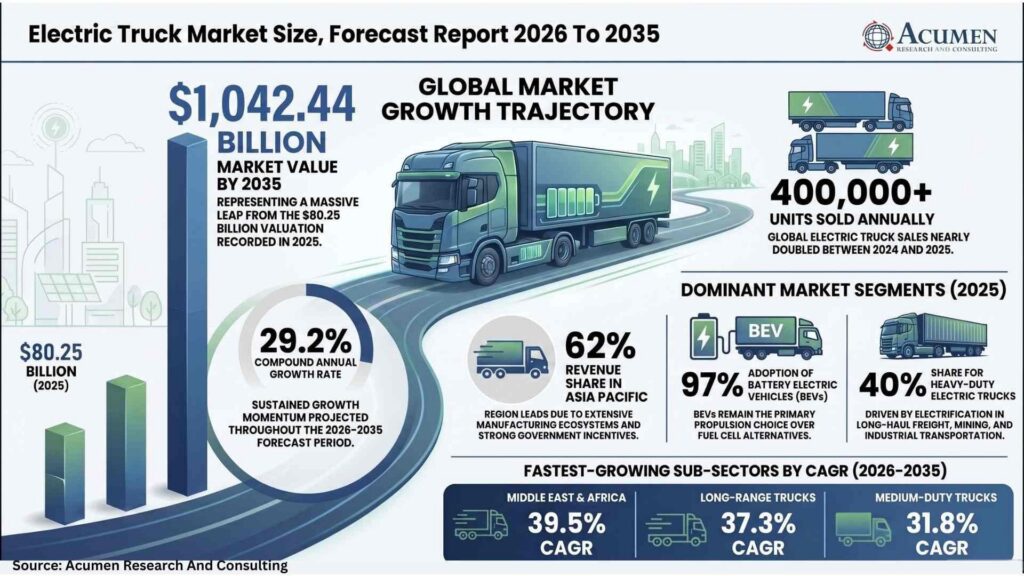
According to the latest research by Acumen Research and Consulting, the Global Electric Truck Market was valued at USD 80.25 Billion in 2025 and is projected to reach USD 1,042.44 Billion by 2035, registering a robust CAGR of 29.2% during the forecast period from 2026 to 2035.
The report highlights that increasing investments in commercial electric vehicles, expanding charging infrastructure, and the modernization of freight transportation are supporting long-term market expansion. As businesses prioritize operational efficiency and sustainability, electric trucks are becoming an increasingly important part of global logistics, urban delivery, industrial transportation, and regional freight networks.
What Is the Electric Truck Market?
The Electric Truck Market comprises battery-powered and hydrogen-powered commercial trucks designed to transport goods without conventional internal combustion engines. These vehicles support sustainable freight transportation by reducing tailpipe emissions while improving energy efficiency across logistics, municipal services, industrial operations, and regional distribution networks.
Growing investments in fleet electrification, charging infrastructure, and alternative propulsion technologies continue to accelerate the adoption of electric commercial vehicles worldwide.
Electric Truck Market at a Glance
The latest market research provides the following highlights:
- Electric Truck Market Size (2025): USD 80.25 Billion
- Projected Market Value (2035): USD 1,042.44 Billion
- Forecast Period: 2026–2035
- Compound Annual Growth Rate: 29.2%
- Largest Regional Market: Asia-Pacific (62% market share in 2025)
- Fastest-Growing Region: Middle East & Africa (39.5% CAGR)
- Leading Propulsion Type: Battery Electric Vehicles (BEVs) – 97% market share
- Largest Vehicle Category: Heavy-Duty Electric Trucks – 40% market share
- Largest Driving Range Segment: Short-Range Electric Trucks – 45% market share
- Largest End User: Logistics & Freight Companies – 35% market share
These findings demonstrate how commercial fleet electrification is reshaping the future of freight transportation across global markets.
Fleet Electrification Continues to Drive the Electric Truck Market
Commercial transportation is undergoing one of its most significant transformations as businesses increasingly adopt electric commercial vehicles to support sustainability objectives and improve long-term operational efficiency.
Fleet operators are investing in electric trucks to modernize transportation networks while supporting corporate decarbonization initiatives. As organizations expand their sustainability strategies, demand for zero-emission trucks continues to grow across logistics, industrial transportation, municipal services, and urban freight distribution.
The report indicates that this ongoing shift toward green mobility is expected to remain one of the defining trends supporting the long-term expansion of the Electric Truck Market.
Battery Electric Trucks Continue to Dominate the Market
Based on propulsion type, Battery Electric Vehicles (BEVs) accounted for 97% of the global market share in 2025, making them the dominant technology within the Electric Truck Market.
Their leadership is supported by technological maturity, expanding charging infrastructure, and lower operating costs compared with conventional commercial vehicles. As charging networks continue to improve and fleet operators gain greater confidence in electric mobility, BEVs remain the preferred solution for a wide range of commercial transportation applications.
Growing deployment across urban logistics, regional freight, municipal operations, and commercial delivery services continues to reinforce the leading position of battery-powered electric trucks.
Hydrogen-Powered Trucks Present Long-Term Growth Opportunities
While battery electric trucks currently dominate the market, the report identifies Fuel Cell Electric Vehicles (FCEVs) as the fastest-growing propulsion segment through 2035.
Increasing investments in hydrogen infrastructure and the growing focus on long-haul freight electrification are expected to support future adoption of fuel cell technologies. As the commercial transportation industry explores multiple zero-emission solutions, hydrogen-powered trucks are gaining attention for applications requiring extended driving ranges and operational flexibility.
The emergence of FCEVs highlights the evolving landscape of alternative propulsion technologies, creating new opportunities for manufacturers, fleet operators, and infrastructure providers.
Heavy-Duty Electric Trucks Lead Commercial Adoption
By vehicle category, heavy-duty electric trucks represented 40% of the market in 2025, reflecting growing demand across long-haul freight transportation, mining operations, and industrial logistics.
Large commercial fleets are increasingly investing in heavy-duty electric vehicles to support sustainability objectives while improving transportation efficiency. These vehicles play an important role in moving high-volume cargo across industrial supply chains and freight corridors.
At the same time, the report projects medium-duty electric trucks to register the fastest growth, with a CAGR of 31.8% during the forecast period. Rising demand for regional logistics, urban freight transportation, and distribution services is expected to support continued expansion of this vehicle category.
Short-Range Electric Trucks Continue to Lead Urban Commercial Mobility
The latest Electric Truck Market analysis highlights how different driving range requirements are shaping purchasing decisions across commercial transportation. Fleet operators are selecting electric trucks based on route profiles, operational efficiency, charging availability, and total cost of ownership.
In 2025, short-range electric trucks accounted for 45% of the global market, making them the largest driving range segment. Their widespread adoption reflects strong demand across urban logistics, municipal services, construction support operations, and last-mile delivery networks, where predictable routes and frequent access to charging infrastructure support efficient daily operations.
The continued expansion of e-commerce and city-based distribution networks is further reinforcing demand for short-range electric trucks, particularly among organizations seeking to reduce emissions while maintaining reliable delivery schedules.
Long-Range Electric Trucks Gain Momentum with Advancing Technology
While short-range models currently dominate the market, long-range electric trucks are expected to register the fastest CAGR of 37.3% through 2035.
The report attributes this growth to ongoing advancements in battery technology and the development of megawatt charging infrastructure, which are expanding the operational capabilities of electric commercial vehicles. These innovations are improving driving range and supporting broader adoption across longer freight routes.
As charging solutions continue to evolve, long-range electric trucks are expected to become an increasingly attractive option for commercial operators looking to electrify regional and long-distance transportation while supporting sustainability goals.
Logistics and Freight Companies Remain the Largest End Users
By end user, logistics and freight companies held the largest market share of 35% in 2025, highlighting the transportation sector’s leading role in commercial fleet electrification.
Many logistics providers are modernizing vehicle fleets to improve operational efficiency, reduce environmental impact, and support long-term corporate sustainability initiatives. As electric truck technologies continue to mature, fleet operators are increasingly integrating zero-emission vehicles into freight transportation strategies.
The Acumen Research And Consulting report also identifies retail and e-commerce fleets as the second-largest end-user segment, accounting for 20% of the market in 2025. The continued growth of online retail, rising consumer expectations for faster deliveries, and increasing investment in sustainable delivery networks are contributing to greater adoption of electric commercial vehicles across this segment.
Together, these trends illustrate how the transition toward cleaner transportation is expanding across multiple commercial industries.
Asia-Pacific Leads the Global Electric Truck Market
Regional analysis indicates that Asia-Pacific accounted for 62% of the global Electric Truck Market in 2025, making it the largest regional market.
The region’s leadership is supported by its extensive electric vehicle manufacturing ecosystem, strong government incentives, and large-scale commercial fleet electrification initiatives. These factors continue to accelerate the deployment of electric trucks across logistics, industrial transportation, and urban mobility applications.
As manufacturers expand production capacity and governments promote cleaner transportation solutions, Asia-Pacific is expected to remain a key contributor to global market growth throughout the forecast period.
Middle East & Africa Emerges as the Fastest-Growing Regional Market
The report projects the Middle East & Africa to record the fastest CAGR of 39.5% during 2026–2035.
Growing investments in sustainable transport infrastructure, smart city development, and zero-emission mobility initiatives are creating new opportunities for commercial vehicle electrification across the region. As governments and businesses continue prioritizing cleaner transportation systems, demand for electric trucks is expected to increase steadily.
The region’s strong growth outlook highlights the expanding global adoption of electric commercial vehicles beyond traditionally established EV markets.
Electric Trucks Are Reshaping the Future of Sustainable Freight Transportation
The rapid evolution of commercial transportation reflects broader changes across the global mobility ecosystem.
Businesses are increasingly prioritizing fleet modernization strategies that improve efficiency while supporting environmental commitments. Electric trucks are becoming an important part of this transition, helping organizations reduce operational emissions and prepare for the next generation of freight transportation.
At the same time, advances in battery technology, charging infrastructure, and alternative propulsion systems continue to improve the commercial viability of electric trucks across a growing range of applications.
As fleet operators evaluate future investments, scalability, operational reliability, and infrastructure readiness are expected to remain central considerations in vehicle purchasing decisions.
These long-term trends position the Electric Truck Market for sustained expansion over the coming decade.
Why This Research Matters
The Electric Truck Market is evolving rapidly as commercial transportation transitions toward cleaner and more efficient mobility solutions.
This report provides comprehensive insights into market size, forecast, regional performance, propulsion technologies, vehicle categories, driving range trends, and end-user demand. By examining the factors shaping market development, the study supports informed decision-making for manufacturers, investors, logistics providers, infrastructure companies, and other stakeholders evaluating opportunities in the electric commercial vehicle industry.
Electric Truck Market Outlook Remains Strong Through 2035
The long-term outlook for the Electric Truck Market remains highly positive as commercial transportation continues to transition toward low-emission mobility solutions. Businesses are increasingly integrating electric trucks into fleet operations to improve efficiency, support sustainability objectives, and prepare for the future of freight transportation.
The Electric Truck Market report projects the market will grow from USD 80.25 Billion in 2025 to USD 1,042.44 Billion by 2035, reflecting a CAGR of 29.2% during the forecast period. This sustained growth underscores the expanding role of electric commercial vehicles in reshaping logistics, industrial transportation, municipal services, and regional freight distribution.
Continued investments in charging infrastructure, advancements in battery technologies, and growing interest in hydrogen-powered transportation are expected to influence the evolution of commercial mobility over the coming decade. As organizations evaluate long-term fleet strategies, electric trucks are positioned to play an increasingly important role in supporting operational efficiency and zero-emission transportation goals.
The report’s regional and segment-level analysis also highlights how market opportunities vary across propulsion technologies, vehicle categories, driving ranges, and end-user industries. These insights can help stakeholders better understand changing demand patterns and align their business strategies with emerging market trends.