



The rapid evolution of artificial intelligence (AI), cloud computing, and enterprise digital transformation is reshaping the global technology landscape, creating unprecedented demand for high-performance server processors. As organizations modernize data centers, expand cloud infrastructure, and deploy increasingly complex AI workloads, server CPUs have become the foundation of enterprise computing and mission-critical digital infrastructure.
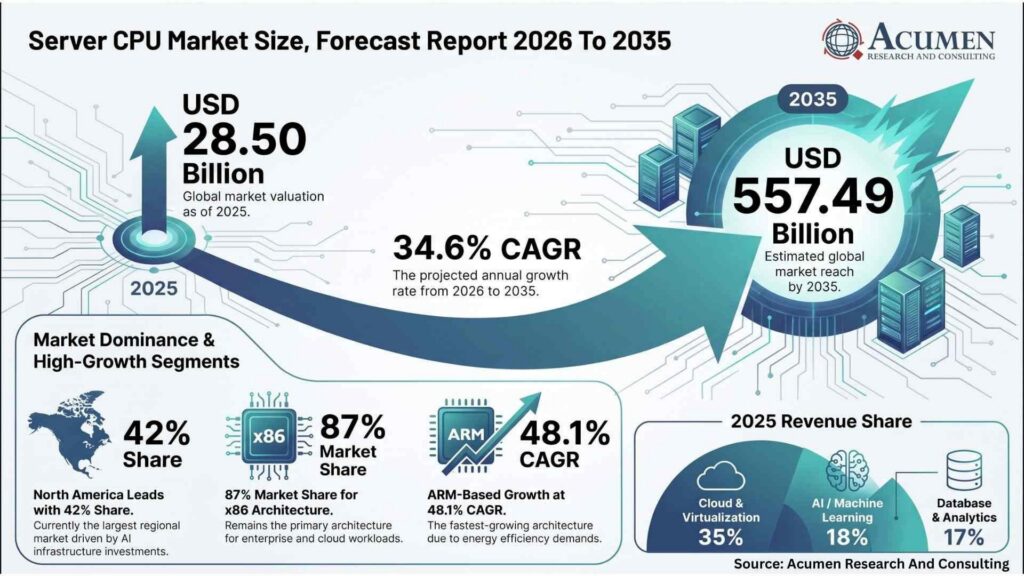
According to the latest research published by Acumen Research and Consulting, the Server CPU Market was valued at USD 28.50 Billion in 2025 and is projected to reach USD 557.49 Billion by 2035, expanding at a compound annual growth rate (CAGR) of 34.6% from 2026 to 2035. The report highlights how accelerating investments in AI infrastructure, hyperscale data centers, cloud-native applications, and high-performance computing (HPC) are creating long-term opportunities across the global Server Processor Market.
As enterprises continue to generate and process larger volumes of digital information, organizations are investing in advanced enterprise server CPU technologies that deliver greater compute performance, scalability, and energy efficiency. These trends are reinforcing the strategic importance of server processors in supporting modern business operations, virtualization, and next-generation digital services.
What Is the Server CPU Market?
The Server CPU Market comprises processors designed to power enterprise servers, cloud platforms, hyperscale data centers, and high-performance computing systems. These processors provide the computational capability required to support virtualization, AI applications, cloud-native workloads, data analytics, and other resource-intensive enterprise operations.
As businesses continue expanding their digital infrastructure, the demand for advanced server processors is increasing across industries that require reliable, scalable, and high-performance computing environments.
Server CPU Market at a Glance
The latest server CPU market study highlights the following key insights:
- Market Size (2025): USD 28.50 Billion
- Projected Market Value (2035): USD 557.49 Billion
- Forecast Period: 2026–2035
- CAGR: 34.6%
- Largest Regional Market (2025): North America (42% market share)
- Fastest-Growing Region: Asia-Pacific (36.6% CAGR)
- Leading Processor Architecture: x86 (87% market share in 2025)
- Fastest-Growing Architecture: ARM-based processors (48.1% CAGR)
These figures underscore the increasing importance of server processors as enterprises expand investments in AI-ready infrastructure, cloud services, and data center modernization.
AI, Cloud Computing, and Enterprise Digital Transformation Continue to Accelerate Market Growth
Organizations worldwide are adopting artificial intelligence to improve business intelligence, automate workflows, enhance customer experiences, and support data-driven decision-making. These applications require significantly greater computing resources, placing increasing demand on advanced server processors capable of handling complex AI workloads.
At the same time, cloud computing continues to reshape enterprise IT strategies. Public, private, and hybrid cloud deployments are expanding rapidly as businesses seek greater flexibility, operational efficiency, and scalable computing resources. This transition is driving sustained demand for high-performance cloud server CPUs that can efficiently manage diverse enterprise workloads while supporting continuous business operations.
The report also highlights the continued expansion of hyperscale data centers as another major factor influencing market growth. Cloud service providers and large enterprises are investing in advanced server infrastructure to meet increasing demand for digital services, enterprise applications, and high-volume data processing.
Collectively, these developments are strengthening demand across the broader Data Center CPU Market, where organizations increasingly prioritize processor performance, reliability, and energy efficiency.
Why the Server CPU Market Is Expanding
Several long-term industry trends continue to strengthen the outlook for the global Server CPU Industry.
One of the most significant drivers is the rapid growth of enterprise digital transformation. Organizations across multiple industries are replacing legacy infrastructure with modern computing platforms capable of supporting virtualization, cloud-native applications, and AI-enabled business processes.
Growing investments in AI infrastructure are also creating new opportunities for advanced server processor technologies. As machine learning models become increasingly sophisticated, organizations require processors capable of delivering higher compute performance while efficiently managing demanding workloads.
The continued adoption of high-performance computing (HPC) across research, engineering, healthcare, financial services, and industrial applications is further supporting market expansion. These environments require server processors that combine scalability, reliability, and processing efficiency to support data-intensive operations.
Meanwhile, the evolution of edge computing is creating additional opportunities for enterprise infrastructure providers. As organizations move computing resources closer to end users to reduce latency and improve application responsiveness, demand is increasing for server processors capable of delivering consistent performance across distributed computing environments.
Together, these trends are reshaping the global Server Processor Industry, positioning advanced server CPUs as a critical component of modern enterprise technology ecosystems.
Market Challenges Highlight the Need for Continuous Innovation
Despite its strong growth trajectory, the Server CPU Market continues to face several challenges that may influence industry development over the forecast period.
Developing next-generation server processors requires substantial investment in semiconductor research, processor architecture, engineering, and advanced manufacturing technologies. As enterprise computing requirements continue to evolve, processor manufacturers must balance performance improvements with energy efficiency, cost optimization, and long-term product reliability.
The report also identifies semiconductor supply chain complexity as an ongoing consideration for the industry. Maintaining efficient production capabilities while responding to rapidly changing customer requirements remains essential for supporting future market growth.
However, continuous innovation in processor design and enterprise computing technologies is expected to create new opportunities for manufacturers, technology providers, and infrastructure companies as digital transformation initiatives continue worldwide.
Server CPU Market Segmentation Reveals Evolving Enterprise Computing Priorities
The latest Server CPU Market report provides detailed segmentation insights that reflect the changing requirements of enterprise computing environments. As organizations deploy more data-intensive applications, purchasing decisions increasingly focus on processor performance, scalability, energy efficiency, and the ability to support diverse workloads across modern IT infrastructures.
x86 Architecture Continues to Lead the Market
Based on processor architecture, x86 processors accounted for 87% of the global market share in 2025, underscoring their established role in enterprise servers and data center environments.
The widespread adoption of x86 architecture reflects its mature software ecosystem, broad compatibility with enterprise applications, and long-standing presence in server deployments. Organizations continue to rely on x86-based enterprise server CPU solutions to support virtualization, cloud platforms, business-critical applications, and large-scale data center CPU deployments.
Its proven reliability and compatibility make x86 architecture a preferred choice for enterprises seeking stable, scalable computing environments capable of supporting a wide range of workloads.
ARM-Based Processors Expected to Record the Fastest Growth
While x86 processors currently dominate the market, the report identifies ARM-based processors as the fastest-growing architecture, projected to expand at a CAGR of 48.1% during the forecast period.
The increasing focus on energy-efficient computing, combined with growing demand for optimized cloud workloads and evolving enterprise infrastructure requirements, is supporting broader adoption of ARM-based server processors.
As organizations seek to improve operational efficiency without compromising performance, ARM architecture is gaining attention for applications where power efficiency and workload optimization are increasingly important. This trend highlights how innovation in processor architecture is expanding the range of solutions available within the global AI Server Processor Market and the broader server processor industry.
Modern Enterprise Infrastructure Is Reshaping Processor Demand
The role of the server CPU has expanded significantly as enterprises continue modernizing their digital infrastructure.
Today’s organizations depend on server processors to support virtualization, cloud-native applications, advanced analytics, artificial intelligence, and increasingly complex enterprise workloads. These evolving requirements are encouraging investments in processor technologies that deliver improved compute performance, scalability, and operational efficiency.
As digital transformation initiatives accelerate, organizations are prioritizing server platforms capable of handling mission-critical workloads, supporting workload optimization, and enabling reliable business continuity across distributed computing environments.
This shift is reinforcing the strategic importance of advanced cloud server CPU technologies within enterprise IT ecosystems.
Regional Insights Highlight Diverse Growth Opportunities
Regional performance continues to shape the competitive landscape of the Server CPU Market, with both mature and emerging markets contributing to long-term industry growth.
North America Maintains Market Leadership
According to the report, North America accounted for 42% of the global Server CPU Market in 2025, making it the largest regional market.
The region’s leadership is supported by its well-established cloud ecosystem, significant investments in AI infrastructure, and the continued expansion of hyperscale data centers. Strong enterprise adoption of advanced computing technologies and ongoing modernization of digital infrastructure are also contributing to sustained demand for high-performance server processors.
As organizations continue investing in enterprise computing capabilities, North America is expected to remain a key market for innovation and technology adoption.
Asia-Pacific Emerges as the Fastest-Growing Regional Market
The report projects that the Asia-Pacific region will register the fastest CAGR of 36.6% throughout the forecast period.
Growing investments in digital infrastructure, increasing enterprise technology adoption, expanding cloud computing services, and continued modernization of business operations are expected to support strong regional growth.
As enterprises across the region accelerate digital transformation strategies, demand for advanced server processors capable of supporting AI applications, cloud workloads, and high-performance computing is anticipated to rise steadily.
Global Digital Transformation Continues to Expand Market Potential
Beyond North America and Asia-Pacific, enterprises worldwide continue investing in technologies that enhance operational efficiency, computing performance, and business resilience.
The adoption of cloud computing, enterprise virtualization, AI-driven analytics, and modern data center infrastructure is creating new opportunities across multiple regional markets. These long-term trends reinforce the growing importance of server processors in supporting the next generation of enterprise technology ecosystems.
Industry Outlook Points to Sustained Long-Term Growth
The long-term outlook for the Server CPU Market remains highly promising as enterprises continue investing in technologies that support digital transformation and data-driven innovation.
The convergence of artificial intelligence, cloud computing, edge computing, and high-performance computing (HPC) is fundamentally changing enterprise infrastructure requirements. Organizations increasingly require processors capable of managing larger datasets, more complex workloads, and continuously evolving application environments.
These developments are expected to drive sustained demand across the Server Processor Market, encouraging ongoing innovation in processor architecture, performance optimization, and energy-efficient computing.
According to Acumen Research And Consulting Analysts, the sever CPU market is forecast to grow from USD 28.50 Billion in 2025 to USD 557.49 Billion by 2035, reflecting the transformative impact of AI adoption, cloud expansion, and enterprise modernization on the future of global server computing.
Why This Research Matters for Industry Stakeholders
As the technology landscape evolves, organizations need reliable market intelligence to guide strategic decisions. This report provides a comprehensive assessment of the Server CPU Market, including market size, forecast, growth trends, segmentation, regional performance, and the factors influencing future demand.
By presenting a balanced analysis of growth drivers, market challenges, emerging opportunities, and regional dynamics, the study supports informed decision-making for technology companies, infrastructure providers, investors, and enterprise leaders evaluating opportunities in the global server processor ecosystem.
Server CPU Market Positioned for the Next Era of Enterprise Innovation
Looking ahead, the Server CPU Market is expected to remain at the forefront of enterprise technology transformation. As organizations continue scaling AI initiatives, expanding cloud environments, and modernizing data center infrastructure, demand for advanced server processors is anticipated to increase steadily throughout the forecast period.
Businesses across industries are prioritizing investments in computing platforms that can efficiently support virtualization, data analytics, cloud-native applications, and AI-enabled workloads. This shift is reinforcing the strategic role of server CPUs in enabling digital business operations, improving infrastructure performance, and supporting long-term scalability.
The report indicates that continued advancements in processor architecture and enterprise computing technologies will help organizations address evolving workload requirements while improving operational efficiency. At the same time, investments in hyperscale infrastructure and next-generation data centers are expected to create new opportunities across the global Server Processor Market.
As digital transformation accelerates worldwide, organizations will increasingly require computing solutions that deliver a balance of performance, scalability, reliability, and energy efficiency. These long-term trends are expected to support sustained market expansion through 2035.
Why the Server CPU Market Matters
The rapid growth of AI, cloud computing, and enterprise digital transformation is fundamentally changing how businesses build and manage IT infrastructure. Server CPUs have evolved beyond traditional computing components to become the processing foundation for mission-critical enterprise workloads.
Organizations are now investing in infrastructure capable of supporting intelligent automation, advanced analytics, high-performance computing, and large-scale cloud deployments. As these technologies continue to mature, the need for powerful, scalable, and efficient server processors is expected to grow across both established and emerging markets.
With the server CPU market projected to expand from USD 28.50 Billion in 2025 to USD 557.49 Billion by 2035, the report highlights how innovation in server processor technologies will remain central to the future of enterprise computing.
About Acumen Research and Consulting
Acumen Research and Consulting provides market intelligence and business consulting services across a wide range of industries. Its research reports deliver in-depth analysis of market trends, growth opportunities, competitive dynamics, regional developments, and industry forecasts, helping organizations make informed strategic decisions.
The Server CPU Market report offers comprehensive insights into market size, forecast, segmentation, regional performance, growth drivers, challenges, and emerging opportunities, enabling technology companies, investors, infrastructure providers, and enterprise decision-makers to better understand the evolving server processor landscape.
Frequently Asked Questions
What is the Server CPU Market?
The Server CPU Market includes processors designed for enterprise servers, cloud platforms, hyperscale data centers, and high-performance computing systems. These processors enable organizations to run AI workloads, virtualization, cloud-native applications, and other compute-intensive business operations.
What is the projected size of the Server CPU Market?
According to the report, the global Server CPU Market is projected to grow from USD 28.50 Billion in 2025 to USD 557.49 Billion by 2035, registering a CAGR of 34.6% during the 2026–2035 forecast period.
What factors are driving the Server CPU Market?
The market is primarily driven by increasing adoption of artificial intelligence, expansion of cloud computing, investments in hyperscale data centers, enterprise digital transformation, edge computing, and the growing need for high-performance computing infrastructure.
Which region dominates the Server CPU Market?
North America held the largest market share in 2025, accounting for 42% of the global market. The region benefits from strong cloud infrastructure, advanced enterprise technology adoption, and significant investments in AI and hyperscale data centers.
Why are ARM-based server processors gaining popularity?
The report projects ARM-based processors to register the fastest growth, with a 48.1% CAGR, as organizations increasingly seek energy-efficient computing solutions capable of supporting evolving cloud and enterprise workloads.