
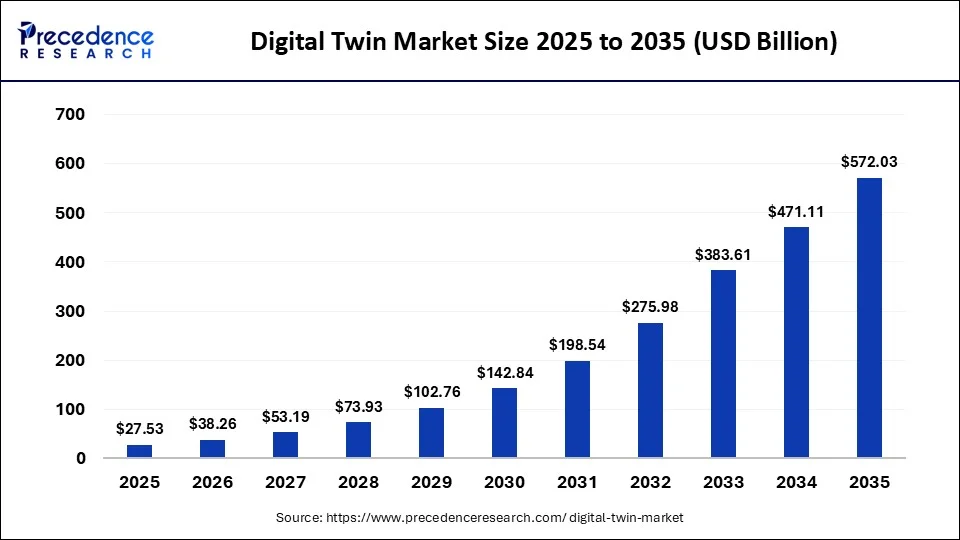
The global digital twin market size is calculated at USD 27.53 billion in 2025 and is predicted to increase from USD 38.26 billion in 2026 to approximately USD 572.03 billion by 2035, expanding at a CAGR of 35.44% from 2026 to 2035.
Digital Twin Market Key Insights
- Asia Pacific led the global market with the highest market share of 35.91% in 2025.
- By solution, the process segment has held the largest market share in 2025.
- By application, the automotive and transport segment captured the biggest revenue share in 2025.
Digital Twin Market Overview
The digital twin market has evolved from a niche engineering idea into an essential technological framework utilized in multiple industries, including manufacturing, healthcare, automotive, aerospace, energy, and smart infrastructure.

A digital twin serves as a virtual counterpart to a tangible product or system by enabling organizations to track key metrics and simulate possible outcomes for better foresight on operations, which can be adjusted in real time. The rise of IIoT (Industrial Internet of Things) solutions alongside advancements in cloud computing technologies like artificial intelligence (AI) and advanced analytics have significantly broadened the capabilities offered by digital twin solutions.
Regional Outlook for Digital Twin Market
North America is expected to grow at the fastest CAGR during the forecast period, as expanding demands help to drive the market growth with an enhanced growth rate. The market is experiencing significant growth in the region, owing to the rising adoption of the Internet of Things (IoT), 5G connectivity, cloud computing, and big data analytics.
Numerous industries, from healthcare and manufacturing to construction and others, are implementing digital twins to increase operational efficiencies as well as make the real-time decision-making process quicker and prioritize predictive maintenance. Many influential businesses in this space are increasingly utilizing acquisitions, collaborations, and partnerships in a bid to expand their influence and position in the industry.
Asia-Pacific dominated the global digital twin market with the largest market share in 2025, due to rapid industrialization, heavy manufacturing activities, and infrastructure development, along with investments into smart infrastructure initiatives. Countries in this region are working towards implementing digital twins on an unprecedented scale for greater operational efficiency, better production methods, and digital transformation efforts.
The growing numbers of IoT devices, 5G networks, and government-backed smart city initiatives are other important drivers of this. Moreover, major technology providers are already being added to and growing industrial automation capabilities have a great impact with positive effects on market development at the regional level.
Europe is expected to experience significant growth over the forecast period because of its commitment to sustainability and enhancements in supply chain efficiency, generating substantial demand for novel solutions. Policies like the EU Green Deal promote the application of digital technologies to improve operational efficiencies while also lowering carbon emissions.
One of the common trends is to couple the use of digital twins to enable various AI types of applications, edge computing, and industrial Internet of Things (IoT), which in turn create highly connected manufacturing ecosystems. Also, EU investments made into programs for digital transformation and climate initiatives are stimulating a search for a solution that utilizes digital twin technology to conserve energy and carbon output and reinforce the resilience of infrastructure.
Market Scope
| Report Coverage | Details |
| Market Size in 2025 | USD 27.53 Billion |
| Market Size in 2026 | USD 38.26 Billion |
| Market Size by 2035 | USD 572.03 Billion |
| Growth Rate from 2026 to 2035 | CAGR of 35.44% |
| Largest Market | Asia Pacific |
| Fastest Growing Market | North America |
| Base Year | 2025 |
| Forecast Period | 2026 to 2035 |
Segmental Outlook of Digital Twin Market
By Solution Insights
The Process Segment Dominated the Digital Twin Market in 2025
The process segment held a major revenue share in the market in 2025, due to its extensive use in optimizing industrial workflows, production lines, and operational efficiency. Process twins became more common in large manufacturing firms for visualizing and simulating complex processes prior to implementing changes in live environments.
The fact that this technology helps to identify where the bottlenecks are, remove wasted resources, and optimize the use of assets through this makes process-oriented digital twins highly useful in sectors including manufacturing, energy production, chemicals processing, and logistics. Process twins emerged as an attractive medium to improve productivity while reducing operational risks as companies sought greater operational insight and cost efficiency.
By Applications Insights
Which Application Segment Dominated the Digital Twin Market?
The automotive and transport segment accounted for a considerable revenue share in the market in 2025, because of their widespread adoption across vehicle design, manufacturing processes, fleet management, and infrastructure planning. Digital twins have been increasingly adopted by automotive manufacturers to simulate vehicle performance scenarios, streamline production processes, and reduce product development timelines.
At a similar level, transportation providers used this technology to monitor conditions in their fleets, predict maintenance needs, and enhance operational efficiency. With its forward-looking integration of new technologies and higher needs in terms of connectivity and autonomous mobility, the sector has established itself as the leading application domain for the global digital twin.
Recent Developments
- In January 2026, Siemens AG built an advanced collaboration framework through collaboration with NVIDIA Corporation to develop an Industrial AI Operating System. Siemens recently launched Digital Twin Composer, a tool combining simulation with real-time operational data and artificial intelligence to create highly accurate digital twins targeted for use in industry, as part of this collaboration.
- In March 2026, Teamcenter Digital Reality Viewer and Digital Twin Composer were launched by Siemens AG in India. These solutions marry Siemens software with NVIDIA Omniverse technologies to deliver digitally immersive and physics-driven digital twins, which enable engineering validation, lifecycle management, and operational optimization.
Digital Twin Market Companies
General Electric: General Electric is a global industrial technology company known for its innovations in aerospace, energy, and healthcare.The company develops advanced digital and engineering solutions that improve industrial efficiency and sustainability.
Microsoft Corporation: Microsoft Corporation is a leading technology company offering cloud computing, AI, productivity software, and enterprise solutions.Its Azure cloud platform and AI technologies support digital transformation across industries worldwide.
Hitachi Ltd.: Hitachi Ltd. is a multinational company specializing in digital systems, industrial equipment, energy, and infrastructure solutions. The company leverages AI, IoT, and data analytics to enhance operational efficiency and smart manufacturing.
Dassault Systèmes SE: Dassault Systèmes SE is a global software company providing 3D design, engineering, simulation, and product lifecycle management solutions. Its 3DEXPERIENCE platform helps businesses accelerate innovation and digital transformation.
Autodesk Inc.: Autodesk Inc. develops design and engineering software for architecture, manufacturing, construction, and media industries. Its flagship solutions, including AutoCAD and Fusion, enable digital design, simulation, and collaboration.
SAP SE: SAP SE is a global enterprise software company specializing in ERP, business analytics, and cloud-based business applications. Its digital solutions help organizations optimize operations, manage data, and improve business performance.