
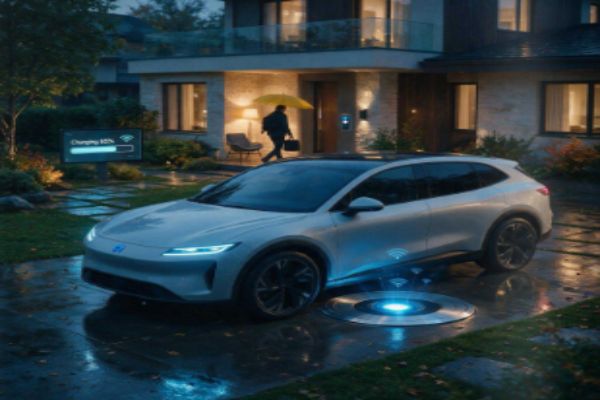
You pull into your parking space after a long day, switch off your electric vehicle (EV), grab your bag, and walk away. No searching for a charging cable. No plugging in. No worrying about rain, dust, or damaged connectors. By the time you’re ready to drive again, your vehicle is fully charged.
What once seemed like science fiction is steadily becoming reality through Wireless Power Transfer (WPT). As electric vehicles become more common, the demand for charging solutions that are faster, safer, and more convenient is growing just as rapidly. While wired charging has successfully supported the first wave of EV adoption, the next phase of mobility is shifting toward intelligent, automated charging experiences where vehicles recharge with minimal human intervention (Shahin et al., 2025).
At the heart of this transformation lies power electronics—the technology responsible for converting, controlling, and efficiently delivering electrical energy. Every wireless charging system relies on sophisticated power electronic components, including high-frequency converters, resonant circuits, semiconductor switches, and digital controllers, to transfer electricity safely from the grid to a vehicle without physical contact (Miller, Onar, & Chinthavali, 2015).
Wireless charging is no longer limited to research laboratories. Today, it is being tested on highways, integrated into public transportation, and adopted by premium automotive manufacturers. As advances in semiconductor technology, magnetic design, and intelligent energy management continue, Wireless Power Transfer is emerging as one of the most promising innovations in electric mobility.
Why the EV Industry is Looking Beyond Charging Cables
Charging cables have undoubtedly enabled the global expansion of electric vehicles, but they also introduce several practical limitations. Public charging stations often experience connector wear, cable theft, weather-related damage, and regular maintenance requirements. For users, manually connecting heavy charging cables multiple times a week can become inconvenient, particularly for elderly drivers or individuals with limited mobility.
Wireless charging addresses many of these issues by eliminating the physical connection between the charger and the vehicle. Instead of plugging in, drivers simply position the vehicle over a charging pad embedded in the ground. Once proper alignment is detected, charging begins automatically through electromagnetic induction.
Beyond convenience, this technology also enhances reliability. Since there are no exposed electrical contacts, wireless charging systems are less susceptible to corrosion, moisture, dust, and mechanical degradation. This makes them particularly attractive for outdoor charging environments, commercial fleets, and autonomous vehicles that operate without human supervision (Feliziani et al., 2023).
The technology is equally important for the future of mobility. Autonomous taxis, self-driving delivery vehicles, warehouse robots, and electric buses cannot depend on humans to plug them in several times a day. Wireless charging enables these systems to recharge automatically, significantly improving operational efficiency while reducing downtime.
As cities move toward connected transportation ecosystems, cable-free charging aligns naturally with the broader vision of smart infrastructure and automated mobility (Shahin et al., 2025).
How Does Wireless Power Transfer Actually Work?
Although wireless charging appears almost magical, its operating principle is based on a well-established concept in electromagnetics known as electromagnetic induction.
Every wireless charging system consists of two primary components: a transmitter installed beneath the parking surface and a receiver mounted underneath the electric vehicle.
When alternating current flows through the transmitter coil, it generates a rapidly changing magnetic field. This magnetic field travels across a small air gap and induces an electric current in the receiver coil located inside the vehicle. The received electrical energy is then converted into direct current (DC) suitable for charging the battery (Miller et al., 2015).
Modern EV charging systems primarily rely on resonant inductive coupling, where both transmitter and receiver coils operate at the same resonant frequency. This resonance significantly improves power transfer efficiency even when the coils are separated by several centimeters.
The charging process occurs in several carefully controlled stages:
- Electricity from the power grid is first converted into DC.
- A high-frequency inverter transforms this DC into high-frequency alternating current.
- The transmitter coil generates a magnetic field.
- The receiver coil captures the magnetic energy.
- Rectifiers and DC-DC converters convert the received energy back into battery-compatible power.
Throughout this process, communication between the vehicle and charging station continuously monitors battery status, charging efficiency, coil alignment, and system safety.
While the driver experiences effortless charging, the underlying electronics perform thousands of switching operations every second to ensure efficient energy transfer.
Power Electronics: The Invisible Hero Behind Wireless Charging
Wireless charging would not exist without advances in power electronics. Every stage of energy conversion depends on electronic devices capable of handling high voltages, rapid switching frequencies, and precise control.
Once electricity enters the charging station, AC-DC converters prepare the incoming power before high-frequency inverters generate the alternating current needed to create magnetic fields. Operating at frequencies between approximately 20 kHz and 150 kHz allows energy to be transferred efficiently across the air gap separating the charging pad and vehicle (Vinod et al., 2024).
Inside the vehicle, high-speed rectifiers convert the received AC electricity back into DC. Intelligent DC-DC converters then regulate voltage and current according to the battery’s charging requirements. At every stage, digital controllers continuously optimize performance, monitor temperatures, detect abnormal operating conditions, and communicate with the vehicle’s Battery Management System (BMS).
One of the biggest breakthroughs enabling modern wireless charging has been the rise of wide-bandgap semiconductor materials, particularly Silicon Carbide (SiC) and Gallium Nitride (GaN).
Compared to conventional silicon devices, SiC and GaN switches operate at much higher frequencies while generating significantly lower switching losses. This enables smaller magnetic components, higher overall efficiency, reduced heat generation, and more compact charging equipment (Shahin et al., 2024).
Higher switching frequencies also allow engineers to design thinner charging pads and lighter onboard receiver systems—two critical factors for commercial EV adoption.
Equally important is intelligent control software. Modern digital controllers continuously adjust operating frequencies to compensate for slight vehicle misalignment, ensuring that charging efficiency remains high even when parking is not perfectly centered.
Innovation i9s Accelerating Faster Than Ever
Wireless charging technology has advanced remarkably over the past decade. Earlier prototypes often suffered from significant efficiency losses whenever vehicles were slightly misaligned. Today, advanced coil geometries, adaptive impedance matching, resonant compensation circuits, and AI-assisted control algorithms have dramatically improved system performance.
Researchers are now developing charging systems capable of automatically detecting coil position and adjusting operating parameters in real time to maximize efficiency. Multiple-coil architectures further expand the effective charging area, reducing the precision required when parking an EV (Applied Sciences, 2025).
Another important development is the integration of wireless charging with the Internet of Things (IoT). Smart charging stations can communicate with cloud platforms, utility operators, and vehicle management systems to schedule charging during periods of lower electricity demand, optimize energy consumption, and support predictive maintenance.
Artificial Intelligence is also beginning to influence wireless charging by predicting user charging behavior, optimizing power flow, and reducing unnecessary energy losses. These intelligent systems are expected to become increasingly important as connected vehicles become standard across global transportation networks (Shahin et al., 2025).
Static or Dynamic? Two Paths to a Cable-Free Future
Not all wireless charging systems work the same way. Depending on when and where energy is transferred, Wireless Power Transfer (WPT) for EVs is broadly categorized into Static Wireless Charging (SWC) and Dynamic Wireless Charging (DWC). While both rely on the same electromagnetic principles, their applications and infrastructure requirements differ significantly.
Static wireless charging is the more mature and commercially viable solution today. Vehicles receive power while parked over a charging pad installed in garages, parking lots, office complexes, shopping malls, or taxi stands. Because the vehicle remains stationary, maintaining coil alignment is relatively straightforward, resulting in high charging efficiency and lower system complexity (Vinod et al., 2024).
Dynamic wireless charging, on the other hand, represents a far more ambitious vision. Instead of stopping to recharge, vehicles receive power while driving over specially equipped roads containing embedded transmitter coils. As the vehicle moves, different sections of the roadway activate sequentially, transferring electricity to the receiver coil mounted beneath the vehicle (Shahin et al., 2025).
If deployed at scale, this technology could fundamentally change EV design. Instead of carrying large battery packs to maximize driving range, future electric vehicles could recharge continuously during travel, reducing battery size, vehicle weight, charging downtime, and even the demand for large public charging stations. Researchers believe dynamic charging could significantly reduce range anxiety while improving overall energy utilization across transportation networks (Springer Nature, 2025).
Although large-scale implementation remains expensive due to infrastructure requirements, pilot projects in Europe, South Korea, China, and the United States demonstrate that dynamic charging is steadily moving from research laboratories to real-world roads.
Where Wireless Charging is Already Making an Impact
Wireless charging is no longer a concept reserved for future mobility—it is already finding practical applications across multiple industries.
Electric buses are among the earliest adopters. Rather than returning to depots for lengthy charging sessions, buses can recharge wirelessly for a few minutes while passengers board and disembark at designated stops. These opportunity charging systems help maintain continuous service throughout the day without requiring oversized battery packs (Feliziani et al., 2023).
Commercial fleet operators are also exploring wireless charging for taxis, airport shuttle vehicles, and delivery fleets, where predictable routes and scheduled parking intervals make automated charging particularly attractive.
Inside warehouses and manufacturing facilities, autonomous guided vehicles (AGVs) increasingly rely on wireless charging to remain operational without manual intervention. Similarly, mobile robots, drones, agricultural machinery, and even marine vessels are beginning to benefit from contactless charging technologies, particularly in environments where physical connectors are vulnerable to dirt, moisture, or mechanical wear.
Beyond transportation, advances in wireless power electronics continue to influence consumer electronics, medical devices, and industrial automation, highlighting the technology’s versatility across sectors.
The Challenges That Engineers Are Still Solving
Despite remarkable progress, wireless EV charging is not without limitations. Achieving widespread adoption requires overcoming several technical, economic, and regulatory challenges.
One of the biggest concerns is energy efficiency under real-world conditions. While laboratory systems often report efficiencies exceeding 90%, everyday scenarios rarely offer perfect alignment between the transmitter and receiver coils. Even minor positional shifts can reduce coupling efficiency, leading to increased energy losses and longer charging times (Vinod et al., 2024).
Cost is another significant barrier. Installing wireless charging pads involves more than placing a coil beneath the ground. Civil construction, embedded power electronics, communication systems, shielding materials, and precision control equipment all contribute to higher infrastructure costs compared with conventional wired chargers (Springer Nature, 2025).
Electromagnetic compatibility (EMC) also demands careful attention. High-frequency magnetic fields must be designed so they do not interfere with nearby electronic devices such as smartphones, medical implants, or vehicle communication systems. Consequently, wireless charging systems incorporate ferrite shielding, foreign object detection, and strict compliance with international electromagnetic exposure standards (Miller et al., 2015).
Thermal management presents another engineering challenge. High-power charging generates heat within semiconductor switches, magnetic components, and charging coils. Efficient cooling systems are therefore essential to maintain reliability, extend component life, and ensure consistent charging performance.
Interoperability remains equally important. Different vehicle manufacturers and charging equipment providers often use varying communication protocols and hardware configurations. The widespread success of wireless charging will depend on globally accepted standards that allow vehicles from different brands to charge seamlessly on shared infrastructure.
Power Electronics Will Shape the Next Generation of Charging
The future of wireless charging depends as much on advances in power electronics as it does on improvements in battery technology.
Wide-bandgap semiconductor materials such as Gallium Nitride (GaN) and Silicon Carbide (SiC) are enabling higher switching frequencies, lower power losses, and more compact converter designs than conventional silicon-based devices. These characteristics translate directly into lighter charging equipment, smaller magnetic components, and improved overall system efficiency (Shahin et al., 2024).
Researchers are also exploring adaptive resonant compensation techniques capable of automatically maintaining optimal operating conditions even when coil alignment changes during charging. Combined with digital signal processors and AI-driven control algorithms, these intelligent systems could enable self-optimizing wireless chargers that continuously adjust frequency, voltage, and current for maximum efficiency.
Another emerging trend is the integration of wireless charging with renewable energy and smart grids. Future charging stations may intelligently coordinate with rooftop solar installations, battery energy storage systems, and Vehicle-to-Grid (V2G) networks, allowing electric vehicles to function not only as energy consumers but also as distributed energy resources capable of supporting grid stability.
As software-defined power electronics continue to evolve, charging systems will become increasingly adaptive, predictive, and interconnected—laying the foundation for fully autonomous energy management.
The Road Ahead: Charging Without Thinking About Charging
The evolution of electric mobility is no longer focused solely on increasing battery capacity or reducing charging time. Increasingly, the emphasis is shifting toward creating charging experiences that are effortless, intelligent, and seamlessly integrated into everyday life.
Imagine parking outside your office, attending a meeting, and returning to a fully charged vehicle without ever handling a cable. Picture city buses replenishing their batteries at every stop, delivery vehicles recharging during loading operations, or future highways supplying energy continuously as vehicles travel. These scenarios are becoming technically feasible because of rapid advances in wireless power transfer and power electronics.
Governments, research institutions, automotive manufacturers, and semiconductor companies are investing heavily in next-generation charging infrastructure. As production scales and technology matures, costs are expected to decline while interoperability and charging performance continue to improve.
Although wired charging will remain an essential part of EV infrastructure for years to come, wireless charging is steadily positioning itself as a complementary technology—particularly for premium passenger vehicles, commercial fleets, autonomous transportation, and smart city ecosystems.
Conclusion
Wireless Power Transfer represents far more than a convenient alternative to charging cables. It is a convergence of advanced power electronics, intelligent control systems, high-frequency energy conversion, and digital communication technologies that together are redefining how energy is delivered to electric vehicles.
From resonant inductive charging pads and wide-bandgap semiconductor devices to AI-enabled charging optimization and dynamic charging roads, innovation in this field is progressing rapidly. While challenges related to cost, infrastructure, efficiency, and standardization remain, ongoing research demonstrates that these barriers are steadily being addressed.
Ultimately, the future of electric mobility may not be measured simply by how fast vehicles charge, but by how naturally charging becomes part of the driving experience. As power electronics continue to evolve, wireless charging has the potential to make energy transfer almost invisible—turning every parking space, bus stop, and perhaps even every highway into a source of intelligent, effortless power.
References:
Feliziani, M., Campi, T., Cruciani, S., & Maradei, F. (2023). Wireless Power Transfer for e-Mobility. Academic Press.
Miller, J. M., Onar, O. C., & Chinthavali, M. (2015). Primary-side power flow control of wireless power transfer for electric vehicle charging. IEEE Journal of Emerging and Selected Topics in Power Electronics, 3(1), 147–162.
Shahin, M., et al. (2024). Power Electronics and Wide-Bandgap Devices for Wireless EV Charging. Electronics, 13(8), 1411. MDPI. https://doi.org/10.3390/electronics13081411
Shahin, M., et al. (2025). Wireless Power Transfer and IoT in EV Charging: Opportunities, Challenges and Future Directions. Research article.
Vinod, M., Kishan, D., Kannan, R., Iqbal, A., & Sulthan, S. M. (2024). Primary-side control strategies for battery charging regulation in wireless power transfer systems for EV applications. International Transactions on Electrical Energy Systems.
Additional sources consulted for technical insights:
- Applied Sciences, 16(4), 2003 (2025). Advances in Wireless Power Transfer Systems for Electric Vehicles.
- Springer Nature. (2025). Recent developments in wireless charging technologies for electric vehicles. SN Applied Sciences.
- ScienceDirect. (2025). Wireless charging technologies for electric vehicles.
- ScienceDirect. (2024). Emerging trends in wireless charging technologies for electric mobility.