From digital twins to synthetic data, the technology that will power autonomous mobility has already been created, even before the car hits the road.
Introduction: The Most Important Test Drive in the World Takes Place in the Clouds
Picture a scenario where an autonomous vehicle has to cross an intersection in Bengaluru during the busiest traffic hours. A motorcycle rider unexpectedly crosses the lane. A pedestrian begins walking across the street while checking his mobile phone. It starts raining; the cameras have reduced visibility because of the rain and the faded road markings due to water puddles. An ambulance is approaching the car from the back.
The human driver should make decisions instantly based on the situation. The autonomous vehicle (AV) needs to calculate thousands of options every second, based on the work of multiple sensors and AI technology.
Now imagine creating hundreds of scenarios like that, but not in the real world but virtually.
This is where the future of autonomous driving is being shaped.
The key problem faced by autonomous mobility technology today is not developing more intelligent sensors and fast processing technologies anymore. The challenge now is to design systems that would be able to deal with the infinite amount of possibilities for the real-life driving situation. Testing an autonomous vehicle on the physical road alone is not enough, because even fleets that drive hundreds of thousands of kilometres may never see all the rare yet critical situations.
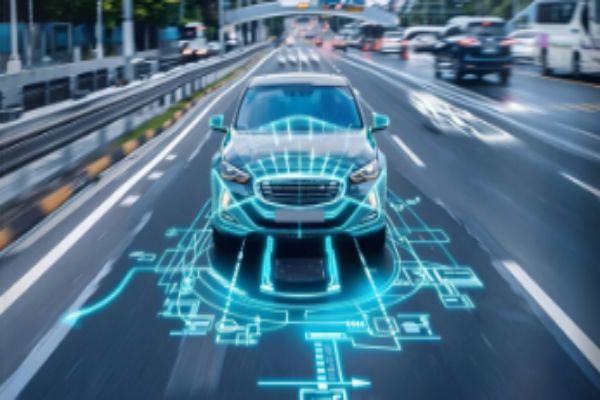
To overcome this challenge, automotive engineers use a completely new approach based on AI simulation and virtual testing of sensors. Engineers create whole digital worlds where autonomous vehicles are exposed to years of driving conditions in a few days only. Such environments allow manufacturers to generate any dangerous weather conditions, unexpected traffic and unusual situations until the AI system learns how to deal with them confidently.
Combining artificial intelligence, high-fidelity simulation, cloud computing and digital twins is revolutionizing the development process of autonomous vehicles. No longer does it take kilometres of physical testing, it takes billions of virtual miles now.
Welcome to the new era of mobility engineering.
The Importance of Sensor Testing
Every self-driving car is based on a complex sensor system that sees the world in its own way.
As compared to human drivers who mainly use their vision and experience, self-driving cars must have some other ways of perceiving the surrounding world.
Among them are such components as:
● Cameras that see colors, textures, lane lines, street lights, and road signs.
● Radar technology that is capable of calculating with high precision the speed and distance to other cars and objects under any weather conditions.
● LiDAR technology that creates a detailed map of the environment using laser pulses.
● Ultrasonic sensors used for precise parking in close range.
● GPS and IMU (inertial measurement unit) that calculate the position of the car and how it moves.
Each sensor separately has its drawbacks.
For example, a camera can hardly function in dense fog and during night time. LiDAR can lose effectiveness during strong rain or snowing. GPS might have problems in tunnels and heavily urbanized areas. Radar technology measures the distance well but with low spatial resolution as compared to cameras or LiDAR.
It is only the combination of these components that creates real smartness.
Instead of posing the question, “What does the camera see?” the question becomes, “What do all sensors say about this scenario?”
The test of such collaboration becomes a much more complicated task than testing each sensor individually.
From Hardware Validation to Intelligence Validation
Conventional car testing was concerned with reliability.
Companies tested their engines, brakes, suspensions, crashes, and components’ resistance to damage in controlled conditions. However, autonomous cars pose an entirely new challenge. Currently, one has to validate perception algorithms, neural networks, prediction models, planning systems, and decision-making software, all at once.
That’s a shift from validation of hardware to validation of intelligence. Think about even such a simple thing as pedestrian recognition.An artificial intelligence model needs to correctly recognise:
● children,
● cyclists,
● construction workers,
● pedestrians with umbrellas,
● people partly obscured by stationary cars,
● groups walking in pairs or crowds,
● and people who behave unexpectedly.
All these variations will affect the vehicle’s actions. Multiply it by all weather conditions, lighting conditions, road geometry, and traffic patterns, and you will get billions of combinations. Physical testing of such a variety is practically impossible.
AI-based Simulation Emerges
There have been tremendous changes in simulation technologies during the last ten years.
In the past, car simulators were mainly used for analysing such things as braking distance, suspension reaction, or fuel consumption. Nowadays, self-driving car simulators simulate not only one city but all its components.
- Each street light.
- Each signboard.
- Each bicyclist.
- Each reflection from the wet streets.
- Each shadow created by nearby buildings.
But artificial intelligence allows us to go even further and simulate a dynamic environment which resembles the real world. Instead of simulating pre-designed scenarios, AI-based simulated drivers act like real people.
- Some of them follow traffic regulations.
- Some of them drive dangerously fast.
- Some are hesitating at intersections.
- Some of them merge into lanes inappropriately.
Pedestrians suddenly appear and run across the street. Animals appear on the road, unexpectedly. Police cars come out of nowhere. Road construction sites pop up everywhere.
Digital Twins: Constructing Whole Cities in Computers
One of the most revolutionary ideas impacting the evolution of self-driving cars is that of the digital twin.
The digital twin is a very precise virtual copy of a physical object, environment, or system.
In the case of self-driving cars, digital twins simulate the roads, highways, intersections, buildings, weather systems, and traffic networks to great accuracy.
Imagine constructing a whole metropolitan city in virtual reality. All traffic lights run according to the actual timing cycles. Road slopes reflect actual measurement values. Building shadows fall correctly throughout the day. Rainwater pools where the drainage isn’t good. Construction activity changes the road design just like it does in real life.
Self-driving cars can traverse the virtual city over and over again without ever venturing into the physical world. Engineers can throw in hazardous conditions in an instant that would otherwise be extremely difficult or even unethical to create physically.
For instance:
● a kid running after a football into the traffic,
● cargo spillage from a truck on the highway,
● faulty sensors,
● tyre bursts,
● heavy rains and thick fog together,
● malfunctioning of traffic lights,
● or debris coming out of a blind bend.
Such situations help develop the ability of making decisions for the car.
Synthetic Data: Learning for AI without Waiting
For artificial intelligence, one of the key ingredients is vast amounts of training data.
For autonomous vehicles, it involves capturing millions of images, video, radar images, and LiDAR point clouds. But how do we capture the rare occurrences that happen on our highways? How often does a moose walk across the road? How many times does a reflective-clothed pedestrian show up in a snowstorm at dusk?
Some scenarios may happen only once every million kilometres. Waiting for those naturally would mean waiting for a long time before we can train our AI models. The solution is synthetic data. It relies on using graphics engines and generative AI to build photorealistic worlds in which every single object is pre-labeled by default.
Engineers get to instantaneously create:
● roads in rain,
● flooded roads,
● mountain roads,
● deserts,
● tunnels,
● urban traffic,
● rural roads,
● school zones,
● car accidents,
● emergency vehicles,
● unusual pedestrian behavior, and
● rare animal crossings.
The options are endless.
What’s even more valuable about synthetic worlds is that engineers can purposefully build balanced datasets.
Instead of gathering millions of common driving experiences and only a few rare cases, teams working on AI could generate thousands of examples of particular situations when the autonomous system needs some additional training.
AI Is Testing AI
The most exciting trend that comes out right now is that artificial intelligence has stopped being just a tool for autonomous vehicles. It has become the instrument for testing autonomous cars as well.
Modern simulation systems make use of AI agents in order to generate tough scenarios.
Without using the imagination of the engineer, reinforcement learning algorithms find situations that may reveal weaknesses of autonomous driving software.
One AI drives the car. Another tries to confuse it. The third AI evaluates its performance. That is why both the environment and the autonomous driving program constantly learn from each other. Thus, there is a chance to identify safety vulnerabilities much quicker and have a much wider coverage of the testing process than just manual scenario creation.
This approach, sometimes referred to as AI-versus-AI validation, seems to be one of the most promising trends in autonomous vehicle testing.
Sensor Fusion: Many Perspectives Become One
The real strength of driverless cars comes from sensors cooperating rather than from the use of individual components. Like:
- A camera detects a traffic light.
- Radar checks the speed of the approaching car.
- LiDAR measures distances accurately.
- GPS provides the coordinates of the vehicle.
The artificial intelligence unifies all this data into one understanding of the surroundings.
Consequently, testing of sensor fusion should check not just the proper functioning of each sensor but also the behavior of the entire perception system in case some sensors fail. The failures are purposefully introduced by engineers during simulations.
- The camera’s lens might be blocked by mud.
- LiDAR operation might suffer from heavy snow.
- Radar can receive distorted signals.
- GPS might stop working in the urban canyon.
Despite the failure, the car should be able to operate safely.
Such resilience is one of the distinguishing features that differentiate experimental self-driving systems from production ones.
Instead of striving for perfect sensors, the latest iteration of AI technology is being built on top of reasoning capabilities to handle situations with incomplete information, something that comes naturally to skilled human drivers when visibility is poor or unexpected circumstances arise.
The Road Ahead
The era of autonomous vehicle development is seeing the industry move into an entirely new phase in which the focus is now on gathering intelligent experience in virtual environments rather than accumulating mileage in the physical world. AI simulation, digital twins, synthetic data, and state-of-the-art sensor fusion testing allow automakers to test their autonomous systems at volumes that were inconceivable a decade ago.
However, it is only the beginning.
The next wave of innovation will consist of cloud-native simulation solutions, generative AI, driving foundation models, real-time digital twins, and certification regulations.