
Industrial AI Is Moving From Prediction to Action
For years, one of the most valuable questions artificial intelligence could answer inside a factory was relatively straightforward:
When is this machine likely to fail?
That question helped establish predictive maintenance as one of the earliest commercially successful applications of industrial AI.
The next generation of industrial AI is being asked much more.
Why is production efficiency falling?
Which process parameter is causing a quality problem?
Can an AI system interpret maintenance manuals, sensor histories and engineering records simultaneously?
Can it simulate a proposed change before production is interrupted?
Can an AI agent execute an engineering workflow rather than simply recommend the next step?
And eventually, can AI coordinate machines, robots, digital twins and production systems with progressively less manual intervention?
This evolution is transforming the Industrial AI Market.
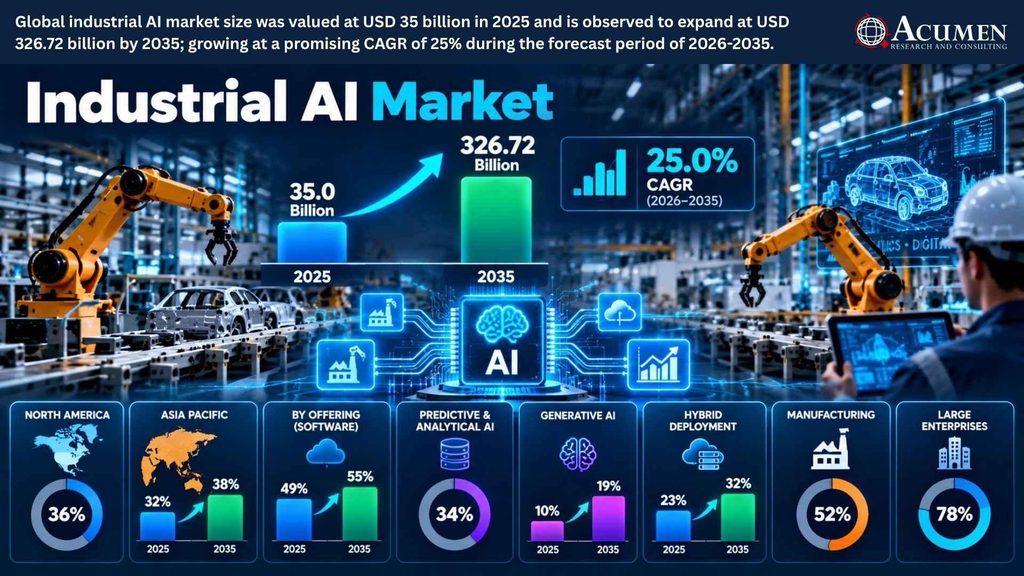
According to Acumen Research And Consulting, the global industrial AI market was valued at USD 35.0 billion in 2025 and is projected to reach USD 326.72 billion by 2035, expanding at a 25.0% CAGR during 2026–2035.
But the bigger story is the changing role of AI inside industrial environments.
The evolution can increasingly be described as:
Predict → See → Understand → Recommend → Coordinate → Act
Industrial AI is moving beyond an analytics tool toward becoming an intelligence layer connecting machines, industrial software, digital twins, edge infrastructure, engineers and increasingly autonomous physical systems.
What Is Industrial AI?
Industrial AI refers to the application of artificial intelligence and machine learning across manufacturing and other asset-intensive industries such as energy, utilities, oil and gas, mining, transportation and infrastructure.
Unlike general-purpose enterprise AI, industrial AI operates in environments closely connected with physical equipment and operational processes.
These environments generate information from:
- Sensors and industrial IoT devices.
- PLCs and control systems.
- Manufacturing execution systems.
- Machine-vision cameras.
- Robots.
- Maintenance records.
- Engineering software.
- Digital twins.
- Enterprise systems.
- Production and quality databases.
Industrial AI attempts to transform these different data sources into predictions, recommendations, decisions and increasingly automated actions.
Its applications already include predictive maintenance, anomaly detection, machine vision, quality inspection, production optimization, robotics, energy optimization, demand forecasting and supply-chain planning.
The 2026 NIST roadmap for AI and machine learning in smart manufacturing identifies areas ranging from industrial big-data analytics and sensing to digital twins, robotics, autonomous systems, generative AI, foundation models and explainable AI.
That breadth illustrates why industrial AI is becoming less of a standalone technology category and more of an intelligence layer across the industrial technology stack.
Industrial AI Market Could Reach $326.72 Billion by 2035
The Industrial AI Market is projected to expand from USD 35.0 billion in 2025 to USD 326.72 billion by 2035, representing a 25.0% CAGR.
That means the industrial AI market could become more than nine times larger over the forecast period.
Several technologies are converging to support this expansion.
Factories are becoming increasingly connected.
Industrial edge computing is placing processing power closer to equipment.
Digital twins are creating virtual representations of physical systems.
Computer vision is giving machines greater visual perception.
Generative AI is creating natural-language interfaces to engineering and operational knowledge.
Robotics is becoming more adaptive.
Together, these technologies are creating the foundation for a more sophisticated form of industrial intelligence.
The resulting architecture increasingly looks like:
Physical Asset → Sensors → Edge Computing → Industrial Data → AI Model → Digital Twin → AI Agent → Human/Automated Action
This is considerably different from the first generation of industrial analytics.
AI is gradually moving closer to the actual operational workflow.
Predictive and Analytical AI Leads With 34%
Despite the excitement around generative AI, predictive and analytical AI remained the largest industrial AI technology segment in 2025 with 34% market share.
There is a practical reason.
Predictive AI addresses measurable industrial problems.
A manufacturer can analyze vibration, temperature, pressure, acoustic signals, electrical characteristics and maintenance histories to detect patterns associated with equipment deterioration.
Instead of waiting for equipment to fail, maintenance teams can potentially intervene earlier.
The operating model changes from:
Failure → Repair
Monitor → Predict → Schedule → Maintain
Predictive AI can also extend beyond maintenance.
Production data can identify abnormal operating conditions.
Demand information can improve forecasting.
Process models can optimize production parameters.
Energy data can identify inefficient equipment.
Quality information can reveal patterns associated with defects.
These applications provide measurable operational outcomes, explaining why predictive and analytical AI remains the foundation of the Industrial AI Market.
But the fastest structural changes are occurring elsewhere.
Generative and Foundation-Model AI Could Nearly Double Its Market Share
Generative and foundation-model AI represented only 10% of Industrial AI Market revenue in 2025.
By 2035, its share is projected to reach 19%, representing the largest share increase among the AI technology categories covered by the report.
This transition could fundamentally change how industrial workers interact with technology.
Traditional industrial analytics frequently requires specialists to navigate dashboards, databases or engineering applications.
Generative AI creates another interface:
Natural language.
An engineer could potentially ask:
“Why did Line 4 experience increased vibration during the previous production run?”
A maintenance technician could ask:
“Show me the relevant maintenance procedure for this fault code.”
A production manager could ask:
“Which variables contributed most to yesterday’s decline in throughput?”
The AI system could search technical documents, maintenance records, machine histories and operational data to assemble an answer.
That capability transforms AI from an analytical engine into an interface to industrial knowledge.
Industrial Copilots Are Becoming a Bridge Toward AI Agents
Industrial copilots represent an intermediate stage between traditional analytics and more autonomous AI agents.
A copilot assists a human worker.
An agent can potentially execute parts of a workflow.
That distinction became increasingly visible during 2026.
Siemens announced nine additional AI-powered industrial copilots spanning product lifecycle management, manufacturing and operations as part of its broader industrial AI strategy.
The company has also emphasized the potential for copilots to interact with industrial knowledge through natural-language interfaces.
But the market is already moving beyond the copilot model.
In April 2026, Siemens launched its Eigen Engineering Agent, describing it as a shift from AI that generates suggestions toward AI capable of carrying out engineering tasks end-to-end using multi-step reasoning and self-correction. The system was piloted with more than 100 customers across 19 countries before becoming generally available.
This represents an important evolution:
Dashboard → Copilot → AI Agent
The dashboard displays information.
The copilot helps the user understand or create something.
The agent can potentially perform a sequence of actions toward a defined objective.
Agentic AI Could Become the Next Industrial Software Layer
Agentic AI is particularly relevant to industrial environments because industrial workflows are inherently multi-step.
Diagnosing a production problem might require an AI system to retrieve machine information, analyze sensor data, consult engineering documentation, compare operating parameters, examine maintenance history and recommend corrective actions.
A future industrial agent could coordinate those steps.
Siemens describes agentic industrial AI as systems capable of perceiving, reasoning, acting and continuously learning while coordinating specialized expert agents across industrial workflows.
The potential architecture becomes:
Operator Request
Orchestrator Agent
Maintenance Agent + Quality Agent + Engineering Agent + Production Agent
Industrial Software / Digital Twin / Machine Data
Recommended or Authorized Action
This does not mean industrial plants suddenly become fully autonomous.
Industrial environments have strict safety, reliability and governance requirements.
But it suggests that AI software can gradually progress from assisting individual tasks toward orchestrating increasingly complex workflows.
Software Leads the Industrial AI Market With 49%
This transition also helps explain why software is already the largest offering category.
Software represented 49% of Industrial AI Market revenue in 2025, compared with hardware at 32% and services at 19%.
By 2035, software is projected to increase its share to 55%.
Hardware remains essential.
Industrial AI requires sensors, cameras, industrial computers, AI accelerators, networking equipment and edge infrastructure.
Within hardware, AI accelerators and computing hardware represented 35% in 2025, followed by industrial edge AI hardware at 25% and AI-enabled machine-vision hardware at 22%.
But hardware provides the computing foundation.
Software determines how that computing capacity becomes useful.
Industrial AI platforms increasingly need to manage data, deploy models, monitor AI performance, integrate with industrial systems, orchestrate workloads and surface recommendations to workers.
As AI agents emerge, software’s role becomes even larger.
It is becoming the intelligence and orchestration layer above industrial infrastructure.
Machine Vision Gives Industrial AI the Ability to See
If predictive AI allows industrial systems to anticipate what may happen, computer vision allows them to interpret what is physically happening.
Machine-vision cameras combined with AI can inspect products, identify defects, monitor production and help robots interpret their environment.
Traditional vision systems were frequently rule-based.
AI-based computer vision can recognize more complex visual patterns.
Applications include surface-defect detection, assembly verification, dimensional inspection, package inspection, worker-safety monitoring and robotic perception.
This makes vision AI especially important in industries where quality must be evaluated continuously at high production speeds.
As AI-enabled cameras and edge processors improve, visual inspection can increasingly occur directly beside the production line.
That creates a natural relationship between Industrial AI Market growth and Industrial Edge Computing Market growth.
Edge AI Moves Intelligence Closer to Industrial Equipment
Some industrial AI workloads cannot depend on a distant cloud.
Machine vision may require immediate analysis.
Robots need low-latency responses.
Safety applications can require local processing.
Industrial facilities may also need applications to continue operating when external connectivity is unavailable.
Edge AI addresses these requirements by placing AI inference close to the machines generating data.
The workflow becomes:
Machine/Sensor → Local Edge AI → Immediate Decision → Selected Data to Cloud
Acumen identifies edge AI as a major opportunity for machine vision, predictive maintenance, robotics, anomaly detection and real-time process control.
This does not eliminate cloud AI.
Instead, industrial AI is moving toward a distributed architecture.
Hybrid Deployment Could Rise From 23% to 32%
On-premises infrastructure accounted for 47% of Industrial AI Market revenue in 2025, compared with cloud at 30% and hybrid at 23%.
But hybrid deployment is projected to increase from 23% in 2025 to 32% by 2035, recording a 29.6% CAGR.
That growth reflects the unique computing requirements of industrial AI.
Latency-sensitive applications can remain on-premises or at the edge.
Large-scale model training can occur in centralized AI infrastructure.
Enterprise analytics can run in the cloud.
Centralized platforms can manage AI models across multiple factories.
The architecture becomes:
Machine Edge → Factory Edge → On-Premises Infrastructure → Cloud/AI Infrastructure
Rather than forcing every workload into one environment, manufacturers can place computing where it creates the greatest operational value.
Hybrid AI could therefore become one of the defining architectures of industrial digitalization.
Digital Twins Give Industrial AI Context
AI models are powerful, but industrial systems are more useful when AI understands the physical context around the data.
Digital twins can provide that context.
A digital twin creates a synchronized virtual representation of a physical asset, production process or factory.
Industrial AI can analyze data flowing into the twin.
The twin can simulate potential operating conditions.
AI can then evaluate possible outcomes.
This creates a powerful loop:
Physical System → Operational Data → Digital Twin → AI Analysis → Simulation → Optimized Decision → Physical System
The 2026 NIST roadmap identifies digital twins alongside autonomous systems, robotics, generative AI and foundation models as important areas in the evolution of AI-enabled smart manufacturing.
The combination becomes particularly powerful when AI agents are introduced.
Instead of simply displaying a digital twin, an AI agent could potentially query it, run simulations and compare possible actions before presenting a recommendation.
Physical AI Connects Industrial Intelligence With Machines
Industrial AI becomes even more consequential when intelligence begins interacting directly with physical equipment.
This is the emerging domain of physical AI.
Physical AI combines AI models with robots, autonomous machines and other systems operating in the real world.
NVIDIA’s manufacturing ecosystem increasingly connects AI with simulation, digital twins, robotics and physical AI workflows. In September 2026, for example, Skild AI introduced a robotic foundation model designed to learn previously unseen tasks from video demonstrations using an AI stack spanning synthetic data, training, simulation and physical deployment.
This represents another progression:
Industrial Analytics → Industrial AI → Agentic AI → Physical AI
Industrial analytics interprets data.
Industrial AI predicts and optimizes.
Agentic AI coordinates tasks.
Physical AI can connect intelligence with machines capable of acting in the physical environment.
This convergence could become one of the most important long-term drivers of the Industrial AI Market.
Manufacturing Accounts for 52% of Industrial AI Demand
Manufacturing accounted for a dominant 52% of Industrial AI Market revenue in 2025.
No other industrial sector combines as many AI opportunities within a single environment.
AI can influence product design.
Production planning.
Predictive maintenance.
Machine vision.
Robotics.
Quality inspection.
Inventory.
Energy consumption.
Supply chains.
Worker assistance.
Factories also generate large quantities of structured and unstructured data from machines and production systems.
This makes manufacturing a natural proving ground for industrial AI.
As successful use cases expand from one production line to multiple factories, the market moves from isolated pilots toward enterprise-scale AI deployment.
Industrial AI Extends Far Beyond Manufacturing
Manufacturing leads, but the Industrial AI Market extends across other asset-intensive industries.
Energy and utilities accounted for 12% in 2025, followed by oil and gas at 9%, transportation and logistics at 8.5%, mining and metals at 6%, and construction and infrastructure at 5%.
Many of these sectors share similar operational challenges.
Assets are expensive.
Downtime matters.
Infrastructure is geographically distributed.
Safety is critical.
Equipment generates continuous data.
AI can therefore support asset monitoring, anomaly detection, demand forecasting, maintenance optimization and operational decision-making.
The technology differs by industry, but the underlying economic logic remains similar:
Use operational data to make physical assets more productive, reliable and efficient.
North America Leads With 36% Market Share
North America accounted for 36% of the Industrial AI Market in 2025, making it the largest regional market.
The region benefits from a mature cloud and AI infrastructure ecosystem, industrial automation adoption, enterprise software capabilities and substantial technology investment.
But industrial AI requires more than powerful AI models.
Manufacturers need reliable data infrastructure, sensors, connectivity, cybersecurity, industrial software and integration between IT and operational technology.
NIST’s 2026 roadmap emphasizes several of these challenges, including industrial data complexity, heterogeneous sensing and control systems, trustworthy AI and reliable industrial operation.
The next stage of adoption therefore depends less on demonstrating that AI can work and more on making it reliable enough to operate inside real industrial systems.
Asia-Pacific Could Become the Largest Industrial AI Region
Asia-Pacific represented 32% of the total industrial AI market in 2025, only four percentage points behind North America.
By 2035, its share is projected to reach 38%, supported by a 27.4% CAGR during 2026–2035.
The region has a structural advantage: manufacturing scale.
China, Japan, South Korea, Taiwan, India and Southeast Asian economies collectively contain enormous automotive, semiconductor, electronics, machinery, robotics and industrial-production ecosystems.
These sectors are becoming more automated and data-intensive.
More automation produces more machine data.
More machine data creates more opportunities for AI.
More AI creates greater demand for edge computing, digital twins, accelerators and industrial software.
That creates a reinforcing technology cycle:
Automation → Data → AI → Optimization → More Automation
This could make Asia-Pacific the center of gravity for industrial AI deployment over the coming decade.
Governments Are Treating Industrial AI as Strategic Infrastructure
Industrial AI is also becoming part of national manufacturing strategies.
The United States published the 2026 Roadmap on Artificial Intelligence and Machine Learning for Smart Manufacturing, covering areas including industrial data, digital twins, autonomous systems, robotics, trustworthy AI and foundation models.
China’s AI + Manufacturing initiative establishes targets for industrial intelligent agents, industrial datasets, application scenarios and benchmark enterprises.
Germany reorganized its Industrie 4.0 initiative around industrial AI in 2026, while Japan is supporting manufacturing-data and robotics-foundation-model initiatives.
India’s broader AI infrastructure expansion can also support domestic industrial AI development. Acumen notes that the IndiaAI Mission carries a government outlay of ₹10,371.92 crore and that more than 38,000 GPUs had been onboarded through its compute initiative by March 2026.
These initiatives demonstrate an important shift.
Industrial AI is increasingly being treated not merely as enterprise software but as part of national industrial competitiveness.
Large Enterprises Hold 78%—But SMEs Could Be the Next Adoption Wave
Large enterprises accounted for 78% of Industrial AI Market revenue in 2025, while SMEs represented 22%.
Large organizations have obvious advantages.
They operate more assets and production sites.
They generate larger datasets.
They can employ specialized AI and data teams.
And they have greater capacity to fund integration projects.
But several technology trends could gradually lower barriers for smaller manufacturers.
Cloud AI reduces infrastructure requirements.
AI-as-a-Service lowers upfront investment.
Packaged industrial AI applications reduce development effort.
Edge AI appliances can simplify deployment.
Generative AI can make sophisticated industrial software easier to use.
As these technologies mature, industrial AI could become less dependent on large internal data-science teams.
That may broaden adoption considerably.
Data Quality May Be the Biggest Constraint on Industrial AI
AI performance ultimately depends on the information it receives.
Industrial environments often contain fragmented data.
A factory may combine modern connected equipment with machines installed decades earlier.
Different PLCs, SCADA systems, MES platforms, ERP systems and sensors may use different data structures.
Historical records may be incomplete.
Sensors can produce erroneous readings.
Maintenance information may exist in documents rather than structured databases.
This creates a fundamental problem:
Poor industrial data produces poor industrial AI.
Acumen cites survey evidence showing that 76% of industrial manufacturing executives identified unreliable data as a top AI risk, even while many organizations were investing in stronger AI data foundations.
This suggests that the competitive advantage in industrial AI may not belong simply to organizations with the largest models.
It may belong to organizations with the best industrial data architecture.
Trustworthy AI Is More Important in Industry Than in Many Digital Applications
A recommendation error in a consumer application may be inconvenient.
An incorrect AI decision connected with industrial equipment can have much larger consequences.
Factories must consider reliability, explainability, cybersecurity, worker safety and production continuity.
NIST specifically highlights trustworthy, explainable and reliable operation as important requirements for industrial AI adoption.
That means the journey toward autonomous industry will likely be gradual.
Human oversight will remain important.
AI systems may first recommend actions.
Then execute low-risk workflows with approval.
Later, selected systems may act autonomously within clearly defined operating boundaries.
The progression may look like:
Human Decision → AI Recommendation → Human Approval → AI Execution → Supervised Autonomy → Bounded Autonomy
The technology can move quickly.
Industrial trust will take longer.
Competition Is Shifting Toward Full Industrial AI Platforms
The Industrial AI Market contains companies from several historically separate technology categories.
Industrial automation companies bring control-system knowledge and installed factory relationships.
Cloud providers bring scalable computing and AI services.
Semiconductor companies provide accelerated computing.
Industrial software companies bring engineering, simulation and lifecycle-management platforms.
AI companies bring models and development tools.
The emerging opportunity is increasingly about connecting these layers.
Siemens and NVIDIA, for example, expanded their collaboration in 2026 around what they describe as an Industrial AI Operating System, spanning design, engineering, manufacturing, operations and supply chains.
NVIDIA is simultaneously expanding manufacturing capabilities around accelerated computing, simulation, physical AI, digital twins and AI agents.
The competitive advantage may therefore shift from selling an individual AI application toward creating a platform capable of connecting:
Data + Compute + AI Models + Digital Twins + Edge + Agents + Automation
That is a much larger strategic opportunity.
Industrial AI Could Become the Brain of the Autonomous Factory
The long-term direction becomes clearest when all these technologies are combined.
Imagine a production environment where sensors continuously monitor equipment.
Edge AI detects abnormal behavior.
Computer vision identifies a quality deviation.
An industrial AI agent retrieves machine history and maintenance documentation.
A digital twin simulates several possible adjustments.
The AI system determines which option best balances throughput, quality and energy consumption.
A human approves the change—or, within defined boundaries, the system executes it automatically.
The result is a closed industrial intelligence loop:
Sense → Understand → Predict → Simulate → Decide → Act → Learn
This does not imply factories without people.
It describes factories where more routine analysis and coordination can be handled by software while engineers and operators supervise higher-level objectives, exceptions and critical decisions.
That is the direction in which industrial AI is increasingly moving.
What Comes Next for the Industrial AI Market?
Five transitions are likely to define the industrial AI market through 2035.
First: Predictive AI → Generative and Foundation-Model AI
Predictive AI remains the largest technology segment, but generative and foundation-model AI is projected to increase from 10% to 19% of the industrial AI market.
Second: Copilots → AI Agents
AI is beginning to move from answering questions toward completing multi-step engineering and operational workflows.
Third: Cloud AI → Hybrid Industrial AI
Hybrid deployment is projected to rise from 23% to 32%, combining cloud-scale intelligence with localized edge and on-premises execution.
Fourth: Digital AI → Physical AI
AI is increasingly connecting with robots, machines, vision systems and autonomous equipment.
Fifth: AI Insights → AI-Driven Operations
The largest long-term opportunity may emerge as AI progresses from analyzing industrial systems toward helping coordinate them.
These transitions explain why the Industrial AI Market is projected to increase from USD 35 billion in 2025 to USD 326.72 billion by 2035.
Industrial AI began largely by helping companies understand their machines.
Its next phase is about helping industrial organizations predict, reason, coordinate and increasingly act.
That transition could make AI not merely another application inside the factory, but the intelligence layer connecting the entire industrial technology stack.
Key Takeaways
- The global Industrial AI Market is projected to grow from USD 35.0 billion in 2025 to USD 326.72 billion by 2035, representing a 25.0% CAGR during 2026–2035.
- North America led with 36% market share in 2025.
- Asia-Pacific is projected to increase from 32% share in 2025 to 38% by 2035, growing at 27.4% CAGR.
- Software accounted for 49% of the industrial AI market in 2025 and is projected to reach 55% by 2035.
- Predictive and analytical AI led with 34% share, while generative and foundation-model AI is projected to increase from 10% to 19%.
- On-premises deployment held 47%, but hybrid AI is projected to rise from 23% to 32% by 2035, growing at 29.6% CAGR.
- Manufacturing represented 52% of Industrial AI Market revenue in 2025.
- Large enterprises accounted for 78%, although cloud, AI-as-a-Service and packaged applications could lower adoption barriers for SMEs.
- AI agents, digital twins, edge AI, computer vision and physical AI are increasingly converging toward more autonomous industrial workflows.
Frequently Asked Questions
What is the Industrial AI Market?
The Industrial AI Market includes AI hardware, software and services used across manufacturing and other asset-intensive industries for predictive maintenance, machine vision, process optimization, robotics, anomaly detection, forecasting, industrial copilots and increasingly AI agents.
How big is the Industrial AI Market?
The global Industrial AI Market was valued at USD 35 billion in 2025 and is projected to reach USD 326.72 billion by 2035, growing at a 25.0% CAGR during 2026–2035.
Which Industrial AI technology has the largest market share?
Predictive and analytical AI led with approximately 34% share in 2025, supported by predictive maintenance, anomaly detection, production optimization and forecasting.
How will generative AI affect industrial operations?
Generative and foundation models can provide natural-language access to engineering knowledge, maintenance information and industrial data. They can also support engineering workflows, industrial copilots and increasingly AI agents.
What is agentic AI in manufacturing?
Agentic AI refers to systems capable of performing multi-step tasks toward defined objectives rather than simply producing individual responses. Industrial agents could eventually coordinate information from engineering systems, machines, digital twins and operational software.
Why is edge AI important for industrial applications?
Edge AI allows latency-sensitive workloads such as machine vision, anomaly detection and robotics to run close to industrial equipment rather than depending entirely on remote cloud infrastructure.
Which industry dominates the Industrial AI Market?
Manufacturing represented approximately 52% of Industrial AI Market revenue in 2025, making it the largest end-use industry.
Which region is growing fastest?
Asia-Pacific is projected to grow at 27.4% CAGR during 2026–2035, with its market share increasing from approximately 32% in 2025 to 38% in 2035.