

A connected medical device may need to send patient measurements across different locations, maintain a cellular connection, and operate for years without anyone physically accessing its hardware. A traditional SIM card can make this more complicated when a device needs a different mobile network operator or a change in its connectivity subscription.
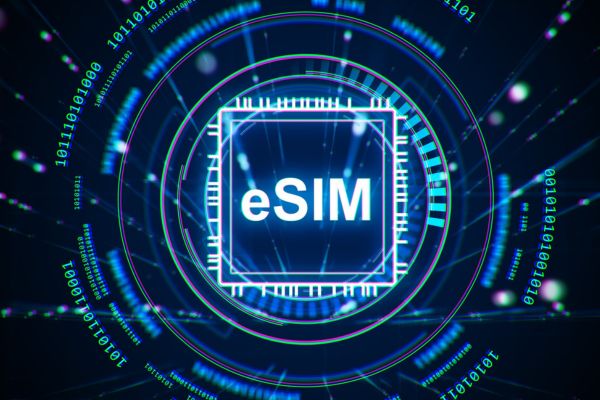
Embedded SIM (eSIM) technology addresses this challenge by allowing compatible devices to store and manage mobile network subscriptions electronically. Instead of physically replacing a SIM card, a device can download a new operator profile remotely, provided its hardware, software, and connectivity service support remote provisioning.
For medical IoT, this capability can simplify the management of wearable monitors, portable diagnostic equipment, and remote patient-monitoring systems. It also creates new design considerations involving secure chips, cellular modems, embedded software, and network compatibility.
What Is eSIM Technology?
An eSIM is a digital SIM solution built around an embedded Universal Integrated Circuit Card (eUICC). The eUICC securely stores mobile network operator profiles and supports their management according to the applicable eSIM specifications.
Unlike a removable SIM card, an embedded eUICC is designed to remain inside the device. Compatible systems can download, enable, disable, or manage operator profiles remotely without requiring physical access to the SIM hardware.
A simplified medical IoT architecture looks like this:
Medical Sensor → Microcontroller → Cellular Modem → eSIM/eUICC → Cellular Network → Remote Monitoring Platform
The sensor collects health measurements, while the processor manages the data. The cellular modem handles radio communication, and the eSIM provides the subscriber credentials needed to authenticate with a supported mobile network.
The eSIM does not replace the cellular modem or antenna. It manages network subscription credentials, while the modem and RF circuitry establish the wireless connection.
How Does eSIM Work in Medical IoT?
Consider a remote monitoring device deployed across several regions. Initially, the manufacturer may configure it to use a supported mobile operator. Later, network coverage, service agreements, or deployment requirements may change.
With a compatible eSIM implementation, an authorized remote provisioning system can deliver a new operator profile to the device. The eUICC securely stores the profile, and the device can activate it according to the supported provisioning process.
The device can then use the new subscription to connect to the relevant cellular network, assuming the modem, frequency bands, operator policies, and local requirements are compatible.
The GSMA’s SGP.31 and SGP.32 specifications define an eSIM architecture and technical framework for IoT devices, including remote profile management for devices with limited user interfaces or connectivity resources. This is particularly relevant to medical sensors that may have no screen or may be installed in locations that are difficult to access. <Cite refs={[“turn249425search0″,”turn249425search4”]}/>
Technologies Used
- Embedded Universal Integrated Circuit Card (eUICC): Securely stores and manages mobile operator profiles.
- Cellular Modem: Connects the medical device to a cellular network using supported technologies such as LTE or 5G.
- RF Transceiver: Transmits and receives cellular radio signals.
- Antenna System: Radiates and receives RF signals across the device’s supported frequency bands.
- Microcontroller or Embedded Processor: Coordinates device operation, sensor data, and communication with the modem.
- Remote SIM Provisioning (RSP): Enables compatible devices to download and manage operator profiles remotely.
- IoT Profile Assistant (IPA): Performs functions within the IoT eSIM provisioning architecture, communicating with the eUICC and remote management system.
- eSIM IoT Remote Manager (eIM): Coordinates remote eSIM management operations in the IoT architecture.
- Power Management IC (PMIC): Regulates power for the modem, processor, sensors, and other electronics.
- Device Management Software: Monitors connectivity status and coordinates provisioning and operational updates.
Why eSIM Matters for Medical Devices
Remote connectivity management
Medical monitoring devices may be deployed in homes, ambulances, clinics, or remote care locations. Physically replacing SIM cards across a large number of devices can require time, travel, and service interruptions.
Remote provisioning can reduce this operational burden when a compatible eSIM system and suitable operator profiles are available.
More flexibility across regions
A device manufacturer serving multiple countries may need to work with different mobile network operators. eSIM technology can make it easier to manage suitable operator profiles without manufacturing separate versions of the device for every deployment.
However, an eSIM does not guarantee access to every network. Regional frequency support, certification, operator agreements, and local regulations still apply.
Better support for compact devices
An embedded SIM removes the need for a removable SIM holder and its associated mechanical space. This can simplify enclosure design and reduce one physical access point.
The overall size reduction depends on the chosen eUICC package and device architecture. The modem, antenna, and other cellular components are still required.
Long-term device management
Some IoT devices are designed for extended deployment. Remote profile management can help operators maintain connectivity as service arrangements change, without requiring a technician to open every device.
This is particularly useful for large deployments, provided the device remains reachable and the provisioning system is correctly configured.
Challenges and Opportunities
Challenges
- Network compatibility: The modem and antenna must support the required cellular bands and technologies.
- Provisioning security: Profile downloads and management commands require secure authentication and protection against unauthorized access.
- Power constraints: Cellular communication and profile downloads consume energy, which matters for battery-powered devices.
- Coverage limitations: An eSIM cannot compensate for weak cellular coverage or an unsupported network.
- Hardware integration: The eUICC, modem, processor, and firmware must work together correctly.
- Regulatory requirements: Medical devices must meet applicable electrical, wireless, cybersecurity, and medical-device requirements.
- Lifecycle management: Manufacturers need a reliable process for managing subscriptions, connectivity failures, and software updates over the device’s operating life.
Opportunities
- Remote switching between supported operator profiles.
- Simpler connectivity management across international deployments.
- Reduced need for physical SIM replacement.
- Easier scaling of cellular medical IoT fleets.
- More flexible integration with LTE, LTE-M, NB-IoT, and compatible 5G devices.
- Better coordination between embedded hardware, cellular connectivity, and remote device management.
What Comes Next?
The evolution of IoT-specific eSIM standards is making remote provisioning more suitable for devices with limited interfaces and constrained resources. As compact cellular modules, secure integrated circuits, and device management platforms improve, eSIM technology could become increasingly useful for long-lived medical IoT deployments.
Integrated SIM technology, or iSIM, is another development to watch. Instead of using a separate eUICC component, iSIM integrates SIM functionality into a suitable system-on-chip or secure system architecture. This may reduce component count and simplify integration in some devices, although implementation depends on the chipset and security design.
Neither eSIM nor iSIM automatically guarantees lower power consumption or better coverage. Their main value lies in how subscription credentials are stored, secured, and managed.
Conclusion
eSIM technology gives medical IoT manufacturers a practical way to manage cellular subscriptions without physically replacing SIM cards. By combining a secure eUICC, cellular modem, RF hardware, and remote provisioning software, connected medical devices can gain greater flexibility throughout their operational life.
As healthcare electronics become more distributed and connected, eSIM will remain an important connectivity option. Its success will depend not only on the embedded SIM itself, but also on secure provisioning, reliable cellular hardware, compatible networks, and careful device integration.