


A 5G-enabled medical device needs more than a modem and an antenna to maintain a reliable wireless connection. Between the two sits a collection of electronic components that control how radio signals are transmitted, received, amplified, and filtered.
This section of the device is called the radio-frequency front end (RF front end or RFFE). It plays an important role in compact medical IoT devices, including wearable monitors, portable diagnostic equipment, and remote patient-monitoring systems.
As medical electronics become smaller and more connected, RF front-end design must balance signal quality, power consumption, circuit-board space, and heat. A poorly designed RF path can weaken connectivity, increase battery drain, or make the device more vulnerable to interference.
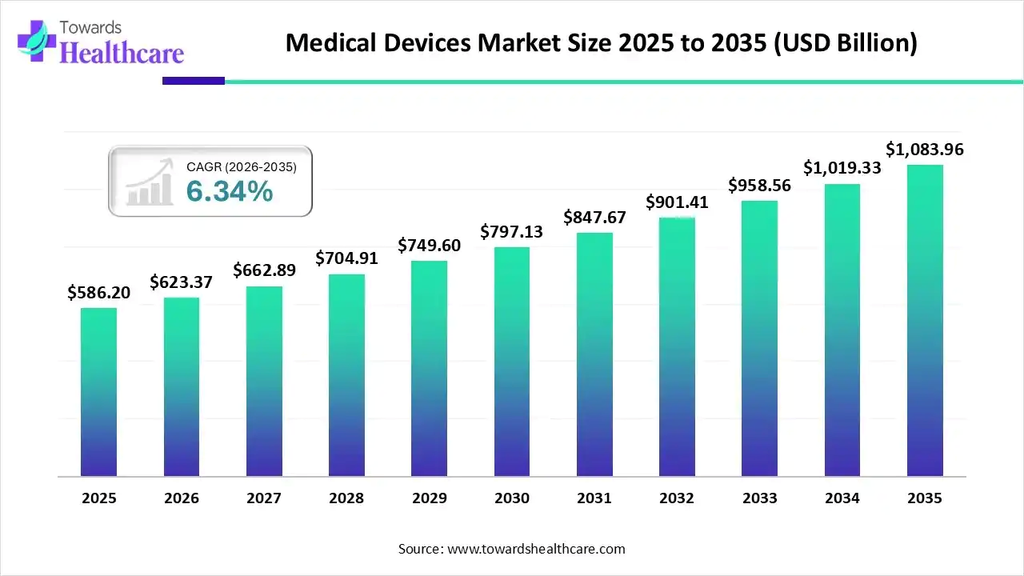
According to Towards Healthcare Research and Consulting, the global medical devices market size is calculated at USD 586.20 billion in 2025, grew to USD 623.37 billion in 2026, and is projected to reach around USD 1083.96 billion by 2035. The market is expanding at a CAGR of 6.34% between 2026 and 2035.
What Is an RF Front End?
The RF front end connects a wireless transceiver to the antenna and manages the radio signals moving between the device and a cellular network.
A typical architecture may include:
5G Modem/Transceiver → RF Front-End Circuitry → Antenna
The front end can contain filters, power amplifiers, low-noise amplifiers, RF switches, and antenna-tuning components. The exact arrangement depends on the frequency bands, antenna configuration, and capabilities supported by the device. Some functions are integrated into a single RF module.
During transmission, the front end prepares the outgoing signal for the antenna. During reception, it helps select and amplify incoming signals before they reach the receiver.
Each component has a different job, but all must work together to preserve signal quality and limit unnecessary losses.
The Three Key Components of an RF Front End
1. RF Filters: Separating Useful Signals From Interference
Medical IoT devices may operate in environments where multiple wireless systems are active. Cellular networks, Bluetooth devices, Wi-Fi access points, and nearby electronic equipment can create challenging radio-frequency conditions.
RF filters allow selected frequency ranges to pass while attenuating unwanted signals. This helps the receiver focus on the intended cellular band and reduces interference from signals outside that band.
Two common filter technologies are surface acoustic wave (SAW) and bulk acoustic wave (BAW) filters. Both are used in RF systems, with their suitability depending on frequency, bandwidth, insertion loss, and rejection requirements.
For a compact 5G medical device, filter selection is especially important because unwanted signals can reduce receiver performance. However, filtering also introduces some signal loss, so engineers must balance interference rejection with the need to preserve weak incoming signals.
2. Power Amplifiers: Sending Signals to the Network
A power amplifier (PA) increases the strength of the outgoing RF signal before it reaches the antenna.
This matters when a medical device sends measurements to a cellular network from a home, ambulance, or another location with limited coverage. The transmitter must deliver sufficient signal power for the connection to work reliably within the network’s operating limits.
However, increasing output power consumes energy and generates heat. This creates a significant design challenge for battery-powered medical electronics.
Engineers therefore evaluate amplifier efficiency, output power, linearity, and thermal performance together. The amplifier must strengthen the signal without introducing excessive distortion into the modulated waveform.
Efficient power-amplifier design can help a device maintain communication while managing its battery budget.
3. Low-Noise Amplifiers: Detecting Weak Incoming Signals
A low-noise amplifier (LNA) performs the opposite role. It amplifies weak signals received through the antenna while adding as little additional noise as possible.
For example, a wearable medical monitor may need to communicate with a cellular base station when the signal is relatively weak. If the receiving circuit introduces too much noise, the device may struggle to recover the transmitted data.
An LNA helps preserve receiver sensitivity, which influences how effectively the device can detect weak signals.
Its position in the receive chain matters. Losses before the LNA can degrade the overall noise performance, so the antenna, filters, switches, and amplifier must be designed as a coordinated system.
4. RF Switches: Routing Signals Through the Correct Path
A 5G device may support multiple frequency bands, antenna paths, or transmission and reception configurations. RF switches direct signals through the appropriate circuit path.
Depending on the architecture, a switch may select an antenna, route a signal through a particular filter, or help manage different RF operating bands.
Two important specifications are insertion loss and isolation. Insertion loss measures how much signal power is lost as the signal passes through the switch. Isolation describes how effectively the switch limits unwanted signal leakage between paths.
Low insertion loss helps preserve transmit power and receiver sensitivity. Good isolation reduces unwanted coupling between circuits.
In compact medical electronics, these characteristics must be achieved without consuming excessive board space or power.
How These Components Work Together
Consider a 5G-connected wearable device that transmits health measurements to a remote monitoring platform.
When the device sends data, its transceiver generates the RF signal. The power amplifier raises the signal to the required level, while filters suppress unwanted frequency components and switches route the signal toward the appropriate antenna path.
When the device receives a network signal, the receive path selects the intended frequency band, filters unwanted signals, and uses an LNA where required to amplify the incoming signal before further processing by the transceiver.
The result depends on the entire chain, not on the performance of one component alone.
A high-performance amplifier cannot fully compensate for excessive loss elsewhere in the circuit. Similarly, an effective filter may improve interference rejection but still harm receiver sensitivity if its insertion loss is too high.
This is why RF engineers evaluate the complete signal path during design and testing.
Technologies Used
- SAW and BAW filters: Select frequency bands and suppress unwanted signals.
- RF power amplifiers: Increase transmit signal power.
- Low-noise amplifiers: Strengthen weak received signals while limiting added noise.
- RF switches: Route signals among antennas, filters, and supported radio paths.
- Antenna tuners: Help maintain antenna performance under different operating conditions.
- RF transceivers: Generate outgoing radio signals and convert incoming signals for processing.
- System-on-Chip (SoC) platforms: Integrate cellular processing and other device functions, depending on the design.
- Power Management ICs (PMICs): Regulate and distribute power to the modem, RF circuitry, sensors, and processor.
- MIPI RFFE control interface: Enables compatible RF front-end components to be configured and controlled by the host system.
Why RF Front-End Design Matters in Medical IoT
Medical devices often operate under tighter physical and power constraints than larger communication equipment. A wearable monitor may need to fit its battery, antenna, sensors, processor, and RF circuitry into a small enclosure.
Every component affects the available space, energy budget, and thermal design.
The human body introduces further complexity for wearable devices. Tissue can absorb RF energy, and proximity to the body can alter antenna performance. Engineers must therefore test the complete device in realistic configurations rather than relying only on isolated component measurements.
Reliable connectivity also matters for devices that transmit measurements continuously or at scheduled intervals. The RF front end must support the required data link without creating unnecessary power consumption or interference.
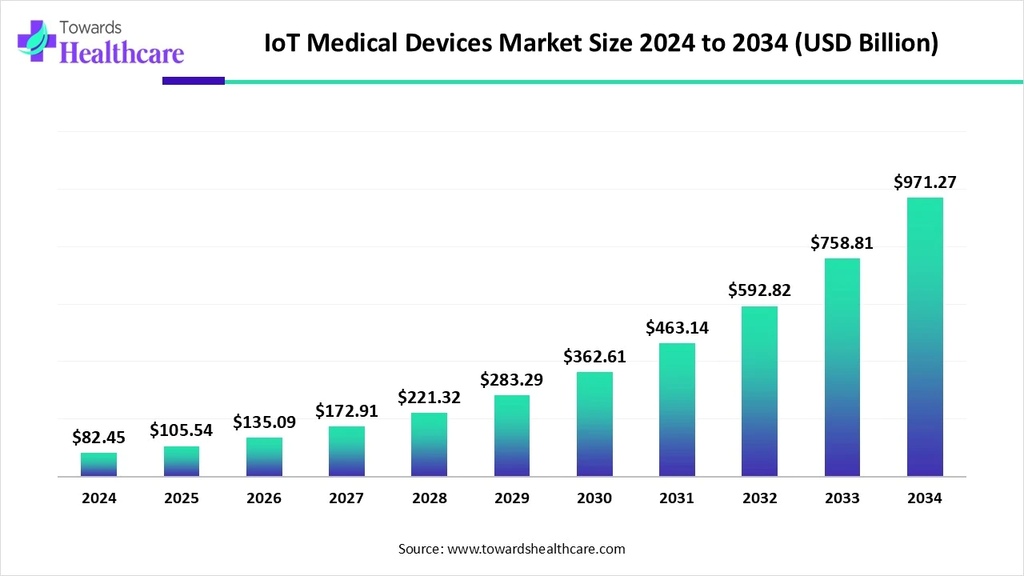
The global IoT medical devices market size is calculated at US$ 82.45 in 2024, grew to US$ 105.54 billion in 2025, and is projected to reach around US$ 971.27 billion by 2034. The market is expanding at a CAGR of 28% between 2025 and 2034.
Challenges and Opportunities
Challenges
- Power consumption: Amplifiers and other active RF components contribute to the device’s energy budget.
- Insertion loss: Filters and switches can reduce signal power along the RF path.
- Interference: Nearby transmitters and unwanted signals can affect receiver performance.
- Thermal management: Power amplifiers and compact RF modules can generate heat.
- Miniaturization: Integrating multiple RF functions into a small PCB requires careful layout and component selection.
- Antenna interaction: The enclosure, battery, PCB, and proximity to the body can influence RF performance.
- Multiband operation: Supporting multiple frequency bands increases filtering, switching, and antenna-design complexity.
Opportunities
- Integrated RF modules: Combining multiple functions can reduce component count and simplify device integration.
- More efficient amplifiers: Improved efficiency can reduce energy losses during transmission.
- Advanced filter technologies: Better selectivity can help manage interference across supported bands.
- Compact cellular modules: Smaller RF solutions can support more space-constrained medical electronics.
- Improved antenna tuning: Adaptive tuning can help maintain performance as device conditions change.
- Optimized power control: Coordinating the modem, RF front end, and PMIC can reduce unnecessary energy use.
What Comes Next?
Future RF front ends will continue to focus on higher integration, lower losses, improved power efficiency, and more reliable multiband operation. As cellular IoT technologies such as 5G RedCap expand the range of devices that can use 5G connectivity, RF design will remain an important consideration for compact connected electronics.
However, a capable RF front end alone does not guarantee a suitable medical device. Designers must also consider electrical safety, electromagnetic compatibility, wireless coexistence, software reliability, and the relevant medical-device requirements.
Conclusion
The RF front end is a critical part of 5G medical electronics. Filters control unwanted frequencies, power amplifiers prepare outgoing signals, low-noise amplifiers strengthen weak incoming signals, and switches route signals through the appropriate paths.
These components must work together to deliver reliable connectivity without excessive power consumption, heat, or circuit complexity.
As medical devices become smaller and more connected, RF front-end engineering will help determine how efficiently and reliably they communicate. It is a small section of the overall device, but its design can have a substantial effect on wireless performance.