

AI Is Reshaping the Economics of Data Center Infrastructure
The global data center industry is entering a new investment cycle as artificial intelligence, cloud computing and high-performance computing transform the infrastructure required to process and store information.
For years, data center development primarily focused on expanding server capacity, improving storage efficiency and supporting enterprise applications. The rapid growth of generative AI is changing these priorities.
AI training and inference workloads require increasingly powerful computing systems, high-speed networking, greater electrical capacity and more sophisticated thermal management. As a result, data center operators must invest in a broader range of components to support higher computing density and more demanding operating conditions.
According to Acumen Research and Consulting, the global Data Center Components Market was valued at USD 260 billion in 2025 and is projected to reach USD 1,009.56 billion by 2035, expanding at a CAGR of 14.5% during 2026–2035.
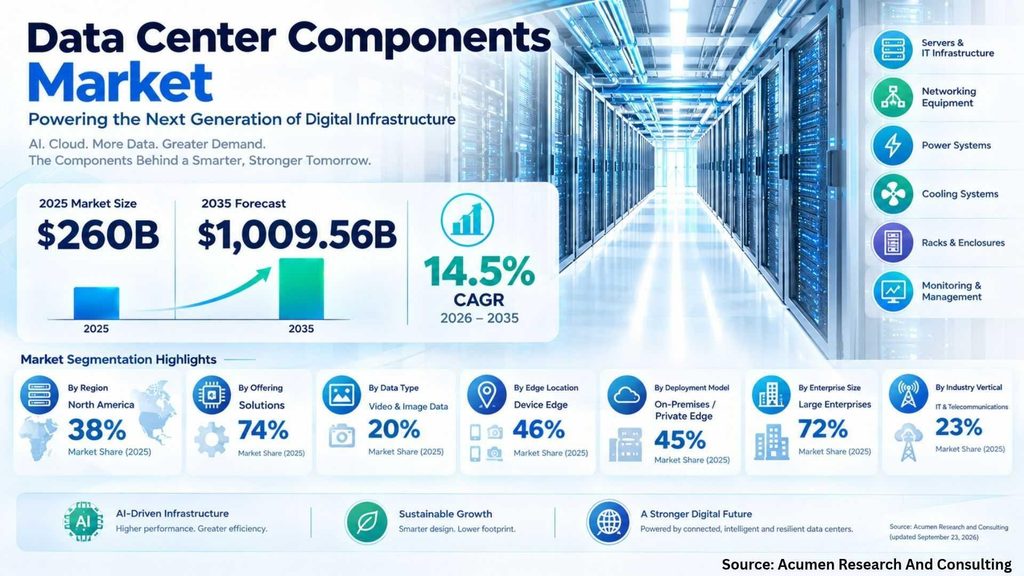
The data center components market includes IT infrastructure, power infrastructure, cooling infrastructure, racks and enclosures, monitoring and management systems, physical security and other supporting components.
Data Center Components Market Statistics
| Market indicator | Statistics |
| Global Data Center Components Market size, 2025 | USD 260 billion |
| Global Data Center Components market forecast, 2035 | USD 1,009.56 billion |
| CAGR, 2026–2035 | 14.5% |
| Leading region | North America — 38% |
| Leading component category | IT infrastructure — 52% |
| Leading data center type | Hyperscale — 40% |
| Leading facility-size category | 10 MW to under 50 MW — 35% |
| Leading rack density | 10–19 kW — 28% |
| Leading end-user category | Hyperscale and cloud providers — 36% |
| Fastest-growing region | Asia-Pacific — 17.4% CAGR |
North America accounted for 38% of the market in 2025, while IT infrastructure represented 52% of total market revenue. Hyperscale data centers accounted for 40%, reflecting the importance of large-scale cloud and AI infrastructure investment.
The underlying opportunity extends beyond servers and processors. AI infrastructure requires coordinated investment across computing, networking, electricity distribution, cooling and physical facility systems.
As AI workloads become more demanding, competitive advantage will increasingly depend on how efficiently data center operators integrate computing capacity with power, cooling and networking infrastructure.
Data Center Components Market Size and Forecast
The global Data Center Components Market is projected to grow from USD 260 billion in 2025 to USD 1,009.56 billion by 2035.
This expansion reflects increasing investment in AI infrastructure, cloud platforms, digital services and large-scale data processing.
Several factors support the forecast.
First, AI workloads are increasing demand for accelerated computing, specialized servers and high-bandwidth networking equipment.
Second, cloud service providers continue to expand infrastructure to support enterprise applications, consumer services and AI platforms.
Third, higher rack power densities are increasing requirements for power distribution, backup systems and advanced cooling.
Fourth, growing data volumes are creating demand for storage, network connectivity and monitoring systems.
Finally, data center operators are investing in infrastructure modernization to improve reliability, scalability and operational efficiency.
The data center component market’s growth will not be evenly distributed across all component categories. IT infrastructure will remain central to computing capacity, while power and cooling systems are becoming increasingly important as constraints on data center expansion.
This creates opportunities for suppliers across the entire infrastructure ecosystem.
AI Infrastructure Is Changing Data Center Design
Traditional data centers were generally designed around predictable enterprise workloads and relatively moderate rack densities.
AI infrastructure introduces different requirements.
Training large AI models and serving inference workloads can require substantial computing capacity, rapid communication between processors and continuous movement of large datasets.
These workloads influence how operators select servers, networking equipment, racks, electrical systems and cooling technologies.
High-density AI racks can place substantially greater demands on power delivery and heat removal than conventional enterprise configurations.
As a result, operators increasingly evaluate data centers as integrated systems rather than collections of independent components.
A server deployment may require corresponding investments in switches, network adapters, optical connectivity, power distribution units, cooling equipment and monitoring systems.
This interdependence expands the addressable market for component manufacturers.
It also increases the importance of compatibility, system integration and coordinated procurement.
IT Infrastructure Dominates With 52% Market Share
By component category, IT infrastructure accounted for 52% of the Data Center Components Market in 2025, making it the largest segment.
IT infrastructure includes servers, storage systems, networking equipment and related computing hardware.
Its leadership reflects the fundamental role these components play in processing, storing and transmitting information.
The expansion of AI applications is increasing demand for accelerated servers, high-performance processors and specialized computing platforms.
Cloud providers also require extensive infrastructure to support databases, enterprise applications, digital services and distributed workloads.
Networking equipment is becoming particularly important as AI systems require rapid communication between large numbers of processors.
Storage infrastructure remains essential for managing training datasets, enterprise information and growing volumes of generated content.
However, IT infrastructure is increasingly dependent on improvements elsewhere in the facility.
Servers cannot operate reliably without sufficient power, effective cooling and appropriate physical infrastructure. This creates complementary demand across component categories.
Power Infrastructure Is Becoming a Strategic Bottleneck
Power infrastructure accounted for 14% of the market in 2025, according to Acumen Research and Consulting.
This category includes electrical distribution systems, uninterruptible power supplies, backup generators, switchgear, transformers and related equipment.
Reliable electricity is essential to data center operation. Even brief interruptions can affect critical computing workloads and business services.
AI infrastructure is increasing the importance of power management because high-density computing environments can require substantial electrical capacity.
Operators must ensure that electricity can be delivered safely and reliably from the grid or other sources to individual racks and computing systems.
This requires coordinated planning across transformers, switchgear, backup systems and rack-level power distribution.
Power availability can also influence where new data centers are built and how quickly they can become operational.
Consequently, component procurement increasingly needs to account for electrical equipment lead times, local grid capacity and redundancy requirements.
For suppliers, the opportunity extends beyond traditional data center power equipment to more efficient distribution, monitoring and management technologies.
Cooling Infrastructure Is Evolving for High-Density AI Workloads
Cooling is another increasingly important component category.
Conventional air-cooling systems remain suitable for many enterprise and cloud workloads. However, higher computing densities can increase the difficulty of removing heat efficiently.
AI infrastructure is accelerating interest in liquid-cooling approaches, including direct-to-chip systems and other technologies designed for high-density environments.
Liquid cooling can transfer heat from computing components more directly than conventional room-level air cooling, depending on the system design.
Supporting infrastructure may include coolant distribution units, pumps, heat exchangers, piping and control systems.
Cooling strategies must be matched to server specifications, rack density, facility architecture and operational requirements.
Retrofitting existing data centers can be particularly challenging because older facilities may not have been designed for the power and thermal demands of modern AI systems.
This creates opportunities for component manufacturers that can support both new construction and infrastructure upgrades.
Hyperscale Data Centers Lead With 40% Market Share
By data center type, hyperscale facilities represented 40% of the global Data Center Components Market in 2025.
These facilities support large-scale cloud services, AI computing, data storage and digital platforms.
Hyperscale operators deploy substantial quantities of servers, networking equipment, power systems, cooling infrastructure and racks.
Their scale also makes component standardization and supply-chain efficiency particularly important.
Large deployments require suppliers capable of delivering consistent product quality, reliable capacity and compatibility across extensive infrastructure programs.
Hyperscale facilities can also influence component design by establishing requirements for rack density, energy efficiency, serviceability and monitoring.
Colocation data centers represent another important market.
These facilities provide computing space and infrastructure to multiple customers, creating demand for scalable power, cooling, connectivity and physical security.
Enterprise data centers remain relevant for organizations with specialized security, compliance or operational requirements, although cloud and colocation adoption can change their share of overall component spending.
High-Density Racks Are Changing Component Requirements
Rack density is becoming an increasingly important consideration in data center design.
Acumen Research and Consulting identifies racks with 10–19 kW density as the leading category, accounting for 28% of the market in 2025.
These configurations support many enterprise, cloud and colocation applications that require more computing capacity without the extreme thermal and electrical demands of the densest AI systems.
Racks in the 20–29 kW category accounted for another 22%.
However, AI workloads are encouraging the deployment of higher-density configurations in suitable facilities.
As rack power increases, operators must evaluate power distribution, cable management, cooling capacity and physical rack design together.
Higher density can improve computing capacity per unit of floor space, but it can also introduce greater operational complexity.
Not every data center can accommodate the same rack densities. Infrastructure decisions depend on workload requirements, electrical capacity, cooling design and the economics of facility upgrades.
The market opportunity therefore spans both conventional racks and specialized infrastructure for high-performance computing.
Large Data Centers Represent the Leading Facility-Size Category
Large data centers with capacities of 10 MW to under 50 MW accounted for 35% of the market in 2025.
These facilities occupy an important position between smaller enterprise environments and very large hyperscale campuses.
They can support substantial cloud, colocation and enterprise workloads while offering more flexibility than the largest developments.
Mega and hyperscale facilities with capacities of 50 MW and above represented 28% of the market.
Smaller facilities below 1 MW accounted for 12%, while medium facilities between 1 MW and under 10 MW represented 25%.
The distribution illustrates the diversity of data center infrastructure requirements.
Smaller facilities may prioritize compact equipment, efficient power usage and limited operational complexity.
Larger facilities require scalable electrical systems, extensive networking, sophisticated cooling and more complex monitoring.
Component manufacturers must therefore serve different facility architectures rather than assume that one infrastructure configuration fits every market.
Hyperscale and Cloud Providers Account for 36% of Demand
Hyperscale and cloud service providers represented 36% of the Data Center Components Market in 2025, making them the largest end-user category.
Their investment decisions influence demand for servers, storage, networking, power, cooling and rack systems.
Cloud infrastructure must accommodate changing workloads while maintaining reliability and performance.
AI services are adding another layer of complexity by increasing demand for accelerated computing and high-speed connectivity.
Colocation providers accounted for 24% of the market, while enterprises represented 21%.
Colocation operators invest in shared infrastructure to serve customers with different computing and connectivity requirements.
Enterprises continue to maintain infrastructure for business-critical applications, data governance and specialized workloads, even as some computing requirements move to cloud and colocation environments.
Telecom operators, government organizations, research institutions and other users contribute additional demand.
This diversity helps support the market beyond the spending patterns of a small number of hyperscale buyers.
North America Dominates the Data Center Components Market
North America accounted for 38% of the global data center components market in 2025, supported by established hyperscale infrastructure, major cloud platforms, strong AI investment and a mature supplier ecosystem.
The United States is the principal country-level market in the region.
Its infrastructure ecosystem includes data center developers, cloud providers, semiconductor companies, server manufacturers, networking suppliers and specialists in power and cooling.
The expansion of AI infrastructure is creating demand for accelerated servers, high-bandwidth networking, advanced cooling and high-capacity electrical equipment.
However, regional growth also depends on access to electricity, grid connections, land and equipment supply.
These constraints can influence construction schedules and the location of new facilities.
North America’s continued importance reflects its established infrastructure and large-scale technology investment, although other regions are expanding their share of global demand.
Asia-Pacific Is the Fastest-Growing Regional Market
Asia-Pacific is expected to record a 17.4% CAGR during 2026–2035, making it the fastest-growing region in the report.
Cloud adoption, AI investment, digitalization and new data center capacity are supporting demand across the region.
China, Japan, India, Singapore, South Korea and Australia are important markets, although their infrastructure profiles and growth trajectories differ.
The region’s electronics manufacturing capabilities also contribute to the broader technology supply chain.
New data center development creates demand for computing hardware, networking equipment, power systems, cooling, racks and monitoring solutions.
India is an important emerging market because of its expanding digital services, enterprise modernization and increasing demand for localized computing capacity.
As new facilities are developed, suppliers may find opportunities to establish local manufacturing, service and integration capabilities.
Regional growth will depend on infrastructure investment, power availability, regulatory conditions and the ability to deliver facilities efficiently.
India’s Data Center Expansion Creates New Opportunities
India’s digital economy is generating demand for data processing, cloud services and enterprise computing infrastructure.
Financial services, telecommunications, e-commerce, government services and technology businesses all require reliable computing and storage capacity.
New data center projects create opportunities across servers, storage, networking, power distribution, cooling and physical infrastructure.
AI adoption could further increase requirements for high-performance computing and thermal management.
However, infrastructure growth depends on more than demand for computing.
Electricity availability, grid connections, water management where relevant, equipment procurement and construction timelines can influence project feasibility.
Suppliers that can provide reliable components, local technical support and efficient installation may benefit from new developments.
For Indian manufacturers and service providers, the opportunity also includes integration, monitoring, maintenance and infrastructure modernization.
Europe Is Prioritizing Efficiency and Infrastructure Resilience
Europe remains an important market for data center components, supported by cloud infrastructure, enterprise computing and demand for digital services.
Energy efficiency and environmental performance are important considerations for operators across the region.
This can support investment in efficient power systems, advanced cooling, monitoring and infrastructure management.
Data sovereignty and regulatory requirements also influence where organizations store and process information.
However, access to electricity, construction costs and grid connection delays can constrain new development in some locations.
These factors encourage operators to evaluate infrastructure efficiency and regional alternatives when planning capacity.
Component suppliers that can improve performance, reliability and resource efficiency may benefit from these priorities.
Leading Companies Across the Data Center Components Ecosystem
The market includes manufacturers of computing systems, networking equipment, power infrastructure, cooling solutions, racks and facility management technologies.
NVIDIA supplies accelerated computing platforms and technologies used in AI infrastructure.
Dell Technologies and Hewlett Packard Enterprise provide servers, storage and enterprise infrastructure systems.
Supermicro specializes in server and storage platforms, including systems designed for accelerated computing.
Cisco Systems and Arista Networks participate in data center networking.
Vertiv supplies critical digital infrastructure technologies, including power and thermal management systems.
Schneider Electric provides power distribution, energy management and data center infrastructure solutions.
Eaton participates in electrical power management and related infrastructure.
ABB and Siemens supply electrical equipment and automation technologies relevant to data center facilities.
Legrand offers infrastructure products that include racks, cabling and power distribution solutions.
Other companies across the broader ecosystem include Lenovo, Broadcom, Intel, AMD, Huawei Technologies, Delta Electronics and STULZ.
These companies operate in different component categories and should not be interpreted as direct competitors across the entire market.
Competitive differentiation increasingly depends on system performance, energy efficiency, product availability, compatibility and the ability to support high-density computing environments.
Supply-Chain Constraints Are Affecting Data Center Component Procurement
Data center development requires coordination across multiple equipment categories.
A project may depend on the timely availability of servers, networking equipment, transformers, switchgear, power distribution units, cooling systems and racks.
Delays in one critical category can affect commissioning schedules for the entire facility.
Electrical equipment can be particularly important because some components require specialized manufacturing and extensive testing.
AI-related demand can also increase competition for selected computing and networking components.
As a result, developers may place orders earlier, diversify suppliers and seek longer-term procurement arrangements.
These strategies can improve planning but may increase capital commitments before facilities become operational.
Component suppliers that offer predictable delivery schedules, reliable technical support and scalable manufacturing may gain an advantage.
However, procurement strategies vary by project size, geography and equipment type.
Sustainability and Energy Efficiency Are Becoming Core Design Priorities
Data center operators are increasingly evaluating energy efficiency alongside computing performance.
Power infrastructure, cooling systems and monitoring technologies all influence facility operating requirements.
Efficient electrical distribution can reduce losses, while advanced cooling and controls can improve thermal management.
Monitoring systems can help operators identify inefficient equipment and adjust operating conditions.
Hardware efficiency is also important.
More computing capacity does not necessarily translate into proportional improvements in energy use, because performance depends on the workload, system architecture and utilization.
Operators therefore need to assess energy consumption and computing output together.
Sustainability initiatives may also influence material selection, equipment lifecycle management and facility design.
For component manufacturers, these priorities create opportunities to differentiate products through measurable improvements in efficiency, reliability and serviceability.
What Are the Main Challenges Facing the Data Center Components Market?
Despite the strong outlook, several factors could affect market development.
Capital expenditure: Large data center projects require substantial upfront investment in facilities and equipment.
Power availability: Grid constraints and electricity infrastructure can limit project development.
Component lead times: Specialized electrical and computing equipment may take time to manufacture and deliver.
Technology changes: Rapid advances in AI hardware can shorten equipment lifecycles and alter infrastructure requirements.
Cooling complexity: Higher rack densities may require major changes to facility thermal systems.
Supply-chain concentration: Dependence on specialized suppliers can create procurement risks.
Energy efficiency: Operators must balance performance, reliability and operating costs.
Demand uncertainty: Infrastructure investment depends on actual workload demand and the commercial returns generated by digital services.
These challenges reinforce the need for careful capacity planning, supplier diversification and infrastructure designs that can accommodate changing workloads.
Data Center Components Market Outlook Through 2035
The global Data Center Components Market is projected to reach USD 1,009.56 billion by 2035, rising from USD 260 billion in 2025 at a CAGR of 14.5% during 2026–2035.
AI infrastructure expansion, cloud computing and increasing data processing requirements are expected to remain important growth drivers.
Several developments will shape the market’s evolution.
AI-oriented infrastructure: Accelerated servers and high-speed networking will influence component specifications.
Power infrastructure as a strategic priority: Electrical distribution and backup systems will become increasingly important as data center capacity expands.
Advanced cooling: Higher-density workloads will create opportunities for more sophisticated thermal management.
Hyperscale expansion: Large cloud providers will continue to influence demand across multiple component categories.
Infrastructure modernization: Existing facilities will require upgrades to accommodate evolving computing requirements.
Efficiency and resilience: Operators will increasingly evaluate performance, energy use, reliability and maintainability together.
The market’s expansion will create opportunities for suppliers across computing, networking, electrical systems, cooling and physical infrastructure.
For technology companies, the key challenge will be delivering components that work together as reliable, scalable systems.
For data center operators, success will depend on aligning infrastructure investment with workload requirements, power availability and long-term operational economics.
As AI transforms computing demand, the data center components industry is becoming a foundational enabler of the next generation of digital infrastructure.
Frequently Asked Questions
How big is the Data Center Components Market?
The global Data Center Components Market was valued at USD 260 billion in 2025 and is projected to reach USD 1,009.56 billion by 2035.
What is the expected CAGR of the Data Center Components Market?
The market is projected to grow at a CAGR of 14.5% during 2026–2035.
Which region dominates the Data Center Components Market?
North America led the market with a 38% share in 2025, supported by established hyperscale infrastructure and significant AI and cloud investment.
Which component category holds the largest market share?
IT infrastructure was the largest component category, accounting for 52% of the market in 2025.
Why is AI driving demand for data center components?
AI workloads require computing accelerators, high-speed networking, storage, power distribution and advanced cooling. These requirements increase investment across the data center infrastructure ecosystem.
Which data center type leads the market?
Hyperscale data centers accounted for 40% of the market in 2025.
Which region is expected to grow fastest?
Asia-Pacific is expected to record the fastest regional growth, at a 17.4% CAGR during 2026–2035.
What are the main challenges for data center component suppliers?
Key challenges include power availability, component lead times, supply-chain constraints, capital expenditure, cooling requirements and rapidly changing computing technologies.