

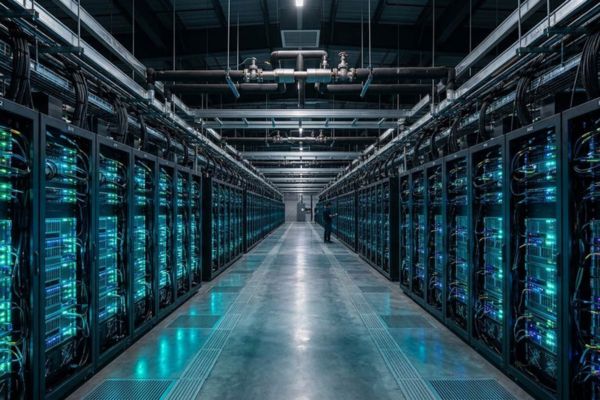
Artificial intelligence (AI) is transforming industries ranging from financial services and healthcare to manufacturing, automotive technology and telecommunications. Behind this transformation is a critical infrastructure layer: AI data centers capable of processing enormous volumes of data and supporting increasingly complex computational workloads.
India is emerging as an important market for AI data center infrastructure as enterprises adopt generative AI, cloud computing and machine learning applications. The expansion of digital services, growing demand for localized data processing and investments in domestic computing capabilities are creating new opportunities for data center operators, semiconductor companies, power equipment manufacturers and cooling technology providers.
According to market estimates published by Cervicorn Consulting, the India AI data center market was valued at approximately USD 1.04 billion in 2025 and is projected to reach USD 7.25 billion by 2035, growing at a compound annual growth rate (CAGR) of 21.5% between 2026 and 2035.
This projected expansion highlights the increasing importance of AI-ready infrastructure in India’s digital economy.
Why India Needs AI-Ready Data Centers
Traditional data centers primarily support enterprise applications, websites, cloud storage and conventional computing workloads. AI data centers have more demanding infrastructure requirements because training and running advanced AI models can require substantial processing power, high-speed networking and specialized storage systems.
Graphics processing units (GPUs) and dedicated AI accelerators are central to these facilities. Unlike conventional processors designed for a broad range of computing tasks, GPUs can perform large numbers of parallel calculations, making them suitable for deep learning, generative AI and large language model workloads.
As businesses move AI applications from experimentation into production, infrastructure providers must accommodate both model training and inference. Training involves developing or updating AI models, while inference enables trained models to generate predictions, recommendations or responses.
This shift is increasing demand for high-density computing systems, scalable cloud platforms and data centers capable of supporting intensive workloads around the clock.
GPUs and AI Accelerators Become Critical Infrastructure
AI computing hardware is one of the most important components of the emerging data center ecosystem. GPU-based servers, specialized accelerators and high-performance computing platforms enable organizations to train advanced models and deploy AI applications at scale.
The growth of AI workloads is also creating opportunities across the semiconductor supply chain. Demand is increasing for advanced processors, high-bandwidth memory, networking chips, power management semiconductors and other components required to operate AI infrastructure efficiently.
Beyond general-purpose GPUs, custom application-specific integrated circuits (ASICs) and other specialized accelerators are attracting attention. These technologies can be designed for particular workloads, potentially improving processing efficiency and reducing operating costs in suitable applications.
However, the selection of AI hardware depends on several factors, including performance requirements, software compatibility, memory capacity, energy consumption and total cost of ownership.
For India’s electronics and semiconductor ecosystem, the expansion of AI data centers could create opportunities in server manufacturing, component supply, systems integration and specialized computing infrastructure.
Hyperscale Data Centers Drive Capacity Expansion
Hyperscale data centers are designed to accommodate large computing workloads through scalable infrastructure and extensive networking capabilities. They are particularly relevant to cloud service providers, technology companies and organizations operating AI platforms for large user bases.
According to Cervicorn Consulting’s market analysis, hyperscale facilities represented a leading segment of India’s AI data center market in 2025. Their importance is expected to increase as generative AI adoption and demand for high-performance computing continue to expand.
India’s established data center hubs, including Mumbai, Chennai, Hyderabad, Bengaluru, Delhi-NCR and Pune, offer different combinations of network connectivity, enterprise demand, power availability and technology infrastructure.
As the market develops, investment decisions will increasingly depend on access to reliable electricity, suitable land, fiber connectivity, skilled professionals and efficient cooling systems.
The expansion of data center capacity also creates opportunities for infrastructure suppliers, including server manufacturers, networking equipment providers, electrical systems companies and construction specialists.
Advanced Cooling Technologies Address Rising Heat Loads
Cooling is becoming a major engineering consideration for AI data centers. High-density GPU servers consume significant amounts of electricity and generate substantial heat, making thermal management essential for maintaining performance, reliability and equipment life.
Air cooling remains an established approach in conventional data center environments. However, as rack power densities increase, operators are evaluating advanced cooling solutions to accommodate demanding AI workloads.
Direct-to-chip liquid cooling transfers heat away from key components through liquid-cooled plates. Immersion cooling involves placing suitable electronic equipment in a specialized dielectric fluid to remove heat. Other approaches include rear-door heat exchangers and hybrid cooling systems.
Each technology has different installation requirements, operating characteristics and maintenance considerations. The most suitable solution depends on server design, rack density, facility configuration, water availability and overall energy efficiency objectives.
The growing adoption of liquid cooling could benefit suppliers of thermal management equipment, pumps, heat exchangers, cooling distribution units, monitoring systems and specialized data center components.
For operators, efficient cooling is not simply an engineering requirement. It is also an important factor in controlling operating expenses and improving the energy efficiency of AI infrastructure.
Power Availability and Sustainability Become Strategic Priorities
Electricity is another major challenge facing AI data center developers. High-performance computing clusters, storage systems, networking equipment and cooling infrastructure require reliable power throughout the year.
As AI workloads expand, data center operators must consider grid connectivity, backup power, uninterruptible power supply (UPS) systems, battery energy storage and renewable energy procurement.
Battery energy storage systems can support power management and help facilities respond to certain grid disturbances, depending on their configuration. Backup generators and UPS systems provide additional layers of resilience.
Renewable energy is also gaining importance as technology companies and data center operators pursue sustainability objectives. Solar and wind power, supported where appropriate by storage and other balancing solutions, can contribute to lower-carbon electricity supplies.
However, integrating renewable energy into a continuously operating facility requires careful planning. Power availability, grid reliability, energy storage duration and the timing of electricity generation must all be considered.
As a result, the expansion of AI data centers is creating demand not only for computing hardware but also for electrical equipment, energy management software, power conversion systems and storage technologies.
Government Initiatives Support India’s AI Ecosystem
Government-led initiatives are helping develop India’s domestic AI capabilities and improve access to computing resources.
The IndiaAI Mission is intended to strengthen the country’s AI ecosystem through measures that include access to computing infrastructure, support for innovation and the development of AI capabilities.
Improved access to computing resources can benefit startups, researchers, educational institutions and businesses that may otherwise face substantial costs when developing and testing AI models.
The broader development of India’s semiconductor and electronics manufacturing ecosystem is also relevant. AI infrastructure relies on a complex supply chain encompassing processors, memory, networking components, power electronics and server systems.
Although domestic AI infrastructure can improve access to computing resources, sustained progress will depend on investment, technical expertise, reliable electricity, advanced hardware availability and effective collaboration between industry, research institutions and policymakers.
Key Challenges Facing AI Data Center Developers
Despite the market’s growth potential, several challenges could affect the pace and economics of new projects.
- High capital expenditure: AI-ready facilities require substantial investment in buildings, electrical infrastructure, servers, networking and cooling systems.
- Power and grid constraints: Large computing campuses need dependable electricity supplies, and securing sufficient capacity can be challenging in some locations.
- Cooling complexity: Higher server densities require more sophisticated thermal management, increasing equipment and operational requirements.
- Hardware and supply-chain dependence: Access to advanced processors, memory and specialized components can affect project costs and deployment schedules.
- Operational expertise: AI data centers require professionals with knowledge of high-performance computing, electrical engineering, thermal management, cybersecurity and infrastructure operations.
- Sustainability requirements: Operators must balance rising computing demand with energy efficiency, emissions reduction and responsible resource management.
Addressing these issues will be important for building infrastructure that can support AI workloads reliably and economically over the long term.
Future Opportunities for Technology and Infrastructure Companies
The development of India’s AI data center market extends beyond data center operators. It creates opportunities across several connected industries.
- Semiconductors: GPUs, AI accelerators, memory devices, networking chips and power management components.
- Electronics manufacturing: AI servers, racks, power supplies, printed circuit boards and related hardware.
- Cooling systems: Direct-to-chip liquid cooling, heat exchangers, pumps and thermal monitoring technologies.
- Power infrastructure: UPS systems, transformers, power distribution equipment, backup power and battery storage.
- Networking: High-speed switches, optical connectivity and low-latency data transmission.
- Cloud services: AI computing platforms, managed infrastructure and scalable enterprise services.
- Monitoring and security: Infrastructure management, energy optimization, access control and cybersecurity solutions.
Companies that can deliver reliable, energy-efficient and scalable solutions may be well positioned to participate in the evolving AI infrastructure supply chain.
Conclusion
India’s AI data center market is entering a period of significant development as organizations invest in artificial intelligence, cloud computing and high-performance computing capabilities. GPUs, hyperscale facilities, advanced cooling technologies and dependable power infrastructure will remain central to this expansion.
The opportunity is not limited to building more data centers. It also includes developing the semiconductor supply chain, improving energy efficiency, strengthening domestic computing capabilities and creating infrastructure that can support increasingly sophisticated AI applications.
While power availability, capital expenditure, cooling requirements and hardware supply remain important challenges, continued investment and technological innovation could strengthen India’s position in the global AI infrastructure ecosystem.
For technology companies, electronics manufacturers, semiconductor suppliers and energy infrastructure providers, the growth of AI data centers represents an important area to monitor over the coming decade.