

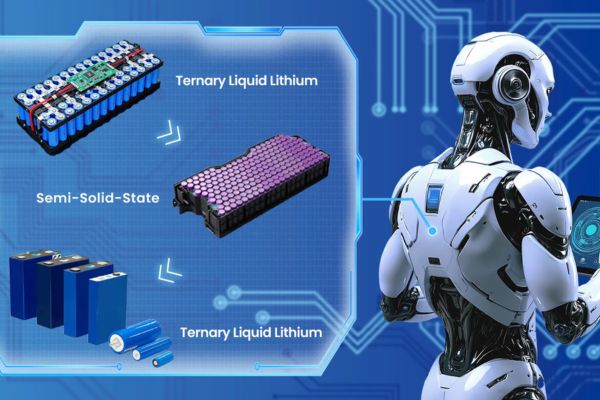
The global Humanoid Robot Battery Management Systems Market is emerging as a specialized segment within the rapidly developing humanoid robotics ecosystem. As robot manufacturers work toward deploying humanoid platforms in manufacturing, logistics, warehousing, and other commercial environments, reliable battery monitoring and control are becoming increasingly important.
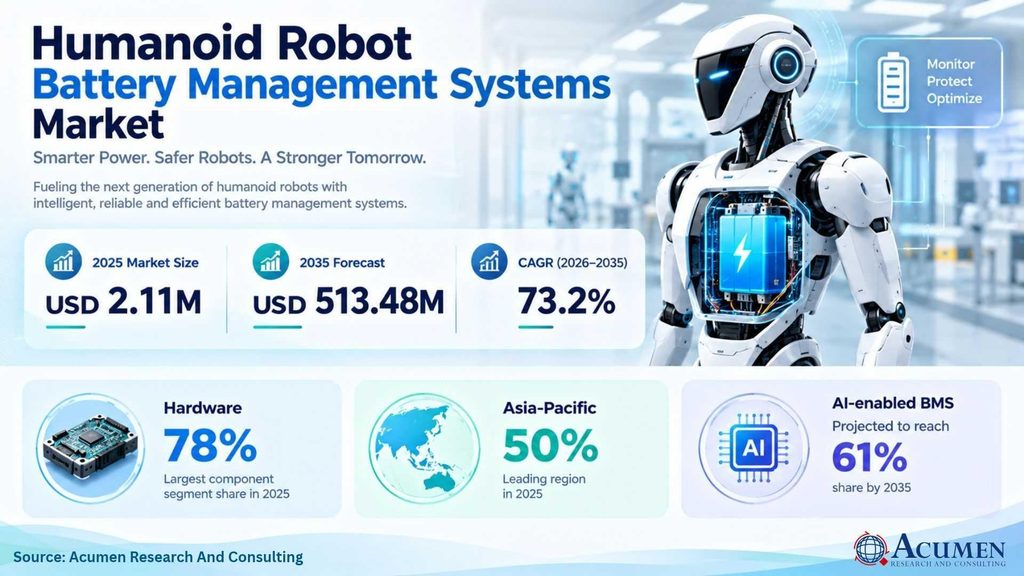
According to Acumen Research And Consulting, the humanoid robot battery management systems market was valued at USD 2.11 million in 2025 and is projected to reach USD 513.48 million by 2035, expanding at a compound annual growth rate (CAGR) of 73.2% from 2026 to 2035.
Battery management systems (BMS) monitor and manage the performance of rechargeable batteries. In humanoid robots, these systems help track voltage, current, temperature, state of charge, and battery health. They also provide protection against unsafe operating conditions and support effective energy delivery to motors, actuators, sensors, processors, and communication systems.
Unlike many stationary applications, humanoid robots experience highly variable power demands as they walk, balance, lift objects, manipulate tools, and process information. These changing loads increase the importance of accurate battery monitoring, responsive protection, and efficient energy management.
The market’s projected expansion reflects the potential growth of humanoid robot deployment and the increasing sophistication of the battery electronics and software needed to support these platforms.
What Is Driving the Humanoid Robot Battery Management Systems Market?
1. Growing Commercial Interest in Humanoid Robotics
Manufacturers and technology companies are exploring humanoid robots for activities that require mobility, manipulation, and interaction with environments originally designed for people. Potential applications include material handling, machine tending, inspection, warehouse operations, and selected repetitive manufacturing tasks.
As deployment moves from research and demonstrations toward commercial use cases, battery performance becomes a key operational consideration. Robot operators need predictable operating time, reliable power delivery, and effective monitoring to coordinate charging, maintenance, and daily work schedules.
This creates demand for battery management systems that can maintain battery safety and support consistent performance under variable workloads.
2. Increasing Demand for Battery Safety and Reliability
Humanoid robots combine batteries with sensitive electronic systems and powerful electromechanical components. Battery faults or thermal problems can affect the robot’s availability and may create safety concerns for nearby equipment and people.
BMS hardware typically includes voltage and current sensing, temperature sensors, control electronics, and protection mechanisms. Depending on the design, the system may also support cell balancing, fault detection, and communication with the robot’s central controller.
As robots become more capable and operate for longer periods, manufacturers are likely to place greater emphasis on battery diagnostics, fault reporting, and system-level validation.
3. Advances in Lithium-Ion Battery Technology
Battery chemistry and pack design influence the energy available to a humanoid robot, its weight, thermal characteristics, and operating duration. High-nickel nickel manganese cobalt (NMC) and nickel cobalt aluminum (NCA) chemistries are relevant where energy density is a major priority.
Lithium iron phosphate (LFP) batteries offer a different balance of cost, thermal stability, durability, and energy density. Solid-state and semi-solid-state technologies are also attracting research and development interest, although their commercial suitability depends on manufacturing readiness, cost, performance, and validation.
These developments increase the need for battery management systems that can accommodate different cell characteristics and operating requirements.
4. Demand for Intelligent Energy Management
Advanced BMS software can improve battery state estimation, identify abnormal behavior, and help operators understand battery condition over time. Intelligent and AI-enabled systems may use operational data to support predictive diagnostics, battery health estimation, and adaptive energy management.
Such capabilities can be valuable in humanoid robots because power demand varies with movement, payload, terrain, task intensity, and processor activity.
However, advanced algorithms must be validated against real operating data and integrated with reliable protection mechanisms. Intelligent software complements rather than replaces essential electrical safeguards.
Hardware Leads the Humanoid Robot Battery Management Systems Market
Hardware accounted for 78% of the market’s component segment in 2025, while software represented 22%.
Hardware: The Foundation of Battery Monitoring
Hardware includes battery monitoring circuits, current and voltage sensors, temperature sensors, controllers, protection components, and associated electronics. These components provide the measurements and control functions required to manage battery packs.
Hardware currently dominates because every BMS architecture requires physical monitoring and protection capabilities. Its performance affects measurement accuracy, response time, system integration, and reliability.
Software: An Increasingly Important Source of Differentiation
Software accounted for 22% of the component segment in 2025, with its share projected to reach 36% by 2035. Software capabilities include state-of-charge estimation, state-of-health monitoring, fault analysis, battery diagnostics, and communication with robot control systems.
As humanoid robots become more sophisticated, software may provide greater differentiation through predictive insights, adaptive power management, and integration with fleet monitoring platforms.
The growing role of software could also create opportunities for specialist developers working with battery manufacturers, robotics companies, and embedded-systems providers.
Centralized BMS Architecture Maintains Its Leading Position
Centralized BMS architecture held a 57% share in 2025. In this configuration, a central controller coordinates battery measurements, protection functions, and relevant communications.
Its relatively straightforward structure can be suitable for integrated battery packs where monitoring and control requirements are managed through a central unit.
Modular BMS architecture accounted for 29% of the market in 2025. Modular systems distribute monitoring and control functions across modules, potentially supporting flexible battery-pack designs and easier adaptation to different configurations. Its share is projected to reach 37% by 2035.
Distributed BMS architectures provide another option for applications where monitoring functions are distributed across battery components or modules.
The preferred architecture depends on battery size, electrical design, serviceability, communication requirements, and the robot manufacturer’s approach to system integration. As humanoid platforms diversify, demand may expand across all three architectures.
High-Nickel NMC/NCA Batteries Dominate the Chemistry Segment
High-nickel NMC/NCA battery systems accounted for 72% of the battery chemistry segment in 2025. Their importance reflects the emphasis on energy density in mobile robots, where battery weight and available space influence overall design.
Humanoid robots must supply energy to multiple systems, including motors, actuators, sensors, onboard computing, and communications. A battery pack must therefore balance energy availability with weight, packaging, thermal management, and safety requirements.
LFP batteries represented 13% of the chemistry segment in 2025, with their share projected to reach 15% by 2035. LFP may appeal to selected applications where durability, cost, and thermal characteristics are important.
Lithium polymer, solid-state and semi-solid-state, and other chemistries provide additional options as battery technology evolves. BMS providers will need to accommodate different charging profiles, cell characteristics, operating limits, and diagnostic requirements.
Swappable Battery Systems Gain Importance
Fixed or integrated battery BMS configurations dominated the battery configuration segment in 2025, with a 63% share. Integrated systems can be designed around a particular robot platform, allowing manufacturers to coordinate battery packaging, electronics, protection, and electrical connections.
However, swappable or removable battery BMS configurations are projected to increase their share from 37% in 2025 to 57% by 2035.
Battery swapping can potentially reduce interruptions associated with recharging, particularly in industrial and logistics environments where robot availability matters. Such systems also introduce additional requirements for connector durability, battery identification, state-of-charge verification, pack compatibility, and safe handling.
For fleet operators, the commercial value depends on the complete operating model, including the availability of charged batteries, charging infrastructure, maintenance procedures, and the time required to replace packs.
Battery Capacity and Voltage Trends
The 1–2.5 kWh Segment Leads
The 1–2.5 kWh battery capacity category accounted for 58% of the market in 2025. This segment reflects the need to balance operating energy, battery weight, physical dimensions, and power delivery in emerging humanoid robot platforms.
Its market share is projected to decline to 42% by 2035 as demand broadens across battery capacities.
The above 5 kWh segment is projected to register a CAGR of 91.7% from 2026 to 2035. Higher-capacity batteries could become more relevant for applications that require longer operating cycles or more energy-intensive tasks. Actual adoption will depend on whether additional energy capacity can be accommodated without compromising mobility, payload, and system efficiency.
48 V to Below 72 V Leads the Voltage Segment
The 48 V to below 72 V category held a 56% market share in 2025. This range reflects the use of mid-voltage battery configurations in humanoid platforms that require a balance between power delivery, electrical design, and component integration.
The 72 V to below 100 V segment is projected to increase its share from 11% in 2025 to 20% by 2035. The 100 V and above category is projected to rise from 4% to 11% over the same period.
These changes suggest a potential shift toward higher-voltage designs in selected applications. However, the appropriate voltage depends on system architecture, power requirements, insulation, protection, regulatory considerations, and the design of the robot’s motors and electronics.
Intelligent and AI-Enabled BMS Solutions Present a Major Opportunity
Conventional BMS solutions held an 84% share in 2025, reflecting their established role in battery monitoring, protection, and control. These systems remain essential for safe operation.
Intelligent and AI-enabled BMS solutions accounted for 16% of the market in 2025. Their share is projected to reach 61% by 2035, making them a significant area of expected market development.
Potential capabilities include:
- More accurate state-of-charge and battery health estimation.
- Predictive identification of abnormal battery behavior.
- Adaptive energy management based on changing robot workloads.
- Battery performance analysis across robot fleets.
- Improved coordination between battery controls and robot systems.
- Data-supported maintenance and battery replacement planning.
The opportunity is not limited to standalone BMS software. Intelligent features can be incorporated into battery controllers, embedded software, fleet-management platforms, and broader robotics operating systems.
Industrial and Manufacturing Applications Lead Demand
Industrial and manufacturing applications accounted for 42% of the humanoid robot BMS market in 2025. Factories are an important potential deployment environment because many facilities contain repetitive operations, material movement, inspection activities, and tasks that require interaction with existing workspaces.
Logistics and warehousing represented 28% of the market. Humanoid robots are being explored for material handling, picking assistance, and other warehouse activities. These applications can involve frequent movement and changing power demand, increasing the importance of battery diagnostics and operating-time estimation.
Healthcare and caregiving accounted for 8%, while retail and hospitality represented 7%. Research and education accounted for 6%, domestic and personal applications for 5%, and other applications for 4%.
Commercial adoption across these categories will depend on robot capability, reliability, safety, cost, and the ability to demonstrate value in real operating environments.
Regional Outlook: Asia-Pacific Leads the Market
Asia-Pacific
Asia-Pacific accounted for 50% of the global humanoid robot battery management systems market in 2025, equivalent to approximately USD 1.06 million. Its position is supported by battery manufacturing capabilities, electronics supply chains, robotics research, and investment in humanoid robot development.
The region’s market share is projected to increase to 54% by 2035. Revenue is forecast to reach USD 277.28 million by 2035, representing a CAGR of 74.6% from 2026 to 2035.
China, Japan, and South Korea are important markets to monitor because of their established manufacturing ecosystems and robotics activities. India also presents an emerging opportunity as industrial automation, electronics manufacturing, and robotics capabilities develop.
North America
North America accounted for 37% of the broader humanoid robot battery market in 2025, according to Acumen Research And Consulting’s related report. This reflects a strong ecosystem of robotics companies, AI developers, advanced manufacturers, and technology investors.
The United States is an important market for humanoid robot development and commercialization. As manufacturers move toward more extensive deployments, demand for battery systems with dependable monitoring, diagnostics, and energy management could expand.
Middle East & Africa
The Middle East & Africa region is projected to be the fastest-growing regional market for humanoid robot battery management systems, with a CAGR of 79.2% from 2026 to 2035. The region accounted for 2.2% of global market revenue in 2025, equivalent to approximately USD 0.05 million.
The high forecast growth rate reflects potential expansion from a small base as investment in automation, advanced manufacturing, and robotics increases. Actual market development will depend on the pace of humanoid robot deployment and the establishment of supporting technical and commercial ecosystems.
Competitive Landscape: Companies to Watch
The humanoid robot battery management systems market spans specialist BMS developers, battery manufacturers, electronics suppliers, and robotics companies that integrate battery controls into their platforms.
Relevant companies and ecosystem participants include:
- Texas Instruments: Battery monitoring, embedded control, and power-management semiconductor solutions.
- Analog Devices: Battery monitoring and measurement technologies for battery management applications.
- NXP Semiconductors: Automotive and industrial battery management and embedded control technologies that may be relevant to robotics system designs.
- Infineon Technologies: Power semiconductors, sensing, and control components used in battery and energy-management systems.
- Renesas Electronics: Embedded processors, analog components, and power-management technologies.
- CATL: Battery technology and manufacturing capabilities, with growing involvement in industrial and robotics-related ecosystems.
- Samsung SDI: Advanced battery research and manufacturing, including technologies relevant to future robotic platforms.
- LG Energy Solution: Lithium-ion battery technologies and battery-system expertise.
- EVE Energy: Lithium-ion battery manufacturing and energy-storage technology.
- Sunwoda Electronic: Battery cells and battery-system solutions.
These companies participate in different parts of the value chain and should not be interpreted as having identical exposure to the dedicated humanoid robot BMS market. The degree of direct participation varies by product portfolio, partnership, and application.
Competitive differentiation is likely to depend on monitoring accuracy, protection capabilities, compact design, power efficiency, integration with robot controls, software intelligence, and support for different battery chemistries.
Key Challenges Facing the Market
Despite strong projected growth, the market faces several challenges.
Early-stage commercialization: Humanoid robot deployment remains an evolving market, and actual demand for dedicated BMS solutions will depend on production volumes and commercial adoption.
Safety and reliability requirements: Battery systems must perform consistently under changing electrical loads, vibration, movement, and thermal conditions.
Weight and space constraints: BMS electronics must fit within compact robot architectures while providing adequate monitoring and protection.
Battery chemistry diversity: Different chemistries require suitable monitoring, charging, protection, and diagnostic strategies.
System integration: BMS providers must coordinate with battery-pack designers, robot manufacturers, embedded software teams, and fleet operators.
Cost pressures: Suppliers must balance advanced functionality with affordability, particularly as robot manufacturers seek scalable commercial platforms.
Addressing these challenges will require close collaboration among battery suppliers, electronics manufacturers, robotics developers, and system integrators.
Future Outlook
The humanoid robot battery management systems market is projected to grow rapidly as humanoid robotics advances from development and pilot projects toward broader commercial use.
The projected increase from USD 2.11 million in 2025 to USD 513.48 million by 2035 highlights the potential for specialized battery monitoring and control technologies as robot platforms become more sophisticated.
Hardware will remain essential, while software and intelligent battery management are expected to gain importance. Swappable battery configurations, advanced diagnostics, and support for diverse battery technologies could also create opportunities for specialized suppliers.
For market participants, the key opportunity is to develop BMS solutions that combine dependable protection with accurate battery information, efficient power management, and straightforward integration into humanoid robot platforms. The scale of future growth will ultimately depend on the pace of robot commercialization, battery technology progress, and the ability of manufacturers to demonstrate reliable performance in real-world applications.
Frequently Asked Questions
1. What is the size of the Humanoid Robot Battery Management Systems Market?
The global humanoid robot battery management systems market was valued at USD 2.11 million in 2025, according to Acumen Research And Consulting.
2. What is the projected market size by 2035?
The humanoid robot battery management systems market is projected to reach USD 513.48 million by 2035, growing at a CAGR of 73.2% from 2026 to 2035.
3. What is a battery management system in a humanoid robot?
A battery management system monitors and manages the robot’s battery, tracking parameters such as voltage, current, temperature, state of charge, and battery health. It also supports protection and power-management functions.
4. Which component segment leads the market?
Hardware led the component segment with a 78% share in 2025, reflecting demand for monitoring circuits, sensors, controllers, and protection components.
5. Which battery chemistry dominates the market?
High-nickel NMC/NCA chemistry led the battery chemistry segment with a 72% share in 2025.
6. Which region dominates the market?
Asia-Pacific led the market with a 50% share in 2025, supported by its battery manufacturing ecosystem, electronics supply chains, and humanoid robotics investment.
7. Which application leads demand?
Industrial and manufacturing applications accounted for 42% of the market in 2025, followed by logistics and warehousing at 28%.
8. What are the major trends shaping the market?
Key trends include intelligent and AI-enabled BMS, predictive battery diagnostics, swappable battery configurations, advanced battery chemistries, and increasing integration between battery controls and robot operating systems.
9. Why is battery management important for humanoid robots?
Humanoid robots experience changing power demands as they move, balance, lift objects, and process data. Battery management helps monitor battery condition, support safe operation, and provide information needed to manage operating time and maintenance.