
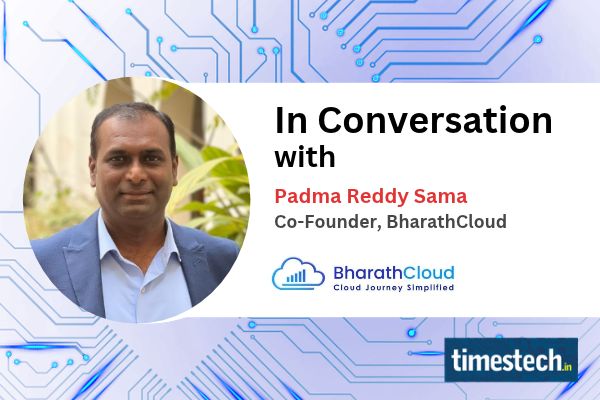
In an interview, Padma Reddy Sama, Co-Founder, BharathCloud, speaks with TimesTech about the infrastructure challenges facing India’s data centres, including power, land, water and connectivity. He discusses renewable energy, the priorities for a national data centre policy, creating opportunities for domestic cloud providers, the importance of data sovereignty, and BharathCloud’s plans to expand its sovereign cloud and AI infrastructure footprint across India and in select international markets.
Read the full interview here:
TimesTech: What are the key challenges in building and operating data centres in India, particularly around power, land, water, and connectivity?
Padma: The challenge is not just to find land and get the plant built, but to find all the surrounding infrastructure at the same time. Data centres need power all the time. Sometimes you have a window where you are losing capacity on the grid, so you are also adding the element of time to the connectivity transmission time factor, which makes it a little more challenging. Land itself may be a challenge, especially in some of the existing Indian zones like Chennai, Mumbai, etc., where it might be a bit less available and permissions may take time. Water is usually outside the scope of planning, but high-density AI loads also put pressure on water resources.
Similarly, connectivity is as much as water; reliable fibre routes, low latency, backup, and not only that one 100-gigabit-speed link. A 2026 report by CEEW suggests that data centres in India alone could draw as much as 150 billion litres of water annually, which could be more than double by 2030.
Green data centres help address the growing concerns surrounding energy consumption, environmental impact and sustainability. Green data centres opt for low-emission materials and practices that help ensure that the infrastructure process itself minimises the release of harmful substances into the environment
TimesTech: With data centre power demand expected to reach 17 GW by 2031-32, how can India balance energy needs with consumer demand?
Padma: The solution lies in managing data centre power demand in the context of the country’s entire electricity demand, rather than it being a new form of demand for a different class of consumption. The CEA predicts data centre demand can ramp up to 17GW by 2031-32, which would be a huge demand on the country’s power. Rather than relying on homes and other sectors to share their power, the focus should be on strengthening power availability through alternative sources.
Data centre operators should bring more renewable power into the system – it can be through open-access deals with batteries or other reliable sources of energy, like solar and wind. Data centres can also be situated in locations that have comparatively higher renewable power and better grid capacity. The objective should be to grow the computing power without leaving other consumers of cheap, reliable power behind.
TimesTech: What should the upcoming national data centre policy prioritise to support domestic cloud providers serving Indian customers?
Padma: The policy should support infrastructure and operations and “level the playing field” by ensuring that domestic cloud players get an ecosystem similar to what global players operate. Clearances, assured power connectivity, land with easy access, pre-approved locations and affordable high-capacity fibre connectivity are among the priority requirements. Clearances for power, grid, etc. should not drive project costs so high that the project cannot be viable at the outset.
Domestic cloud providers will also need investments in servers, storage, network, AI hardware, and, not least, incentives on real capacity build and services. NITI Aayog Data Centre Evaluation Framework with a focus on infrastructure readiness, resource efficiency and outcomes could be a good starting point. A nationally aligned policy with clear benchmarks, targets, and incentives should be framed and adopted to aid cloud providers and data centre operators as distinct but complementary actors.
TimesTech: How can India ensure a level playing field for domestic cloud providers while attracting investments from global hyperscalers?
Padma: India needs to accept global hyperscalers; they can provide capital, technology, infrastructure and demand. But ‘domestic’ cloud service providers also should not be marginalised by regulators and policymakers when it comes to infrastructure, access to capital, energy, or business opportunity. A level playing field means equal access to the Indian market, and not only to the global giants.
Market-based incentives should be linked to real, measurable targets in the economy, environment, infrastructure and skill development. Indian cloud providers can be tapped to cater not only to start-ups and Indian private sector enterprises but also to Indian public sector organisations. Both these variants can be enabled side-by-side and can complement each other.
TimesTech: Why is data sovereignty important for Indian businesses, and what advantages do India-based cloud providers offer?
Padma: Data sovereignty means knowing where business data is stored, understanding who has access to it, and knowing which legislation impacts how it is used. Data sovereignty is especially relevant for organisations operating in the healthcare, financial services, or government sectors, but it is also relevant for any business that relies on its infrastructure and data ecosystem.
Some of the benefits of hosting data in India include understanding the Indian regulatory environment and working more closely with customer organisations. Hosting data within India helps with relevant data localisation requirements and reduces reliance on infrastructure located outside India. Data sovereignty is not solely about where the server physically resides. Access controls, encryption, security practices, data backup policies, and the level of transparency with regard to data processing are equally important factors.
TimesTech: What are BharathCloud’s expansion plans, and how can domestic providers strengthen India’s AI and data centre infrastructure?
Padma: Bharath Cloud is working towards expanding our AI-ready sovereign cloud footprint across India and a few select international markets. We have brought JLL on board as our consulting partner for this upcoming expansion. We are also expanding our Hyderabad footprint through our partnership with CtrlS Datacenters to expand our Cloud and AI infrastructure skills.
Providers must do more than just establish data centres – India requires a robust cloud platform, AI compute, storage, networking, and infrastructure management ecosystem. This includes offering scalable compute resources to enterprises that lack the scale and resources to build their own infrastructure. It also includes cost predictability, local talent and skill-building, and infrastructure/service independence from imports. With the rise of AI, we have the opportunity to build dependable infrastructure supporting Indian businesses and India’s wider digital growth.