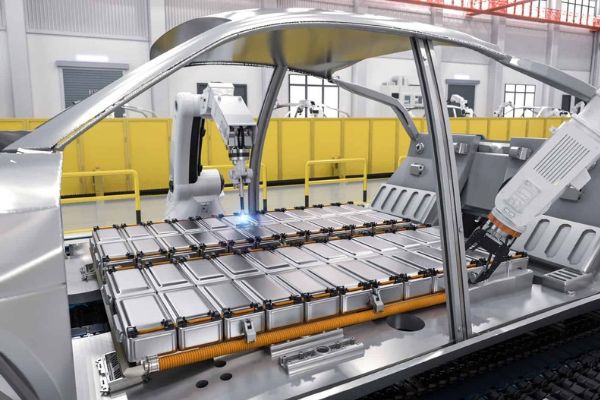
The rapid expansion of electric vehicle (EV) adoption worldwide is creating a significant opportunity for the battery recycling industry. As automakers increase electric vehicle production and battery manufacturers expand manufacturing capacity, the need for sustainable battery disposal, material recovery, and circular supply chains is becoming increasingly important.
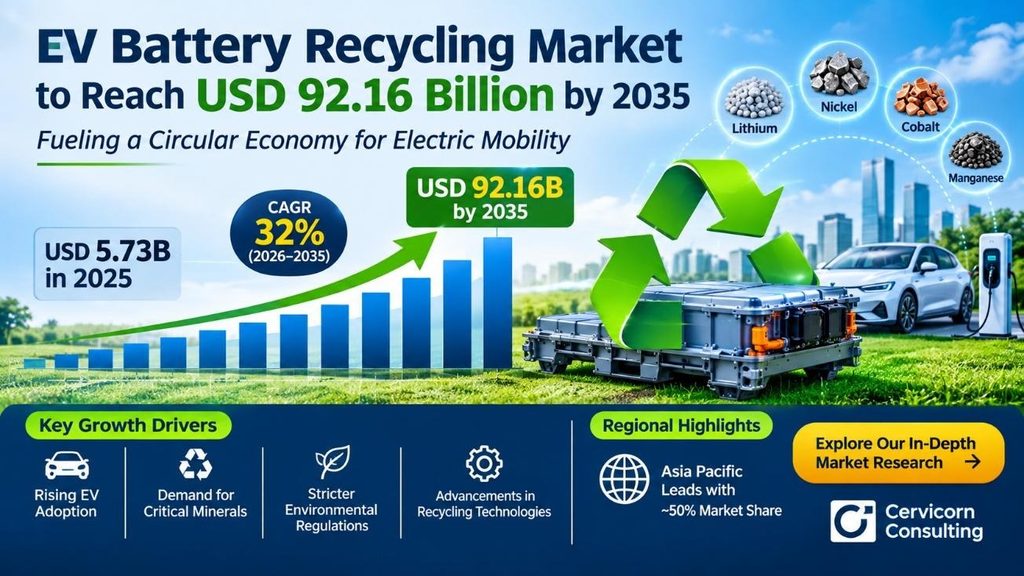
According to Cervicorn Consulting, the global EV battery recycling market was valued at USD 5.73 billion in 2025 and is projected to grow from USD 7.56 billion in 2026 to approximately USD 92.16 billion by 2035, registering a compound annual growth rate (CAGR) of 32% during 2026–2035.
The market’s expansion is being supported by rising demand for lithium, nickel, cobalt, and manganese, increasing volumes of end-of-life electric vehicle batteries, and stricter government regulations concerning battery waste management. Technological advancements in hydrometallurgical processing, direct recycling, and battery material recovery are further strengthening the industry’s growth prospects.
Battery Recycling Becomes Critical to the Global EV Supply Chain
Electric vehicle batteries contain valuable materials that can be recovered and reused in the production of new battery cells. Recycling helps reduce dependence on virgin mineral extraction, improves resource efficiency, and supports the development of a circular battery economy.
As the global EV fleet expands, battery manufacturers and recyclers are increasingly focusing on recovering high-value materials from manufacturing scrap, damaged batteries, and retired EV battery packs.
Lithium, nickel, cobalt, manganese, and graphite are among the major materials targeted through recycling processes. Their recovery can help strengthen supply chain security while reducing the environmental impact associated with conventional mining and mineral processing.
Automotive OEMs, battery manufacturers, and recycling companies are also developing strategic partnerships to establish closed-loop recycling systems. These arrangements enable recovered materials to re-enter battery manufacturing, creating a more integrated and sustainable supply chain.
Advanced Recycling Technologies Transform Battery Material Recovery
Technological innovation is playing a major role in improving the efficiency, economics, and sustainability of EV battery recycling.
1. Hydrometallurgical Recycling
Hydrometallurgical recycling uses chemical solutions to extract valuable metals from used batteries. The process can achieve high recovery rates and produce materials with the purity required for battery manufacturing. Its relatively lower energy requirements compared with conventional high-temperature processing make it an important technology for the recycling industry.
2. Direct Battery Recycling
Direct recycling is gaining attention because it aims to preserve and restore the structure of battery cathode materials instead of completely breaking them down into individual metals. This approach can reduce material losses, energy consumption, and processing requirements.
The technology is particularly relevant for lithium iron phosphate (LFP) batteries, where recovering and restoring cathode functionality can improve recycling economics.
3. Pyrometallurgical Recycling
Pyrometallurgical recycling uses high-temperature processes to recover valuable metals from battery waste. It is an established recycling method, although energy consumption and the recovery of certain materials remain important considerations.
4. Mechanical Recycling
Mechanical recycling involves the physical dismantling, separation, crushing, and sorting of battery components. It is frequently used as an initial processing stage before advanced material recovery technologies are applied.
The development of automated dismantling, artificial intelligence based sorting, and digital battery tracking is expected to improve operational efficiency and worker safety.
Asia Pacific Dominates the EV Battery Recycling Market
Asia Pacific accounted for approximately 50% of global EV battery recycling market revenue in 2025, supported by its strong electric vehicle manufacturing ecosystem, battery production capacity, and growing investments in recycling infrastructure.
The regional market was valued at USD 2.87 billion in 2025 and is projected to exceed USD 46.08 billion by 2035.
China remains a major contributor due to its extensive EV production base, battery manufacturing capabilities, and regulatory focus on battery lifecycle management. The country’s battery recycling ecosystem is increasingly emphasizing traceability, material recovery, and integration between battery manufacturers and recyclers.
India is also emerging as an important market as electric mobility adoption increases and the country seeks to strengthen domestic access to critical battery materials.
India’s dependence on imported lithium, cobalt, nickel, and other battery minerals is creating opportunities for domestic recycling companies to recover valuable materials from manufacturing scrap and end-of-life batteries. Investments in hydrometallurgical processing, direct recycling, and battery-grade material refining can support the development of a stronger domestic battery supply chain.
North America Emerging as a High-Growth Recycling Market
North America is expected to experience significant growth during the forecast period, with the regional EV battery recycling market projected to increase from USD 1.09 billion in 2025 to approximately USD 17.51 billion by 2035.
The expansion of EV manufacturing, investments in battery gigafactories, government incentives, and increasing focus on domestic critical mineral supply chains are supporting regional growth.
The United States is witnessing growing collaboration between automotive manufacturers and battery recycling companies to establish closed-loop material recovery systems. Companies such as Redwood Materials, Li-Cycle, Cirba Solutions, and Ascend Elements are contributing to the development of the domestic battery recycling ecosystem.
These initiatives are intended to improve access to recovered lithium, nickel, cobalt, and other materials while reducing dependence on international mineral supply chains.
NMC and LFP Battery Chemistries Create Different Recycling Opportunities
By battery chemistry, lithium nickel manganese cobalt oxide (NMC) accounted for approximately 40% of the EV battery recycling market in 2025.
NMC batteries contain valuable nickel and cobalt, making material recovery economically attractive. Their use in electric vehicles requiring higher energy density and longer driving ranges is supporting demand for specialized recycling processes.
Meanwhile, lithium iron phosphate (LFP) batteries are expected to witness rapid growth in recycling demand. Their increasing adoption in electric passenger vehicles, commercial vehicles, and energy storage applications is creating a future stream of recyclable battery materials.
Although LFP batteries do not contain the same quantities of high-value nickel and cobalt as NMC batteries, improvements in direct recycling and material recovery technologies are expected to strengthen their recycling economics.
Manufacturing Scrap Creates Immediate Recycling Opportunities
Battery manufacturing scrap represented approximately 60% of the EV battery recycling market by battery source in 2025.
The rapid expansion of battery manufacturing facilities is generating substantial quantities of production waste, including defective cells, electrode materials, and other manufacturing residues.
Unlike end-of-life EV batteries, manufacturing scrap can often be collected and processed through more predictable supply chains. Its relatively consistent composition and availability make it an attractive source of recyclable materials.
However, end-of-life EV batteries are expected to become an increasingly important growth segment as the number of electric vehicles reaching retirement increases over the coming years.
Second-Life Batteries Open New Business Opportunities
Battery recycling is not limited to recovering raw materials. Retired EV batteries can also create value through second-life applications.
Many EV batteries retain approximately 70%–80% of their original capacity when removed from vehicles, depending on their age, usage patterns, chemistry, and operating conditions.
After appropriate testing, grading, and safety assessment, these batteries may be repurposed for stationary energy storage applications, including renewable energy integration, commercial backup power, and grid-support systems.
Second-life battery applications can extend battery utilization before final material recovery, improving resource efficiency and creating additional business opportunities for battery manufacturers, energy storage developers, and recycling companies.
Regulatory Developments Strengthen the Battery Circular Economy
Government regulations are becoming an important driver of the global EV battery recycling market.
The European Union’s Battery Regulation establishes requirements relating to battery sustainability, collection, recycling efficiency, material recovery, and recycled content.
In India, the Battery Waste Management Rules, 2022, provide an extended producer responsibility framework for battery manufacturers and producers, supporting organized collection, recycling, and environmentally responsible battery disposal.
China is also strengthening battery lifecycle management and traceability requirements to improve the collection and recovery of used EV batteries.
These regulatory developments are encouraging automotive OEMs, battery manufacturers, and recycling companies to invest in compliant recycling infrastructure and sustainable material recovery technologies.
Leading Companies Strengthen Their Competitive Positions
The global EV battery recycling industry includes battery manufacturers, material technology companies, specialist recyclers, and resource recovery businesses.
Some of the prominent companies operating in the market include:
- CATL
- GEM Co., Ltd.
- Umicore
- Li-Cycle Corp.
- Glencore
- Attero Recycling
- Redwood Materials
- Cirba Solutions
- Ecobat
- LOHUM
These companies are focusing on recycling capacity expansion, advanced material recovery technologies, strategic partnerships, and closed-loop battery supply chains.
Competition is increasingly shaped by recovery efficiency, processing costs, access to battery feedstock, recovered material quality, and long-term agreements with automotive and battery manufacturers.
Challenges That Could Influence Market Expansion
Despite strong growth prospects, the EV battery recycling industry faces several operational and economic challenges.
The high capital investment required to establish advanced recycling facilities can limit market entry for smaller companies. Recycling economics are also influenced by fluctuations in lithium, nickel, and cobalt prices, which affect the commercial value of recovered materials.
Battery pack designs, cell formats, and chemistries vary across manufacturers, making automated dismantling and standardized recycling processes difficult.
Additionally, damaged or improperly handled lithium-ion batteries can create thermal runaway and fire risks during transportation, storage, and processing. Companies must therefore invest in specialized safety systems, battery discharge technologies, and trained personnel.
Outlook: Building a Circular and Sustainable EV Battery Ecosystem
The EV battery recycling market is expected to become an increasingly important part of the global electric mobility value chain. Rising EV adoption, expanding battery manufacturing capacity, growing demand for critical minerals, and stricter environmental regulations will create long-term opportunities for recycling technology developers and material recovery companies.
Advancements in direct recycling, hydrometallurgical processing, automated battery dismantling, and second-life battery applications are expected to reshape the competitive landscape.
For automotive OEMs, battery manufacturers, investors, and recycling companies, developing reliable access to recyclable battery materials and establishing closed-loop supply chains will become essential to long-term competitiveness.