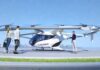



The Emerging Take-Off of Advanced Air Mobility
As urban congestion, climate concerns, and logistical bottlenecks intensify globally, traditional transport solutions are nearing their limits. Enter the concept of Advanced Air Mobility (AAM) — a blend of electric propulsion, vertical take-off and landing (VTOL) or hybrid aircraft, and autonomous/remote-piloted systems — poised to redefine how people and cargo move.
According to the latest study by Acumen Research and Consulting (ARC), the global Advanced Air Mobility Market — long considered niche — is now on the threshold of mainstream relevance. Their forecast suggests a leap from USD 14.5 billion in 2025 to a staggering USD 132.2 billion by 2035, at a compounded annual growth rate (CAGR) of 24.7%.

Understanding What AAM Encompasses
Before diving into the advanced air mobility market specifics, it’s useful to clarify what falls under the umbrella of Advanced Air Mobility Market:
- Vehicle Types & Products: This includes fixed-wing, rotary-blade (e.g. multirotor/tilt-rotor) and hybrid aircraft.
- Propulsion Systems: From gasoline-based early designs to today’s prevailing electric and hybrid propulsion systems.
- Applications: A variety — cargo transport (logistics, last-mile, medical delivery), passenger air-taxis / air-shuttles, mapping & surveying, special missions (emergency services, disaster relief), surveillance & monitoring, and more.
- End-Users: Both commercial and government / military.
- Supporting Infrastructure & Components: Hardware (propulsion units, batteries, avionics, airframes), software — including autonomy, traffic management, fleet & maintenance management.
This breadth reflects why AAM market is not merely a subset of aviation — it’s an ecosystem combining aerospace, urban mobility, IoT/AI, and smart-city infrastructure.
Why the Advanced Air Mobility Market Is Positioned for Explosive Growth
1. Surge in Technological Readiness & Electric Propulsion
One of the foremost catalysts for the Advanced Air Mobility Market Growth is the rapid progress in electric propulsion, battery technology, and autonomous navigation — making eVTOLs and hybrid aircraft more viable than ever.
Compared to conventional helicopters or small aircraft, eVTOLs promise significantly reduced noise, zero or low emissions, lower operational costs, and hence better urban-air viability.
ARC’s breakdown shows hardware already accounts for 82% of the AAM market share (2025), while software — autonomy systems, traffic management, maintenance — is the fast-growing slice, pointing to rising demand for sophisticated digital infrastructure.
2. Diverse Application Potential — Beyond Just Air Taxis
While passenger transport (air taxis) often captures headlines, the Advanced Air Mobility Market Analysis reveals a broader canvas:
- Cargo Transport — currently dominant, accounting for ~28% of advanced air mobility market share. This reflects rising adoption of eVTOL drones and autonomous aircraft for last-mile logistics, medical deliveries, and supply chain optimizations.
- Surveillance & Monitoring, Infrastructure Inspection, Mapping & Surveying, Emergency Services / Special Missions — all rapidly gaining traction. eVTOL/drones offer quick deployment, flexibility, and often lower cost compared to traditional aerial solutions.
This diversified demand significantly underpins the forecasted market growth, making AAM less dependent on just consumer adoption and more resilient across verticals.
3. Regional Momentum — Asia Pacific & North America Leading the Charge
- North America currently holds ~36% of the global AAM market share (2025), leveraging advanced aerospace infrastructure, regulatory support (e.g. from the Federal Aviation Administration (FAA)), and strong private-sector/R&D investment.
- Asia Pacific, though smaller at ~22% market share in 2025, is projected to be the fastest-growing region with a CAGR of 26.2% from 2026 to 2035 — driven by urbanization, growing demand for efficient inter-city mobility, and aggressive investment in smart-city and logistics infrastructure.
This global spread suggests AAM is not confined to developed economies — emerging and fast-urbanizing regions stand to benefit significantly.
4. Strong Commercial & Governmental Buy-In
About 61% of the market share is attributed to commercial uses (logistics, surveying, urban mobility), while 39% stems from government & military applications (border surveillance, disaster response, emergency services).
The dual nature of demand — public and private — gives the Advanced Air Mobility Market a robust foundation. Public-private partnerships, regulatory progress (e.g. for eVTOL certification), and investments in air-traffic management systems are shaping a supportive ecosystem.
Advanced Air Mobility Market Challenges
While the forecast for the Advanced Air Mobility Market Size is optimistic, realization depends on addressing key constraints:
- Airspace Integration & Regulatory Complexity: Integrating dense low-altitude traffic (eVTOLs, drones) with current aviation systems is non-trivial. Certification, pilot/crew licensing, collision-avoidance systems, and harmonized international regulations remain in flux.
- Infrastructure Overhaul Needed: For AAM to scale, cities and regions must establish vertiports, charging stations / maintenance facilities, real-time traffic management — representing massive upfront costs and regulatory approvals.
- Battery & Energy Limitations: Current battery technology limits payload, range, and turnaround time — constraints that affect passenger-air taxi viability and long-haul cargo missions. Hybrid propulsion mitigates some of these limitations, but adds complexity/cost.
These obstacles underline that while AAM’s potential is exciting, the road to full commercial viability will likely be gradual, requiring coordinated efforts from regulators, industry players, infrastructure developers, and investors.
Advanced Air Mobility Market Trends and Strategic Opportunities
Given the current dynamics, several trends and strategic opportunities emerge for stakeholders ready to engage with Advanced Air Mobility:
• Rise of Hybrid & Multi-Modal Air Vehicles
While pure-electric eVTOLs are prominent, hybrid propulsion platforms — combining e-propulsion with combustion/turbine engines — are gaining momentum. According to ARC, hybrid systems already account for 20% of advanced air mobility market product share and are increasingly favored for longer-range missions and regional air mobility.
These hybrid platforms could be critical for cargo logistics, inter-city travel, and regions where charging infrastructure is nascent.
• Software & Digital Infrastructure as Key Differentiators
With hardware costs dominant today (82% share), software — autonomy, UTM (Unmanned Traffic Management), traffic deconfliction, predictive maintenance — is the fastest-growing segment (18%).
Startups and tech firms focusing on fleet management, drone-to-ground communications, AI-powered navigation systems, and data analytics are likely to play central roles in realizing scalable AAM market.
• Cargo & Logistics — The First Scalable Use Case
Cargo transport (logistics, last-mile delivery, medical supply, emergency response) accounts for 28% of current application share in advanced air mobility market and presents a low-barrier entry compared to passenger transport, given regulatory and safety challenges.
Especially in densely populated urban centers or regions with poor ground infrastructure, eVTOL/drone-based cargo delivery can leapfrog traditional logistics — offering speed, flexibility, and sustainability.
• Emerging Market Opportunity in Asia Pacific, Especially India & Southeast Asia
With rapid urbanization, congestion challenges and inadequate ground transport infrastructure, many Asia-Pacific cities stand to gain from AAM. The region is projected to grow at a 26.2% CAGR to 2035.
Countries like India, with a growing startup and aerospace ecosystem, could potentially leapfrog traditional transport constraints and embrace aerial mobility — provided regulatory, infrastructural, and investment support align.
• Government, Defense & Public-Service Use Cases — Catalysts Beyond Commercial Markets
Government & Military end-use constitutes ~39% of the current AAM market share.
Defense, border security, disaster response, medical evacuation, and surveillance are high-value use cases — often with fewer regulatory hurdles than passenger transport. These segments could sustain demand even if consumer adoption lags.
Why These Projections Matter — For Investors, Cities, and Innovators
The projection of advanced air mobility market to USD 132.2 billion by 2035 signals that advanced air mobility is no longer a speculative “flying taxi” dream — it is rapidly evolving into a multi-billion-dollar industry with broad implications for urban planning, logistics, defense, smart cities, and sustainability.
For investors, this represents an opportunity akin to early-stage automobile or renewable-energy markets. Early investments in battery-tech, vehicle manufacturing, software/AI flight systems, vertiport infrastructure, and regulatory-compliance platforms may yield high growth returns if the AAM market matures as forecast.
The Road Ahead
That said, the path is not free of obstacles. As the Advanced Air Mobility Market Analysis indicates, scaling AAM will depend heavily on:
- Regulatory alignment across regions (airspace integration, certification standards, safety & privacy norms).
- Infrastructure investment — vertiports, charging/maintenance stations, traffic-management systems.
- Advances in battery / propulsion tech to ensure sufficient range, payload, speed, and turnaround.
- Public acceptance and safety assurances — especially for passenger-carrying operations.
- Integration of AAM with existing urban mobility and logistics frameworks — to avoid creating a parallel, isolated transport system.
How these challenges are addressed over the next 5–10 years will shape whether AAM becomes a futuristic novelty or a tangible pillar of 21st-century mobility.
The Advanced Air Mobility Market, as projected by Acumen Research and Consulting, stands at the cusp of dramatic expansion. The path from USD 14.5 billion in 2025 to over USD 132.2 billion by 2035 reflects not just technological optimism — but realistic alignment of demand, investment, regulatory support, and evolving urban needs.
Yet, the journey is complex — requiring harmony between aircraft manufacturers, software developers, regulators, infrastructure planners, logistics companies, and end-users. For those who navigate wisely, AAM presents perhaps the greatest shift in mobility since the invention of commercial aviation.
For readers who wish to explore the segmentation, regional breakdowns, trends and full market forecast underpinning these insights, request a detailed sample pages of Advanced Air Mobility Market Report by Acumen Research and Consulting provides a comprehensive resource.