


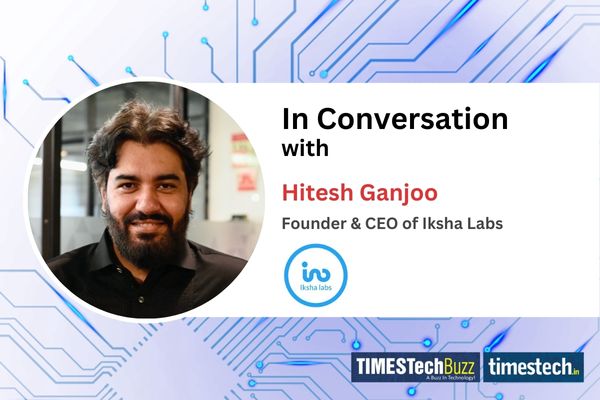
In an interview with TimesTech, Hitesh Ganjoo, Founder & CEO of Iksha Labs, shared insights on how AI agents and agentic workflows are transforming industries like healthcare and fintech. He spoke about balancing AI autonomy with human oversight, the challenges and strengths of building a bootstrapped venture, and the future of immersive technologies like AR, VR, and mixed reality converging with AI to create impactful enterprise solutions.
Read the full interview here:
TimesTech: Iksha Labs has been at the forefront of developing intelligent AI agents and agentic workflows. How do you see AI agents shaping the future of industries like healthcare and fintech in the next 5–10 years?
Hitesh: Agentic workflows are moving from dashboards to real workstreams. In healthcare, expect ambient intake and triage, clinical documentation that writes itself, and continuous care navigation, all with audit trails and consent baked in. In fintech, agents will orchestrate KYC/AML checks, reconcile ledgers, and run collections and retention playbooks with human-level nuance but machine-level consistency. The step-change isn’t just lower cost; it’s shorter cycle times, fewer errors, and measurably better outcomes. The winning stacks will be composable (plug into EHR/core banking), governed (policy-first, explainable), and hybrid-deployed (cloud + on-prem/edge for compliance).
TimesTech: You’ve often spoken about AI as a channel for more human-driven problem-solving. How do you envision the balance between AI autonomy and human oversight evolving in workplaces?
Hitesh: We design with a simple rule: humans set intent and constraints; agents execute within guardrails. Practically, that means:
- Confidence thresholds & escalation (agent acts below ₹X risk, routes to a human above it)
- Policy engines (hard constraints for safety, privacy, and brand voice)
- Full observability (session replays, rationales, and immutable logs)
- Progressive trust (sandbox → supervised → limited autonomy → periodic audit). This keeps speed where it’s safe and preserves judgment where it matters.
TimesTech: Unlike many startups that rely heavily on funding, Iksha Labs has been built as a successful bootstrapped venture. What were the biggest challenges and advantages of following this path?
Hitesh: Bootstrapping is a feature, not a bug. With our own cash flows, we had to ship value early, price for outcomes, and say no to vanity features. The upside: healthier unit economics, uncomfortable honesty about what customers actually use, and a culture that measures, iterates, and owns outcomes. The trade-offs are real—slower brand spend and hiring—but we gained something more valuable: optionality and focus. When every rupee is earned, your roadmap is written by the customer, not the boardroom.
TimesTech: Iksha Labs has developed AI solutions ranging from medical imaging systems to AI hiring and call agents. Could you share a case where one of your solutions created a tangible impact on efficiency, cost, or outcomes?
Hitesh:
- Healthcare (patient access & triage): In a recent IVF access deployment, our voice agent handled first-response + triage with sub-second turn-taking, reducing manual call load and cutting no-shows through proactive reminders and eligibility checks. Early results indicated meaningful reductions in no-shows and faster slot utilization, with staff time reallocated to high-touch cases.
- Fintech (collections & servicing): Our agentic workflow runs risk-tiered outreach, contextual scripts, and payment link follow-through. We’ve seen lower cost per connected resolution and higher reach rates while keeping humans for complex negotiations. The playbook is consistent, compliant, and continuously improved via closed-loop analytics.
TimesTech: With your experience across multiple startups and industries, how has your leadership philosophy shaped Iksha Labs’ culture of innovation and iteration?
Hitesh: My philosophy is simple: reduce theory-to-reality latency. We run small, autonomous pods with clear ownership, write one-page PRDs for everything, and keep a “Friday demo, Monday deploy” cadence. We celebrate deletions as much as features. Postmortems are blameless but specific. And we default to clarity over cleverness—in code, copy, and contracts. The result is a culture that is practical, fast, and customer-anchored, without worshipping shortcuts.
TimesTech: Beyond AI, Iksha Labs is also exploring VR, AR, and mixed reality. How do you see these technologies converging with AI to create disruptive solutions in the near future?
Hitesh: The magic is in pairing spatial understanding with agentic reasoning. In healthcare, think procedure rehearsal, in-theatre guidance with risk alerts, and post-op rehab with real-time form correction. In field ops and manufacturing, digital-twin overlays with hands-free, AI-guided workflows. The stack looks like: on-device perception (CV, SLAM) + low-latency agents (policy-aware) + secure enterprise data connectors. As NPUs land on edge devices, expect on-prem privacy with cloud-grade intelligence, unlocking use cases that were impossible even two years ago.