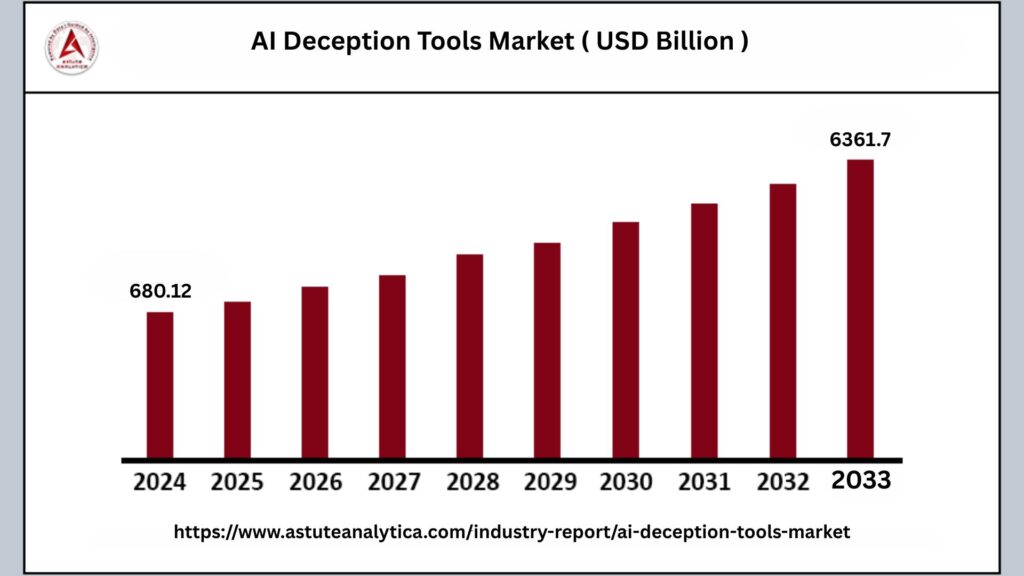
The global AI deception tools market was valued at US$ 680.12 million in 2024 and is projected to reach US$ 6,361.7 million by 2033, reflecting a Compound Annual Growth Rate (CAGR) of 28.20% during the forecast period from 2025 to 2033.
AI deception tools leverage artificial intelligence to generate highly realistic decoys and traps designed to mislead cyber attackers and enhance overall cybersecurity defenses. The growth of the AI deception tools market is being driven primarily by the increasing adoption of AI technologies within the security sector. As cyber threats become more complex and capable of evading traditional security measures, organizations are seeking advanced solutions that go beyond reactive defenses. Conventional tools often fail to detect sophisticated attacks such as polymorphic malware, zero-day exploits, and advanced persistent threats, which can bypass signature-based or static security systems.
AI Deception Tools Market Key Takeaways
- By technology, machine learning is poised to maintain its position as the dominant technology within the AI deception tools market, accounting for over 35% of the market share.
- When examining the market by end use, governments emerge as the primary consumers, holding more than 36% of the market share.
- Regionally, North America stands as the largest market for AI deception tools, commanding over 37% of the global market share.
- In terms of application, cybersecurity represents the largest segment, accounting for more than 52% of the market share.
Regional Analysis
Regulatory Actions Shape North America’s AI in Deception Tools Market
North America’s demand for AI in deception tools is strongly influenced by decisive regulatory measures and the significant financial risks present within the region’s market. Currently commanding over 37% of the global market share, North America stands as a dominant force in this sector.
- FTC’s “Operation AI Comply” Cracks Down on Deceptive Practices: A landmark regulatory initiative in this space is the U.S. Federal Trade Commission’s (FTC) launch of “Operation AI Comply” on September 25, 2024. This operation marked an immediate and forceful response to deceptive AI practices, targeting five companies engaged in fraudulent schemes involving false claims about their AI-powered tools. These actions uncovered scams that defrauded consumers of staggering sums, including cases involving $25 million and $15.9 million losses.
- Legislative Efforts to Combat AI-Driven Misinformation: The legislative branch in North America is proactively addressing AI-related challenges. In June 2024, lawmakers introduced the “Securing Elections by AI Deception Act,” a targeted measure aimed at combating AI-driven misinformation within the political arena. This legislation reflects growing concerns about the potential misuse of AI to manipulate electoral processes and influence public opinion through deceptive tactics.
- Financial Sector as a Key Driver for AI Deception Tools: The financial sector in North America serves as a critical battleground for AI deception, making it a primary driver of market demand for deception tools. Financial institutions face constant threats from sophisticated cyberattacks, fraud schemes, and phishing campaigns that leverage AI to deceive and exploit vulnerabilities. The immense financial risks involved have propelled investments in AI-powered deception technologies designed to detect, mislead, and trap malicious actors.
Europe Leading the Global Market
Europe’s AI in deception tools market is experiencing rapid maturation, driven significantly by a wave of landmark regulations and coordinated cross-border law enforcement efforts.
- The EU’s AI Act as a Central Regulatory Pillar: At the heart of this transformation lies the European Union’s AI Act, which has become the cornerstone of regulatory oversight in the region. Effective from February 2, 2025, the AI Act imposes strict prohibitions on AI systems deemed to pose an “unacceptable risk,” explicitly including manipulative and deceptive techniques. This legislation signals a decisive move toward curbing unethical AI practices by mandating that businesses implement robust tools capable of detecting and managing these prohibited systems.
- Severe Penalties Driving Compliance Across Europe: The enforcement mechanisms under the AI Act are notably rigorous, with penalties for non-compliance reaching as high as €35 million. Such severe financial consequences serve as powerful incentives for businesses throughout Europe to align their AI deployments with the new legal framework. This high-stakes environment compels companies to invest in advanced compliance solutions and to audit their AI systems meticulously.
- Explicit Ban on Specific AI Practices: The regulations under the AI Act delineate eight specific AI practices that are forbidden, signaling a strong stance on certain sensitive applications. Among these banned practices are the use of emotion recognition technologies in workplace environments and the untargeted scraping of images to build facial recognition databases. These prohibitions highlight the EU’s commitment to protecting individual privacy and preventing intrusive surveillance, especially in contexts where AI could be exploited to manipulate or deceive.
Top Trends Escalating the AI Deception Tools Market
Generative AI Creating Highly Realistic and Dynamic Deception Environments: Generative AI is revolutionizing the field of cybersecurity by enabling the creation of highly realistic and dynamic deception environments. Unlike traditional static defenses, these AI-driven environments continuously evolve, adapting to the tactics and behaviors of attackers in real time.
Growing Adoption by Governments and Critical Infrastructure for Defense: Governments and operators of critical infrastructure are increasingly adopting AI deception technologies as essential tools for national defense and cybersecurity. Recognizing the rising threat of cyber warfare and digital espionage, these entities deploy deception platforms to protect vital systems that underpin public safety, energy, transportation, and communication networks.
Shift from Static Honeypots to Automated, Adaptive Deception Platforms: The cybersecurity industry is witnessing a significant transition from traditional static honeypots to automated, adaptive deception platforms powered by AI. Static honeypots are limited by their fixed configurations, making them easier for attackers to identify and avoid. In contrast, AI-driven deception platforms offer continuous adaptation, automatically modifying decoys and network behaviors based on emerging threat patterns.
Rising Sophistication of Advanced Persistent Threats (APTs) and Cyberattacks: The increasing complexity and persistence of advanced persistent threats (APTs) and cyberattacks underscore the urgent need for innovative defense mechanisms. APTs employ stealthy, long-term infiltration techniques, making them particularly challenging to detect with conventional security tools. These sophisticated attackers often use polymorphic malware, social engineering, and multi-stage attack vectors to evade detection.
Need for Proactive Threat Detection and Valuable Intelligence Gathering: In today’s cybersecurity landscape, proactive threat detection and intelligence gathering have become paramount. AI deception technologies enable organizations to move beyond reactive defense by actively engaging attackers within controlled environments. By observing attacker behavior and tactics in real time, security teams gain valuable intelligence that informs future defense strategies and incident response.
Cybersecurity Skills Gap Necessitates Advanced, Automated Security Solutions: The persistent shortage of skilled cybersecurity professionals presents a critical challenge for organizations worldwide. This skills gap limits the ability to effectively monitor, analyze, and respond to the vast number of security alerts generated daily. AI-powered deception platforms offer a powerful solution by automating many aspects of threat detection, triage, and response.
AI Deception Tools Market Segmentation
By Technology
Machine learning has solidified its position as the leading technology in the AI deception market, commanding more than 35% of the total market share. This dominance is largely due to machine learning’s exceptional capability to create dynamic, adaptive, and highly convincing deception environments that significantly outperform traditional static defenses. Unlike fixed security measures, machine learning models continuously learn from evolving threat patterns and attacker behaviors, enabling them to modify and enhance deception tactics in real time. This adaptability is crucial for staying ahead of increasingly sophisticated cyber threats that constantly change their methods to evade detection.
By End-Use
Governments around the world have increasingly positioned themselves as primary end-users of AI deception technology, acknowledging its vital role in contemporary statecraft and national security efforts. In an era marked by rapid technological advancements and escalating cyber threats, these technologies have become indispensable for safeguarding critical national infrastructure against a wide array of attacks. The growing complexity and frequency of cyber intrusions, coupled with the rise of hostile digital environments, have compelled governments to adopt more proactive and sophisticated methods to defend their assets and maintain security.
By Application
In 2024, cybersecurity emerged as the foremost application area for AI deception technology, capturing a commanding 53% share of the market revenue. This dominant position reflects the growing recognition within the industry that traditional security measures are increasingly insufficient against the evolving landscape of sophisticated, polymorphic cyberattacks. Conventional defenses, often reactive, struggle to keep pace with attackers who continuously adapt their methods to bypass static protections. In contrast, AI-driven deception technologies offer a fundamentally proactive approach to security, shifting the focus from mere prevention to active engagement and intelligence gathering.
Recent Developments in the AI Deception Tools Market
HexStrike AI Integrates Leading AI Agents with 150+ Security Tools: In August 2025, HexStrike AI launched its latest version 6.0, dramatically expanding the capabilities of AI agents like OpenAI’s GPT, Anthropic’s Claude, and GitHub’s Copilot. This new release equips these AI systems with access to over 150 professional security tools, including industry standards such as Burp Suite and Nmap. By integrating such an extensive arsenal of tools, HexStrike AI enables autonomous penetration testing, vulnerability research, and bug bounty automation.
Reality Defender Secures $33 Million to Enhance Deception Technologies: In February 2025, Reality Defender successfully closed a $33 million Series A funding round aimed at scaling its platform. The company’s technology serves as a critical complement to deception strategies, helping organizations verify the authenticity of communications while simultaneously deploying deceptive countermeasures.
McAfee Scam Detector Unveiled at CES 2025: At the January 2025 Consumer Electronics Show (CES) in Las Vegas, McAfee announced the launch of its Scam Detector, a cutting-edge AI-powered tool designed to analyze and flag risky messages in real time. This innovation leverages artificial intelligence to identify potentially fraudulent communications quickly, helping users avoid phishing attempts and scams before they cause harm.
TruthScan Raises $16.2 Million to Fight AI-Driven Fraud: In January 2025, TruthScan, a company specializing in enterprise-grade deepfake and AI-generated fraud detection, announced the successful closing of a $16.2 million Series A funding round. This investment highlights strong investor confidence in the urgent need for technologies that can expose and counteract sophisticated AI-driven deception. As deepfakes and AI-generated fraud become increasingly prevalent, TruthScan’s solutions are critical for enterprises seeking to safeguard their operations and reputations.
Top Companies in the AI Deception Tools Market
- Bae Systems
- BlackBerry
- Check Point Software
- Cisco
- CrowdStrike
- Darktrace
- FireEye
- Forcepoint
- IBM
- McAfee
- Microsoft
- NortonLifeLock
- Palantir Technologies
- Splunk
- Trend Micro
- Other Prominent Players
Market Segmentation Overview
By Technology
- Natural Language Processing (NLP)
- Machine Learning
- LLM
- Generative AI (GANs)
- Computer Vision
- Others
By Application
- Fraud Detection
- Cyber Security
- Others
By End Use
- Healthcare
- BFSI
- Telecom & IT
- Government
- Retail
- Others
By Geography
- North America
- Europe
- Asia-Pacific
- Latin America
- Middle East and Africa