For most of the history of modern commerce, supply chains were built to be efficient under predictable conditions. Demand was forecast periodically, buffer stock was held to cover gaps, and when something went wrong, people fixed it. That model worked well enough when markets moved slowly and disruptions were rare. Neither of those things is true anymore.
eCommerce has changed the terms. Customers now expect fast delivery, accurate tracking, and consistent availability as baseline conditions, not premium features. A viral product, a regional weather event, or a single poorly timed promotion can send demand in unexpected directions within hours. Supply chains that wait for problems to surface before responding are structurally too slow for this environment.
This is the central problem that artificial intelligence is beginning to address — not by making reactive systems faster, but by replacing reactivity with anticipation.
Modern AI systems in logistics work by continuously analysing data from multiple sources: historical sales, seasonal patterns, regional demand signals, active marketing campaigns, weather forecasts, and supplier lead times. Unlike conventional forecasting, which produces a periodic estimate and holds it until the next review cycle, AI models update in real time as new information arrives. The result is a demand picture that is always current rather than already out of date.
That shift in forecasting has direct operational consequences. When a business knows with reasonable confidence where demand will concentrate over the next several days, it can position inventory accordingly — moving stock closer to the customer before the order is placed rather than scrambling to fulfil it from a distant warehouse after the fact. Procurement decisions align with actual anticipated need rather than approximations built on last quarter’s numbers. In practical terms, this means fewer stockouts, less dead inventory, and lower fulfilment costs.
Real-time visibility adds a second layer. AI systems now monitor conditions continuously across warehouses, delivery vehicles, and supplier networks. When a shipment is delayed, a warehouse becomes congested, or a delivery route is blocked, the system detects it immediately rather than waiting for a human to notice and report it. That detection capability alone is a meaningful improvement over traditional logistics operations, where problems often compounded quietly before anyone had a complete picture of what was happening.
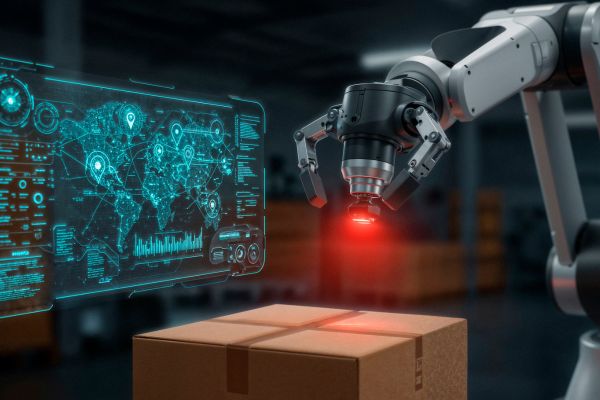
The more significant development, however, is what comes after detection. Self-healing supply chains — a term that has moved from aspiration to partial reality over the last few years — are networks that do not merely flag a problem but respond to it automatically. A blocked delivery route triggers an instant reroute. A demand surge in one region prompts inventory reallocation from another. A supplier delay activates an alternative source without waiting for a manager to authorise the switch. The system acts within the window where action is still useful, rather than generating a report for someone to read the following morning.
This does not eliminate the need for human judgment. Operations teams working alongside these systems spend less time chasing status updates and managing exceptions that could have been prevented, and more time on decisions that actually require experience and context — process improvement, capacity planning, supplier relationships. The technology handles the repetitive, time-sensitive layer; people handle the rest.
There is also an efficiency argument that extends beyond speed. Optimised delivery routing reduces fuel consumption. Accurate demand forecasting reduces waste from overproduction and unsold stock. Better warehouse utilisation lowers the cost per unit handled. For businesses operating on thin margins, these are not marginal gains.
What AI is doing to logistics, in aggregate, is shifting the basis of competitive advantage. Speed matters, but speed alone is insufficient when a disruption can undo it overnight. The businesses that will hold ground in the next phase of eCommerce growth are those whose supply chains can absorb shocks without passing the consequences on to the customer — and do so without requiring a crisis response every time conditions change.
That kind of resilience is not built through better reaction times but by knowing what is coming before it arrives.