

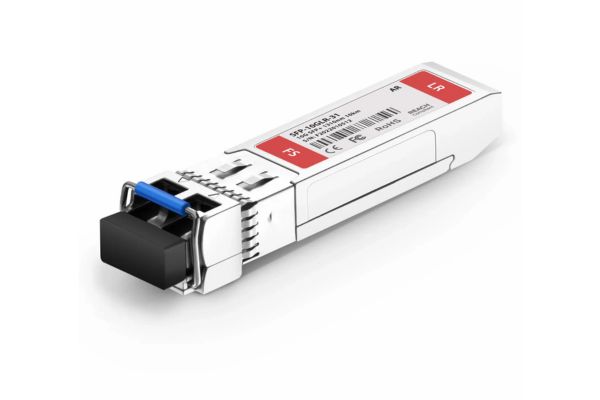
Artificial intelligence infrastructure is creating a fundamental change in data-center networking. As GPU and AI accelerator clusters scale from hundreds to thousands of processors, the network connecting those processors is becoming nearly as important as the compute itself. This transition is putting the global AI Optical Transceiver Market at the center of the AI infrastructure investment cycle.
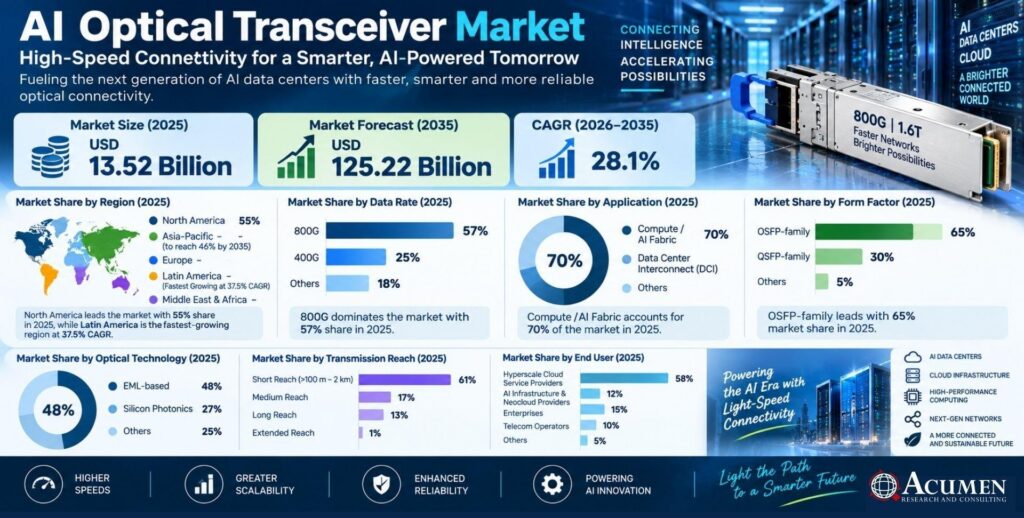
According to Acumen Research and Consulting, the Global AI Optical Transceiver Market was valued at USD 13.52 Billion in 2025 and is projected to reach USD 125.22 Billion by 2035, expanding at a CAGR of 28.1% between 2026 and 2035.
The growth story extends beyond simply installing more optical modules. AI clusters are accelerating the transition from 400G to 800G and 1.6T connectivity, increasing interest in silicon photonics, creating new thermal and power challenges, and reshaping the global optical-component supply chain.
AI Optical Transceiver Market Statistics at a Glance
Key statistics from Acumen Research and Consulting illustrate the changing structure of the market:
- 2025 Global AI Optical Transceiver Market Size: USD 13.52 Billion
- 2035 AI Optical Transceiver Market Forecast: USD 125.22 Billion
- AI Optical Transceiver Market CAGR (2026–2035): 28.1%
- North America Market Share in 2025: 55%
- Asia-Pacific Projected Share by 2035: 46%
- Fastest-Growing Region: Latin America, 37.5% CAGR
- Leading Data Rate in 2025: 800G, 57% share
- 400G Market Share in 2025: 25%
- Leading Application: Compute / AI Fabric, 70% share
- Leading Form Factor: OSFP-family, 65% share
- Leading Optical Technology: EML-based, 48% share
- Silicon Photonics Share: 27%
- Leading Transmission Reach: Short Reach (>100 m–2 km), 61%
What Is Driving the AI Optical Transceiver Market?
The principal growth engine is the rapid construction of GPU-intensive AI infrastructure.
Traditional cloud computing already requires substantial network bandwidth. AI training creates a different level of networking intensity because accelerators continuously exchange model parameters, gradients and intermediate data. Thousands of processors must effectively operate as one computing system.
This creates enormous east-west traffic inside AI data centers.
Copper connectivity faces increasing challenges as bandwidth, distance and signal-integrity requirements rise. Optical transceivers convert electrical signals into optical signals and back again, allowing high-speed information to travel efficiently over fiber between GPUs, switches, storage systems and data-center infrastructure.
Consequently, optical connectivity is moving from a supporting component toward a critical determinant of AI-cluster performance.
800G Is Dominating Today, but 1.6T Defines the Next Upgrade Cycle
One of the clearest AI Optical Transceiver Market trends is the rapid increase in data rates.
Acumen Research and Consulting estimates that 800G accounted for 57% of the market by data transfer rate in 2025, while 400G represented 25%.
800G has become particularly important because it combines high bandwidth with an increasingly mature ecosystem suitable for high-speed Ethernet switching and GPU-intensive AI clusters.
But the industry is already moving toward the next generation.
As accelerator density rises, adding more physical links indefinitely becomes inefficient. Increasing bandwidth per optical link becomes strategically preferable, which is driving the migration toward 1.6T transceivers using 200G-per-lane architectures.
Beyond 1.6T, development toward 400G-per-lane technology provides a pathway toward future 3.2T-class connectivity.
This speed transition creates opportunities across the entire semiconductor and photonics ecosystem—from optical DSPs and EML lasers to continuous-wave lasers, silicon-photonic engines, advanced packaging, substrates, connectors and test equipment.
Why AI Compute Fabrics Represent the Largest Application
Compute / AI fabric accounted for 70% of the AI Optical Transceiver Market in 2025, according to Acumen Research and Consulting.
That concentration is logical.
AI accelerators create value only when they can exchange information fast enough to function as a coordinated cluster. Networking bottlenecks can leave expensive GPUs waiting for data, reducing utilization and weakening the economics of AI infrastructure.
Optical interconnect performance therefore influences the effective productivity of the compute investment itself.
The next opportunity extends beyond individual clusters. Data Center Interconnect (DCI) is projected by Acumen Research and Consulting to grow at a 32.4% CAGR from 2026 to 2035.
As AI infrastructure spreads across multiple buildings, campuses and metropolitan locations, high-speed optical connectivity will increasingly be required not only inside clusters but between geographically separated computing resources.
Hyperscalers Are Setting the Technology Roadmap
Hyperscale cloud service providers represent the largest end-user category in the AI Optical Transceiver Market.
Their importance goes beyond purchasing volume.
Hyperscalers operate enormous AI training clusters, cloud platforms, storage infrastructure and backbone networks. Their network architectures consequently influence transceiver specifications, data-rate transitions, form factors, thermal requirements and supplier roadmaps.
AI infrastructure and neocloud providers are another increasingly relevant customer category, accounting for 12% of the market in 2025 according to Acumen Research and Consulting.
Neocloud providers are particularly significant because they offer GPU-intensive infrastructure to enterprises and AI developers that require high-performance computing capacity without building hyperscale facilities themselves.
The resulting market structure increasingly links optical-transceiver demand directly to AI compute deployment.
Why OSFP Has Emerged as the Leading Form Factor
The move toward 800G and 1.6T creates an engineering challenge: more bandwidth generally means greater thermal and power-management requirements.
This helps explain why the OSFP family captured 65% of the AI Optical Transceiver Market by form factor in 2025.
OSFP’s larger physical envelope offers advantages for thermal management, making the architecture particularly suitable for high-performance 800G and emerging 1.6T modules.
QSFP-family modules still represented 30% of the market in 2025 and benefit from a mature installed ecosystem. However, as networking speeds continue increasing, thermal performance and power density become increasingly important design considerations.
The form-factor competition therefore reflects a broader industry problem: AI networking must deliver dramatically more bandwidth without allowing power consumption and heat generation to scale at the same rate.
EML Leads Today, While Silicon Photonics Gains Strategic Importance
The optical technology landscape presents one of the industry’s most important competitive dynamics.
EML-based technology held 48% of the AI Optical Transceiver Market in 2025, making it the leading optical technology, according to Acumen Research and Consulting. Silicon photonics represented another 27%.
EMLs have established themselves in demanding high-speed optical links because of their transmission performance and suitability for higher-speed data-center connectivity.
Silicon photonics, however, introduces a different strategic proposition.
By integrating multiple optical functions onto silicon-based platforms, silicon photonics potentially offers advantages in integration, manufacturing scalability and cost as bandwidth requirements increase.
The important question is therefore not simply whether silicon photonics replaces conventional approaches. Different technologies can coexist depending on distance, architecture, cost, thermal design and performance requirements.
As the market advances through 800G, 1.6T and eventually higher-speed architectures, the ability to integrate optics efficiently at enormous production volumes could become a defining competitive advantage.
Which Countries Have the Highest Concentration of AI Optical Transceiver Manufacturers?
The manufacturing landscape is concentrated primarily across China and the United States, supported by broader Asian semiconductor and electronics supply chains.
China has become an important high-volume optical-module manufacturing center. Companies such as Innolight Technology, Eoptolink Technology, Accelink Technologies and Hisense Broadband demonstrate the country’s strength in optical-transceiver manufacturing.
The United States retains a particularly strong position in advanced optical components, semiconductor technologies, networking platforms, DSPs and photonics. Companies such as Coherent, Lumentum, Applied Optoelectronics, Source Photonics, Broadcom and Cisco contribute to this ecosystem.
South Korea also benefits from an established semiconductor and electronics manufacturing base, while Taiwan remains strategically important to the broader semiconductor manufacturing and advanced-packaging ecosystem supporting AI hardware.
This creates an interconnected global supply chain in which optical modules, lasers, DSPs, photonic integrated circuits, packaging and networking equipment may originate from different specialized manufacturing clusters.
How Does the AI Optical Transceiver Market Compare Across Regions?
North America: The Current Demand Leader
North America dominated the AI Optical Transceiver Market with a 55% share in 2025.
Its leadership is closely associated with the concentration of hyperscale cloud providers, AI infrastructure companies, advanced data centers and GPU-intensive computing deployments.
The region also hosts significant semiconductor, networking and optical-component expertise. Consequently, North America combines massive end-market demand with influence over technology roadmaps.
Asia-Pacific: Manufacturing Strength Meets Rapid AI Infrastructure Growth
Asia-Pacific is expected to become increasingly influential and is projected by Acumen Research and Consulting to account for 46% of the global market by 2035.
This reflects a powerful combination of optical-module manufacturing, semiconductor capabilities, cloud expansion, data-center construction and AI investment.
China represents a particularly important manufacturing hub, while the broader Asian semiconductor ecosystem gives the region strategic importance across components, electronics manufacturing and advanced infrastructure.
The market could therefore evolve from North American demand leadership toward a more balanced structure in which Asia-Pacific combines enormous manufacturing capability with rapidly expanding domestic demand.
Europe: Strategic AI Infrastructure Creates Optical Demand
Europe’s AI optical transceiver opportunity is closely tied to sovereign AI infrastructure, cloud investment, data-center modernization, telecom networks and research computing.
Although the region lacks the same hyperscaler concentration as North America or optical-module manufacturing scale as China, expanding AI infrastructure and high-performance computing requirements provide a meaningful long-term demand base.
Latin America: The Fastest-Growing Regional Opportunity
Acumen Research and Consulting projects Latin America to record the fastest regional growth, with a 37.5% CAGR through 2035.
Cloud adoption, data-center modernization, hyperscale expansion, colocation investment and growing AI infrastructure requirements are expanding the region’s need for high-speed networking.
This illustrates an important future market dynamic: AI infrastructure investment is becoming increasingly global rather than remaining concentrated in established North American and Asian technology hubs.
Which Companies Are Leading the AI Optical Transceiver Market?
Leading manufacturers identified by Acumen Research and Consulting include Coherent, Lumentum, Innolight Technology, Eoptolink Technology, Applied Optoelectronics, Accelink Technologies, Hisense Broadband, Source Photonics, Broadcom and Cisco Systems.
Their competitive strengths span different layers of the value chain.
Coherent and Lumentum possess significant expertise in lasers, optical components and photonic technologies. Chinese suppliers including Innolight, Eoptolink and Accelink bring substantial high-volume optical-module manufacturing capabilities. Broadcom combines semiconductor, networking and optical expertise, while Cisco’s position in networking infrastructure provides another route into high-speed data-center connectivity.
The competitive landscape should therefore be viewed as an ecosystem rather than simply a list of transceiver manufacturers.
Future leadership will depend on access to advanced lasers, DSP technology, silicon photonics, packaging expertise, thermal engineering, manufacturing yield and hyperscaler qualification.
Component Supply Is Becoming a Strategic Constraint
Rapid demand growth creates supply-side risks.
High-speed optical modules require specialized EMLs, continuous-wave lasers, DSPs, photonic integrated circuits, optical engines, advanced packaging and sophisticated test capabilities.
These components cannot necessarily be scaled instantly.
Qualification cycles are demanding, manufacturing yields matter, and advanced photonics requires specialized engineering expertise. As a result, the availability of critical optical components can become a bottleneck even when demand for finished transceivers remains exceptionally strong.
This means supply-chain control may become as strategically important as product performance.
Vertical integration, long-term supply agreements, manufacturing partnerships and diversified component sourcing could increasingly determine which suppliers are capable of supporting hyperscale deployment volumes.
What Are the Biggest AI Optical Transceiver Market Trends Through 2035?
Five structural trends stand out: migration from 800G toward 1.6T and higher speeds; increasing silicon-photonics adoption; growing optical content per AI cluster; greater importance of power and thermal efficiency; and expansion of optical connectivity from intra-data-center links toward campus and inter-data-center networks.
Transmission distance is also changing.
Short-reach connections of more than 100 meters to 2 kilometers represented 61% of the market in 2025. Acumen Research and Consulting projects their share to decline to 48% by 2035 as longer-distance categories expand.
Medium reach is projected to increase from 17% to 19%, long reach from 13% to 22%, and extended reach from 1% to 6%.
This does not imply weakening short-reach demand. Rather, it suggests that AI infrastructure is expanding geographically, creating additional optical requirements across data-center campuses, metropolitan networks and distributed computing environments.
The Strategic Outlook: AI Compute Is Becoming an Optical Networking Story
The next phase of artificial intelligence will not be determined by GPU performance alone.
As accelerator clusters become larger, system performance increasingly depends on moving enormous volumes of data between processors without allowing networking latency, bandwidth limitations or power consumption to undermine compute utilization.
That changes the strategic importance of optical networking.
The AI Optical Transceiver Market is evolving from a specialized networking segment into an essential layer of the AI infrastructure stack.
Acumen Research and Consulting’s forecast—from USD 13.52 billion in 2025 to USD 125.22 billion by 2035 at a 28.1% CAGR—illustrates the potential scale of this transformation.
The winners will not necessarily be defined solely by who ships the most optical modules today. Long-term leadership will increasingly depend on who can solve the industry’s next engineering challenge: delivering 1.6T and eventually multi-terabit optical connectivity at hyperscale volumes while simultaneously improving power efficiency, thermal performance, reliability and cost.
That is why the AI Optical Transceiver Market should no longer be viewed simply through the lens of networking equipment.
As AI data centers become some of the world’s most demanding computing environments, high-speed optics are becoming part of the fundamental architecture of artificial intelligence itself.