
What is Driving the Growth of the Autonomous SOC Platform Market?
The Autonomous SOC Platform Market is emerging as one of the fastest-growing segments within the cybersecurity industry as organizations increasingly adopt artificial intelligence, machine learning, and automation technologies to strengthen security operations. Autonomous Security Operations Center (SOC) platforms are designed to automate threat detection, investigation, response, and remediation processes, reducing dependence on human analysts while improving operational efficiency.
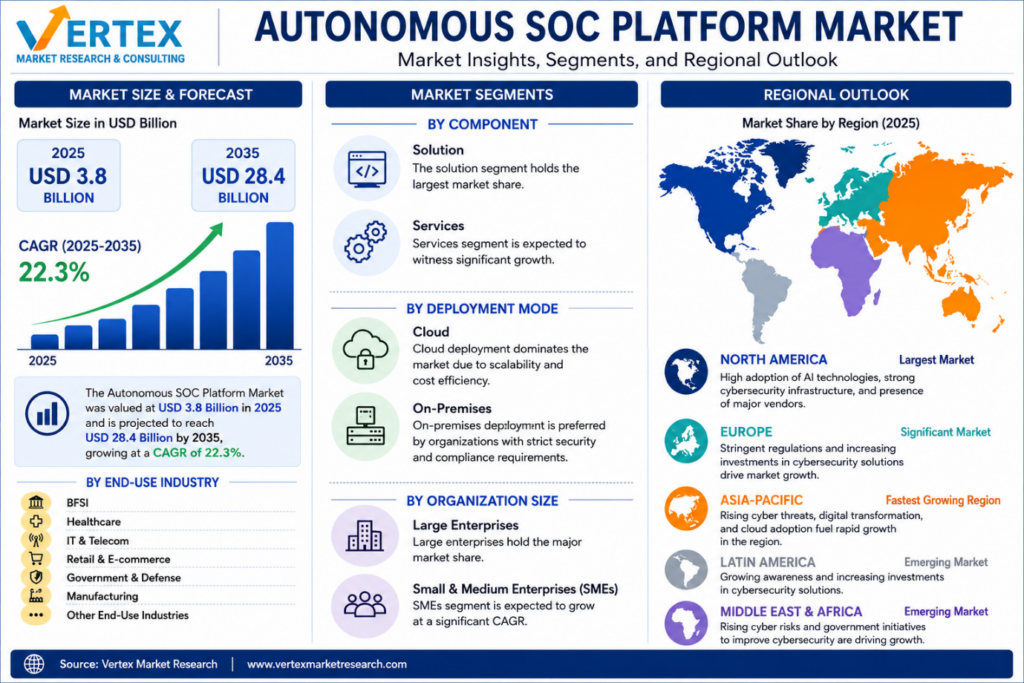
According to Vertex Market Research, the Autonomous SOC Platform Market was valued at USD 3.8 Billion in 2025 and is projected to reach USD 28.4 Billion by 2035, expanding at a CAGR of 22.3% during the forecast period. The rapid increase in cyberattacks, ransomware incidents, and sophisticated threat campaigns is creating strong demand for AI-driven security platforms capable of delivering real-time threat intelligence and autonomous response capabilities.
Why Are Organizations Moving Toward Autonomous Security Operations?
Traditional Security Operations Centers face significant challenges, including alert fatigue, cybersecurity talent shortages, and increasing attack complexity. Security teams often struggle to analyze thousands of alerts generated daily from multiple security tools, resulting in delayed response times and operational inefficiencies.
Autonomous SOC platforms address these challenges by leveraging advanced analytics, behavioral monitoring, and AI-powered automation. These platforms can prioritize threats, eliminate false positives, automate incident triage, and execute predefined response actions without constant human intervention. As a result, enterprises can reduce Mean Time to Detect (MTTD) and Mean Time to Respond (MTTR), significantly improving overall security posture.
Furthermore, the growing adoption of cloud computing, hybrid work environments, and digital transformation initiatives is increasing the attack surface for organizations, making autonomous security operations a strategic necessity rather than an optional enhancement.
How Is Artificial Intelligence Transforming the SOC Environment?
Artificial intelligence serves as the foundation of modern autonomous SOC platforms. AI algorithms continuously analyze vast volumes of security data generated across endpoints, networks, applications, cloud infrastructure, and user activities. By identifying anomalies and behavioral deviations, AI systems can detect threats that traditional rule-based security solutions often miss.
Machine learning models improve over time by learning from historical attack patterns and security incidents. This enables autonomous SOC platforms to predict potential threats, automate investigations, and recommend or initiate corrective actions with minimal human involvement.
The integration of Generative AI is further enhancing SOC capabilities by enabling automated threat hunting, security reporting, incident summarization, and analyst assistance. These advancements are helping organizations manage growing cybersecurity workloads while improving operational efficiency.
What Are the Key Market Drivers Supporting Expansion?
One of the primary growth drivers is the increasing frequency and sophistication of cyberattacks. Organizations across industries are facing ransomware attacks, phishing campaigns, insider threats, and advanced persistent threats (APTs), creating demand for more intelligent and automated security solutions.
Another major factor is the global shortage of cybersecurity professionals. Many organizations struggle to recruit and retain skilled security analysts, making automation essential for maintaining effective security operations. Autonomous SOC platforms help bridge this talent gap by automating repetitive tasks and enabling analysts to focus on strategic security activities.
Additionally, stricter regulatory requirements related to data privacy, cybersecurity compliance, and risk management are encouraging enterprises to invest in advanced threat detection and response capabilities. Industries such as BFSI, healthcare, government, telecommunications, and critical infrastructure are increasingly adopting autonomous SOC solutions to meet compliance requirements and strengthen cyber resilience.
Which Technologies Are Shaping the Future of Autonomous SOC Platforms?
Several technological innovations are accelerating market development:
- AI-powered Extended Detection and Response (XDR)
- Security Orchestration, Automation, and Response (SOAR)
- Threat Intelligence Automation
- Behavioral Analytics and User Entity Behavior Analytics (UEBA)
- Cloud-native Security Platforms
- Zero Trust Security Architecture
- Generative AI-assisted Threat Investigation
- Predictive Security Analytics
The convergence of these technologies is enabling security platforms to deliver comprehensive visibility, proactive threat detection, and automated incident response across increasingly complex enterprise environments.
How Are Different Industries Adopting Autonomous SOC Platforms?
The BFSI sector remains one of the largest adopters due to the high volume of financial cybercrime and stringent regulatory requirements. Financial institutions require continuous monitoring and rapid incident response to protect customer information and financial assets.
Healthcare organizations are increasingly deploying autonomous SOC solutions to secure sensitive patient data and connected medical devices. The rise in healthcare ransomware attacks has accelerated investments in AI-driven security infrastructure.
Government agencies and defense organizations are leveraging autonomous security operations to protect critical infrastructure and national security assets. Similarly, telecommunications providers, retail companies, manufacturing enterprises, and cloud service providers are expanding investments in automated cybersecurity platforms to address evolving threat landscapes.
Which Region Holds the Largest Market Share?
North America currently dominates the Autonomous SOC Platform Market due to high cybersecurity spending, early adoption of AI technologies, and the presence of major cybersecurity vendors. The United States continues to lead market growth as organizations invest heavily in advanced threat detection and autonomous response technologies.
Europe represents another significant market driven by stringent cybersecurity regulations and growing enterprise awareness regarding cyber risk management. Countries such as Germany, the United Kingdom, and France are witnessing increasing deployment of AI-powered security operations platforms.
Meanwhile, Asia-Pacific is expected to register the fastest growth rate throughout the forecast period. Rapid digital transformation, increasing cloud adoption, expanding internet penetration, and rising cyber threats across countries such as China, India, Japan, and South Korea are creating substantial growth opportunities for autonomous SOC vendors.
Who Are the Major Companies Operating in the Market?
The competitive landscape is characterized by continuous innovation, strategic partnerships, and AI-focused product development. Leading market participants are investing heavily in automation capabilities, threat intelligence integration, and cloud-native security architectures.
Key companies operating in the Autonomous SOC Platform Market include:
- Microsoft
- IBM
- Palo Alto Networks
- CrowdStrike
- Cisco
- Splunk
- Google Cloud
- SentinelOne
- Fortinet
- Darktrace
These companies are focusing on AI-driven threat detection, autonomous response mechanisms, cloud security integration, and security analytics to strengthen their market position.
What Does the Future Hold for the Autonomous SOC Platform Market?
The future of the Autonomous SOC Platform Market appears highly promising as organizations continue to modernize cybersecurity operations. Increasing cyber threats, workforce shortages, expanding digital ecosystems, and advances in artificial intelligence are expected to accelerate adoption across enterprises of all sizes.
As AI technologies become more sophisticated, autonomous SOC platforms will evolve from assisting security analysts to independently managing large portions of security operations. The transition toward fully autonomous security environments is expected to redefine how organizations detect, investigate, and respond to cyber threats over the next decade, making autonomous SOC platforms a critical component of future cybersecurity strategies.
Conclusion
The Autonomous SOC Platform Market is experiencing rapid growth as organizations increasingly adopt AI-powered cybersecurity solutions to combat evolving cyber threats and operational challenges. Driven by the need for faster threat detection, automated incident response, and enhanced security efficiency, autonomous SOC platforms are becoming a critical component of modern security operations. With continuous advancements in artificial intelligence, cloud security, and security automation technologies, the market is expected to witness substantial expansion over the coming decade
Author Name: Milind Khangan