

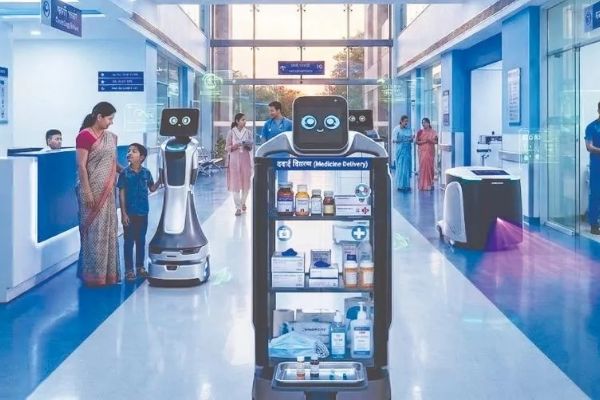
Hospitals are increasingly exploring autonomous mobile robots (AMRs) to transport medicines, laboratory samples, medical supplies, meals and other materials across healthcare facilities. These robots use a combination of sensors, embedded processors, wireless communication and navigation software to move through corridors, elevators and designated delivery areas.
Managing one robot requires navigation and task-control systems. Managing an entire fleet introduces a much larger challenge coordinating multiple robots, tracking their locations, allocating delivery tasks, monitoring battery levels and preventing traffic congestion.
This is where big data analytics becomes important. Every robot generates operational data through LiDAR sensors, cameras, wheel encoders, battery management systems, motor controllers and communication modules. Collecting and analyzing this information helps hospital operators understand fleet performance, improve route planning and manage charging schedules.
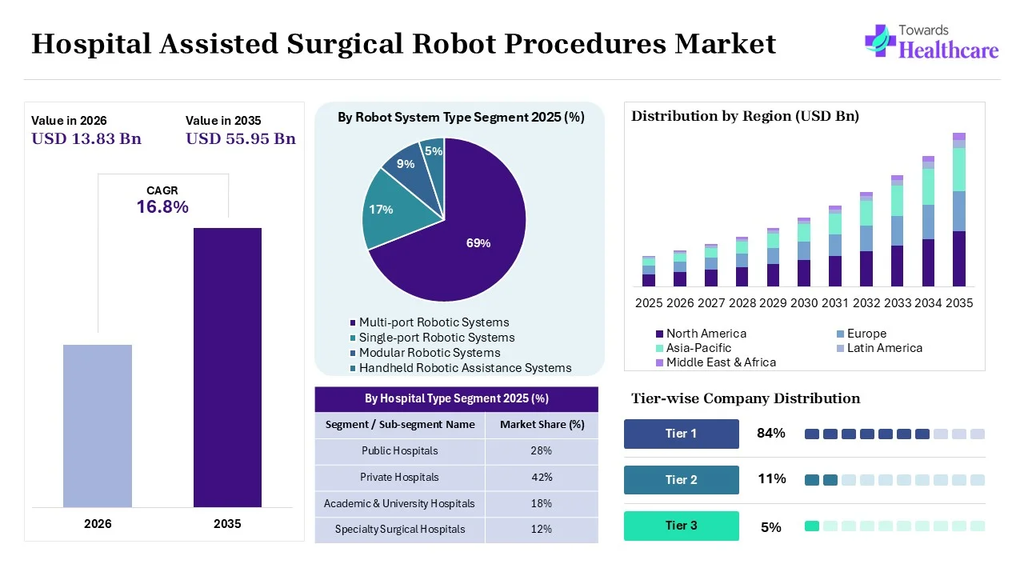
The global hospital assisted surgical robot procedures market is expected to witness steady growth USD 13.83 billion in 2026 as hospitals expand robotic surgery programs, enhance operating room capabilities, and integrate AI-enabled surgical systems into clinical practice. It is projected to reach USD 55.95 billion by 2035, registering a CAGR of 16.8%.
How Hospital Robot Fleet Management Works
A hospital robot fleet usually consists of multiple autonomous mobile robots connected to a centralized fleet management platform. Each robot performs local navigation and obstacle detection while sharing operational information with the fleet system.
The architecture typically includes five layers:
- Sensor layer: LiDAR, cameras, ultrasonic sensors, IMUs and wheel encoders collect environmental and movement data.
- Onboard computing layer: Embedded processors analyze sensor inputs, estimate robot position and execute navigation tasks.
- Communication layer: Wi-Fi or other supported wireless networks transmit robot status, task updates and operational events.
- Fleet management layer: Centralized software allocates tasks, coordinates routes and monitors robot availability.
- Analytics layer: Data platforms process historical and real-time records to identify inefficiencies and improve fleet operations.
The robots must continue handling essential navigation and obstacle avoidance locally. The fleet management platform coordinates broader activities, such as assigning deliveries and managing shared routes.
What Data Do Hospital Robots Generate?
Hospital robots generate several types of data during normal operation. Combining these records provides a detailed picture of fleet performance.
- LiDAR sensors: Generate distance measurements and point clouds for mapping and obstacle detection.
- Cameras: Capture visual information for object recognition and navigation.
- Wheel encoders: Record wheel rotation and movement measurements for speed and position estimation.
- IMUs: Measure acceleration and angular velocity for motion tracking and localization.
- Battery management systems: Monitor state of charge, voltage, current and temperature.
- Motor controllers: Record motor speed, current and operating status.
- Fleet software: Captures task assignments, routes and delivery timestamps.
- Wireless modules: Record connection quality and communication events.
This information can be collected continuously or at defined intervals, depending on the system design.
For example, a robot may record its location, battery level and current task periodically, while important events such as blocked routes, emergency stops or failed deliveries may be recorded immediately.
Big Data Analytics for Hospital Robot Route Optimization
Route optimization is one of the most important applications of fleet analytics. Hospital buildings contain corridors, elevators, restricted areas, patient rooms and busy intersections. The shortest route is not always the most efficient route.
A robot may encounter temporary obstacles, cleaning activities, patient movement or other robots using the same corridor. These conditions can increase delivery time and create congestion.
Big data systems can analyze historical movement records alongside current operating conditions to improve route selection.
1. Mapping and Localization Data
Autonomous mobile robots commonly use simultaneous localization and mapping (SLAM) to estimate their position while building or updating a map of their surroundings.
LiDAR sensors measure distances to nearby objects, while cameras and IMUs provide additional environmental and movement information. Wheel encoders help estimate how far the robot has travelled.
These measurements are combined through sensor fusion to improve localization.
Over time, fleet platforms can compare navigation records to identify:
- Frequently congested corridors
- Areas with repeated localization errors
- Routes affected by temporary obstacles
- Locations where robots frequently stop or require assistance
- Differences between planned and actual travel times
This information can help operators improve maps and identify inefficient routes.
2. Dynamic Route Planning
Traditional route planning often relies on a predefined map. Dynamic route planning adjusts the selected path according to changing conditions.
For example, if a corridor becomes unavailable, the fleet management system can assign an alternative route. If several robots approach the same narrow passage, the platform can coordinate their movement to reduce waiting time.
Route-planning algorithms may consider:
- Distance to the destination
- Estimated travel time
- Corridor congestion
- Robot speed and movement restrictions
- Elevator availability
- Delivery priority
- Battery level and remaining operating time
Algorithms such as A* and Dijkstra’s shortest-path algorithm can support route planning on mapped environments. More advanced fleet systems may use reservation-based traffic management, optimization models or multi-agent coordination.
Big data analytics adds value by using historical traffic and delivery records to improve estimates of travel time and congestion.
Fleet Scheduling and Delivery Task Allocation
A hospital fleet may receive several delivery requests at the same time. These can include laboratory sample transportation, pharmacy deliveries, supply replenishment and meal distribution.
Assigning every new request to the nearest available robot is not always the best approach. The selected robot may have insufficient battery capacity, an existing high-priority task or a route that conflicts with other deliveries.
Fleet management systems can evaluate multiple factors before assigning tasks.
Robot availability: Determines whether a robot is idle, charging, travelling or completing another delivery.
Delivery priority: Distinguishes time-sensitive requests from routine transportation.
Estimated completion time: Predicts when a robot can reach the pickup and delivery locations.
Battery capacity: Checks whether the robot can complete the task and retain an appropriate energy reserve.
Route compatibility: Identifies whether the task can be combined with another delivery without creating unnecessary delays.
For example, a robot transporting supplies to a particular hospital floor may also collect an approved return shipment from the same area. Combining compatible tasks can reduce empty journeys and improve utilization.
Historical task data can help the fleet platform estimate delivery durations and identify recurring demand patterns across different times of day.
Battery Analytics and Charging Cycle Optimization
Battery management is another major part of hospital robot fleet operations. A robot that runs out of energy during a delivery can interrupt the task and reduce fleet availability.
Most autonomous mobile robots use rechargeable battery systems supported by a battery management system (BMS). The BMS monitors parameters such as voltage, current and temperature while estimating the battery’s state of charge (SoC) and state of health (SoH).
Fleet analytics can use these measurements to coordinate charging schedules.
How Battery Data Supports Fleet Management
State-of-charge monitoring: Helps estimate how much usable battery energy remains before the robot needs charging.
Energy consumption analysis: Compares power usage across different routes, payloads and operating conditions.
Charging demand prediction: Uses historical task volumes and battery records to estimate when robots will require charging.
Battery health monitoring: Tracks changes in charging behavior, capacity and temperature to identify batteries that may require inspection.
Charging station allocation: Coordinates access to available charging points and reduces unnecessary waiting.
Predictive Charging Strategies
A fixed charging schedule may leave some robots charging when they are needed for deliveries, while others may reach critically low battery levels during busy periods.
A more flexible approach uses task demand, battery condition and expected workload to determine when each robot should charge.
For example, a fleet platform may identify a period of lower delivery demand and schedule charging for robots with lower battery reserves. It can also maintain a sufficient number of operational robots to handle incoming requests.
Battery analytics can help estimate energy consumption per delivery, compare the performance of different routes and identify charging patterns that reduce fleet downtime.
Real-Time Data Processing and Cloud Infrastructure
Managing multiple robots requires a data infrastructure capable of receiving, processing and storing operational information.
A typical architecture combines onboard computing, wireless communication, local fleet management servers and cloud-based analytics.
Edge computing: Processes sensor measurements and navigation information directly on the robot. This supports low-latency obstacle detection and movement decisions.
Wireless communication: Wi-Fi networks commonly connect mobile robots to fleet management platforms. Network coverage, roaming performance and connection reliability affect operational continuity.
Data ingestion: Collects telemetry, task updates, battery measurements and navigation events from multiple robots.
Cloud storage: Stores historical operational records for reporting, performance analysis and long-term monitoring.
Analytics engines: Process large datasets to identify patterns in route efficiency, battery consumption, delivery times and equipment utilization.
Fleet dashboards: Present information such as robot availability, active tasks, charging status and delivery performance.
Not every operation needs to run in the cloud. Immediate navigation and safety-related decisions should remain on the robot or within appropriately designed local control systems. Cloud platforms are more suitable for historical analysis, fleet-level optimization and centralized reporting.
Key Technologies Behind Hospital Robot Fleet Analytics
Several technologies work together to connect physical robot hardware with the data infrastructure required for fleet management.
| Technology | Role in hospital robot fleets |
| LiDAR | Environmental mapping and obstacle detection |
| SLAM | Simultaneous localization and map generation |
| IMU | Motion and orientation measurement |
| Wheel encoders | Movement and odometry data |
| ROS 2 and DDS | Communication between robot software components |
| MQTT | Lightweight messaging for suitable telemetry applications |
| Wi-Fi | Wireless communication with fleet infrastructure |
| Cloud databases | Storage and retrieval of operational records |
| Machine learning | Demand forecasting and operational pattern analysis |
| Optimization algorithms | Route planning, task allocation and charging coordination |
Robot Operating System 2 (ROS 2) is an important robotics software framework. It uses the Data Distribution Service (DDS) communication layer to support information exchange between software components. Its Quality of Service settings can help configure communication behavior according to application requirements.
These technologies work together to connect physical robot hardware with the data infrastructure required for fleet management.
Measuring Hospital Robot Fleet Performance
Big data analytics becomes useful when operational information is converted into measurable performance indicators.
Hospitals and robot manufacturers can monitor several key metrics:
Delivery completion rate: Measures the percentage of assigned tasks completed successfully.
Average delivery time: Tracks the time taken to complete a delivery.
Robot utilization: Measures the proportion of available time spent performing assigned tasks.
Charging downtime: Tracks time spent waiting for or completing charging.
Energy consumption per task: Measures battery energy used for a delivery.
Empty travel distance: Measures distance travelled without carrying an assigned delivery.
Navigation intervention rate: Tracks how frequently manual assistance or recovery is required.
Network availability: Measures the reliability of robot-to-platform communication.
These indicators help identify operational problems. For example, a high empty-travel distance may indicate inefficient task allocation, while frequent navigation interventions may point to mapping or sensor-related issues.
Comparing performance across different shifts, floors and delivery categories can also help hospitals understand where fleet capacity is being underused.
Challenges in Implementing Big Data Analytics for Hospital Robots
Despite its benefits, fleet analytics introduces several technical and operational challenges.
Network coverage: Hospital buildings contain walls, elevators, equipment and other sources of wireless interference. Weak connectivity can interrupt communication between robots and fleet platforms.
Data volume: Continuous LiDAR and camera streams can generate much larger datasets than ordinary robot telemetry. Systems must decide which information needs real-time transmission and which can be processed or stored locally.
Data synchronization: Measurements from encoders, IMUs, LiDAR and battery systems must be time-aligned to support accurate analysis.
Battery prediction accuracy: Battery performance changes with age, temperature, payload and operating conditions. Charging models must account for these variations.
Multi-robot congestion: Poor task allocation can create traffic conflicts, especially in narrow corridors and elevator areas.
Cybersecurity: Connected robots require secure authentication, encrypted communication, controlled software updates and monitoring for unauthorized access.
System integration: Fleet platforms may need to interact with hospital information systems, elevators, access-control systems and logistics applications. Reliable interfaces and clearly defined data formats are essential.
Future Opportunities in Hospital Robot Fleet Intelligence
The next stage of hospital robotics will involve more intelligent coordination between robots, infrastructure and centralized analytics platforms.
Machine learning models may help predict delivery demand by analyzing historical task volumes, time-of-day patterns and operational schedules. More advanced optimization systems could coordinate charging, task allocation and route selection together rather than treating them as separate problems.
Digital twins offer another opportunity. A virtual representation of a hospital robot fleet can use real operational data to simulate traffic, test new routes and evaluate charging strategies before changes are introduced into the physical environment.
Robots may also benefit from improved sensor fusion, more efficient onboard AI processors and stronger wireless infrastructure. These technologies can improve localization, reduce unnecessary manual intervention and support more coordinated fleet operations.
However, operational improvements must be validated under actual hospital conditions. Reliable navigation, infection-control requirements, patient safety and human interaction remain essential considerations.