

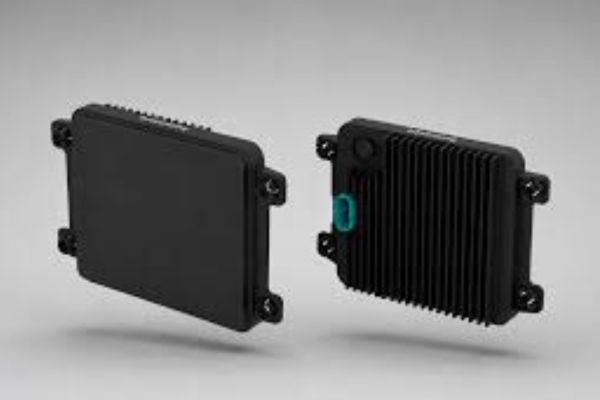
bitsensing, a leading radar solution company, launches the AIR4D Imaging Radar, engineered to help autonomous vehicle (AV) companies deploy autonomous fleets in real-world environments faster and at scale.
In order to drastically speed up the commercialization of AVs worldwide, AIR4D gives companies direct access to high-resolution 4D sensor data (point cloud data & Doppler data), including radar raw data outputs, to train smarter models. Currently, other 4D radar solutions often operate as closed systems, limiting the availability of all the raw data produced from testing.
Access to this raw radar data is critical because it enables developers and AV companies to continuously refine perception models, validate performance and accelerate the path from testing to safe, large-scale fleet deployment.
A 4D Radar Purpose-Built For Autonomous Vehicles
Crucially also, compared to other 4D radars on the mobility market, AIR4D clearly differentiates itself by being purpose-built for AVs. It delivers detailed 4D sensor data designed specifically for AV AI models, while being optimized for power and heat efficiency, helping these vehicles operate reliably in the real world. By contrast, many 4D radars were developed for Advanced Driver Assistance Systems (ADAS) functions in passenger vehicles, not for full autonomous driving functionality.
In addition, AIR4D Imaging Radar relies on a camera-plus-radar architecture for AVs, opening up a viable path to significantly lower per-vehicle sensor costs, while markedly accelerating AV deployment on roads around the world.
AIR4D is available for off-the-shelf deployment, offering:
- Direct velocity per object: bitsensing’s radar measures how fast surrounding vehicles, cyclists or pedestrians are moving in real time, enabling faster and more accurate decision-making for AVs.
- Long-range detection up to 300m: It identifies vehicles and obstacles farther down the road, giving autonomous vehicles more time to react safely.
- Accuracy in nighttime and zero-light environments: The 4D radar can perform in near-total darkness (i.e. <0 lux) helping AVs maintain awareness at night or in poorly lit areas.
- Stable in harsh weather: AIR4D delivers strong sensing performance in rain, fog, snow and other challenging conditions that can reduce visibility for other sensors, as 4D radar millimeter-wave frequencies penetrate these adverse environmental barriers. With AV programs moving toward real-world commercial deployment, this reliability is no longer a nice-to-have; it is a baseline requirement.
- Deep integration with camera sensors: The solution works in combination with cameras, and its robust distance and velocity measurements complement the high-resolution imagery from cameras. This results in a comprehensive perception system that enhances the reliability of autonomous driving.
Dr. Jae-Eun Lee, CEO of bitsensing, said of the launch of AIR4D: “By delivering high-resolution 4D perception data, including, importantly, all raw data outputs, our goal at bitsensing is to empower autonomous vehicle companies to build systems that at speed and at scale.”
Previously, other sensors had been relied upon to provide 3D spatial accuracy for AVs, which 3D radars could not replicate, such as distinguishing a pedestrian from a vehicle, or a road sign from an obstacle. However, 4D imaging radar solves this blind spot by adding elevation data. What this means is that AVs equipped with 4D radar get a high-resolution, real-time spatial picture of their environment across all four dimensions, which is the level of perception fidelity that safe autonomous driving demands.