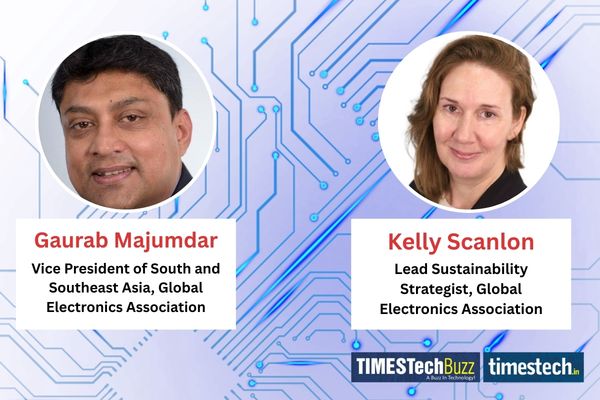
In an interview with Gaurab Majumdar, Vice President of South and Southeast Asia, Global Electronics Association, and Kelly Scanlon, Lead Sustainability Strategist, Global Electronics Association, followed by TimesTech, the discussion explores how circular electronics can redefine India’s manufacturing future. The leaders highlight strategic investments, policy alignment, and industry-led standards as critical enablers for sustainability, competitiveness, resilience, and long-term growth in India’s rapidly expanding electronics ecosystem.
Read the full interview here:
TimesTech: India has committed $120 million toward advancing circularity in electronics. From your perspective, how transformative is this move for India’s ambition to become a global electronics manufacturing hub, and where should this funding be strategically deployed to create long-term impact?
Gaurab: cAs India accelerates growth under the India Semiconductor Mission and broader production-linked incentive (PLI) frameworks, strengthening sustainability alongside scale becomes essential.
As the world’s third-largest generator of e-waste, India has a significant opportunity to formalize recycling systems, enhance material recovery infrastructure, and promote resource-efficient manufacturing practices.
Strategic deployment of this funding should focus on modern recycling technologies, improved Extended Producer Responsibility (EPR) compliance mechanisms under the E-Waste (Management) Rules, 2022, and workforce skilling to ensure safe and efficient disassembly and recovery processes.
If effectively aligned with existing semiconductor and electronics manufacturing initiatives, this investment can help reduce long-term reliance on imported critical materials, strengthen supply chain resilience, and reinforce India’s position as a responsible, globally competitive electronics manufacturing hub.
Kelly: The impact of $120 million USD depends on how well the funding aligns with the scale and urgency of the country’s needs. For example, if technological solutions are the most impactful solutions that will drive circularity in electronics, then the funding should support the technological development. Or, if policy solutions are the most impactful, then funding should support appropriately. The size should meet the need. As we’ve seen elsewhere, multi-pronged solutions are most common and, therefore, the funding should be similarly multi-pronged.
TimesTech: Electronics manufacturing can significantly impact air, water, and land ecosystems. How can industry-led standards and global advocacy frameworks help India reduce environmental pollution while maintaining manufacturing competitiveness?
Gaurab: India’s continued growth in electronics manufacturing makes environmental governance and operational discipline increasingly important. While regulatory measures such as the E-Waste (Management) Rules, 2022 establish accountability through Extended Producer Responsibility (EPR), industry-led standards translate these requirements into practical, measurable actions on the factory floor.
Consensus-based standards help strengthen chemical management, waste handling procedures, process control, and worker safety protocols. Environmental management frameworks such as ISO 14001 and quality-driven initiatives like Zero Defect Zero Effect (ZED) embed sustainability into day-to-day manufacturing systems, ensuring consistency and compliance.
Global advocacy platforms further support this effort by facilitating constructive dialogue between manufacturers and policymakers. This engagement helps shape regulations that are technically sound, internationally aligned, and responsive to evolving sustainability expectations in key export markets.
When environmental performance is integrated into operational excellence through standards and collaboration, it enhances efficiency and strengthens competitiveness without compromising ecological responsibility.
Kelly: Industry-led standards and advocacy are extremely important to maintaining economic competitiveness and reducing environmental and social impacts. Engagement through the Global Electronics Association – for example – drives the necessary alignment across our industry.
In standards development, this means facilitating direct collaboration between industry members and its stakeholders to reach a true consensus and formalize this in documents.
In advocacy, we bridge the gap between industry and policymakers to ensure our priority issues are clear and actionable. We are particularly active in the European Union, where we shape the sustainability and circularity requirements that directly affect India-based electronics companies as customers and suppliers.
TimesTech: You often emphasize that circular electronics lead to safer electronics. Can you elaborate on how circular supply chains can safeguard manufacturers against market volatility while also improving worker health and safety standards?
Gaurab: Circular supply chains help manufacturers manage market volatility by creating structured recovery and reuse systems for materials that would otherwise be discarded. By developing reliable streams of recovered inputs within the domestic ecosystem, companies can reduce exposure to commodity price fluctuations and mitigate the impact of supply disruptions.
Equally important is the safety dimension. In India, where a significant portion of e-waste has historically been processed through informal channels, formalizing circular systems creates safer working environments with defined labor standards, protective equipment, and environmental controls. When producers take structured responsibility for end-of-life products through accountable and traceable recovery systems, they are incentivized to design products for safer disassembly and material recovery.
However, the economic and safety benefits of circularity depend on strong enforcement, transparent reverse logistics, and genuine producer accountability. When implemented effectively, circular supply chains not only improve financial stability but also elevate worker health and safety standards across the electronics value chain.
Kelly: Circular supply chains reduce manufacturers’ exposure to commodity price volatility by creating internal or regional streams of recovered materials, acting as a hedge against open-market swings. When producers take formal responsibility for end-of-life recovery, they have strong incentives to design products for safe disassembly, which protects downstream workers, unlike informal e-waste recycling. The key condition is that circularity must include genuine producer accountability and formal labor standards, otherwise the safety benefits don’t automatically follow.
TimesTech: Electronics manufacturing forms the backbone of India’s renewable energy expansion—from solar to EV ecosystems. How do you see circular manufacturing practices strengthening India’s climate resilience and clean energy transition?
Gaurab: Electronics manufacturing is central to India’s renewable energy ecosystem, and as clean energy capacity expands, the way we manufacture becomes just as important as what we manufacture. Circular manufacturing practices strengthen India’s clean energy transition by embedding resource efficiency, lifecycle thinking, and responsible material management directly into production systems.
By reducing lifecycle emissions and optimizing material use, circular approaches ensure that clean energy growth remains aligned with environmental responsibility. At the same time, integrating recovery, reuse, and structured end-of-life systems enhances the long-term durability of the manufacturing ecosystem.
From a climate resilience standpoint, circular manufacturing reduces systemic stress on natural resources and supports more stable industrial operations in the face of environmental and supply-side uncertainties. In this way, circularity reinforces the structural strength of India’s renewable energy transition, ensuring it is sustainable not only in ambition, but in execution.
Kelly: Circular manufacturing cuts the energy and emissions intensity of production by replacing virgin material extraction with recycled inputs, directly reducing carbon footprints. It also makes the clean energy transition more viable by recovering critical minerals that solar, wind, and battery technologies depend on, without opening new carbon-intensive mines. And by building regional material redundancy, it makes supply chains more resilient to the climate disruptions, like extreme weather, water scarcity, and geopolitical instability that are already stressing linear models.
TimesTech: As the world’s largest trade association representing companies like Microsoft, Siemens, and Dell, how is the Global Electronics Association supporting India in building sustainable, future-ready manufacturing ecosystems?
Gaurab: The Global Electronics Association supports India’s manufacturing ecosystem through three core pillars: standards, workforce capability, and structured sustainability advancement.
First, we help Indian manufacturers align with globally harmonized technical and environmental standards. This ensures that companies operating in India meet international quality, safety, and compliance expectations which is essential for integration into global supply chains.
Second, workforce development is a priority. Through certification and technical education programs, we strengthen the skills required for safe, process-driven, and high-quality electronics manufacturing. A future-ready ecosystem depends on trained professionals who understand both technical excellence and responsible manufacturing practices.
Third, through initiatives such as Evolve, we are supporting companies in assessing and improving their environmental and social performance in a measurable way. Evolve provides a structured pathway for manufacturers to benchmark sustainability maturity and move toward continuous improvement rather than one-time compliance.
In addition, our role as a neutral industry platform enables dialogue between manufacturers, policymakers, and global customers. This collaboration helps ensure that India’s manufacturing growth remains aligned with evolving global sustainability expectations while maintaining competitiveness.
Building a sustainable, future-ready ecosystem requires more than incentives it requires standards, skills, accountability, and collaboration. That is where we see our strongest contribution in India.
Kelly: At the Association’s Evolve program we know that the electronics industry – regardless of geography – is challenged to achieve supply chain resilience, maintain a skilled workforce, manage natural resources and waste, and keep up with reporting and disclosure requirements. We’re positioned to support our global members, including India, with all of these challenges.
TimesTech: Looking ahead five years, what key policy, industry, and innovation shifts are essential for India to emerge not just as a manufacturing powerhouse, but as a global leader in sustainable and circular electronics?
Gaurab: Over the next five years, India’s opportunity lies in embedding sustainability into the foundation of its manufacturing growth rather than treating it as an add-on.
At the policy level, continued strengthening of circular economy frameworks, consistent enforcement of Extended Producer Responsibility, and clear compliance mechanisms will remain important. Predictable and well-implemented regulations provide the stability industry needs to invest confidently in long-term sustainable systems.
At the industry level, greater integration of circular design principles, lifecycle accountability, and measurable environmental performance into core business strategies will be key. Sustainability is increasingly shaping market access, investor expectations, and global partnerships.
Innovation will also play a defining role particularly in advancing material recovery processes, product durability, and resource-efficient manufacturing. Ultimately, progress will depend on sustained collaboration – which we are supporting through Evolve. Government, industry, and technical institutions working in alignment can ensure that sustainability goals are practical, measurable, and globally competitive.
If this alignment continues to strengthen, India has the potential to move beyond scale and be recognized as a leader in sustainable and circular electronics manufacturing.
Kelly: Need the policies that enable circularity and the abilities to ensure compliance against any requirements. We need systems that hold companies accountable and ensures rigor. So, no matter what innovation shifts or policy shifts occur, we need systems that make sure they’re taken seriously and abided by.