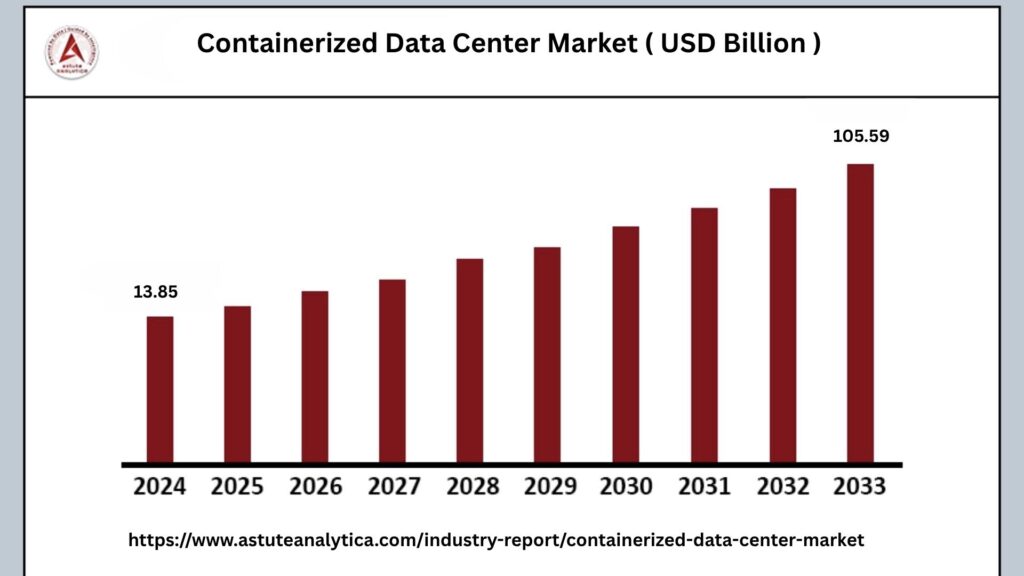
The global containerized data center market was valued at US$ 13.85 billion in 2024 and is projected to reach US$ 105.59 billion by 2033, reflecting a Compound Annual Growth Rate (CAGR) of 25.32% during the forecast period from 2025 to 2033.
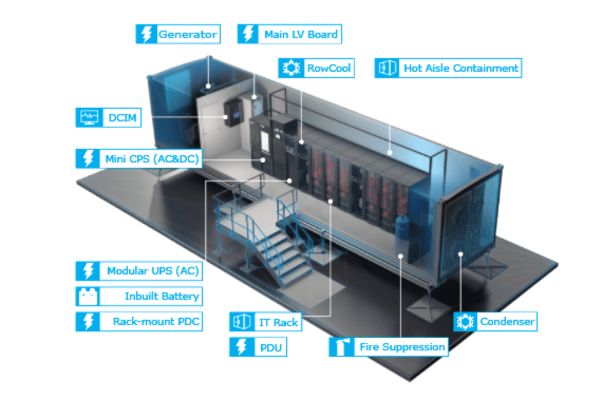
A containerized data center is a modular and portable form of data center infrastructure, constructed within a standard shipping container or a similar enclosure. This design offers a high degree of flexibility and scalability, making it an attractive solution for organizations seeking to rapidly expand or adapt their IT capabilities.

The containerized data center market is poised for continued growth as technological advancements drive new requirements for IT infrastructure. With the increasing volume of data generated by emerging technologies such as artificial intelligence, the Internet of Things, and 5G networks, businesses are demanding more agile and efficient solutions to manage compute and storage needs.
Containerized Data Center Market Key Takeaways
- By Container Size, the 40-foot containers hold a commanding position, capturing a dominant 50% market share.
- The IT and telecommunications sector stands out as the largest end-user within the containerized data center market, accounting for a significant 29% share of deployments.
- Most Lucrative Segment by Organization Size, Large enterprises have emerged as the most lucrative segment in the containerized data center market, commanding over 63% of the market share.
Regional Analysis
North America’s Market Leadership in Containerized Data Centers
North America holds a dominant position in the containerized data center market, capturing approximately 34% of the global share. This leadership is largely attributed to the region’s advanced IT infrastructure and the rapid adoption of cloud computing technologies.
- Advanced Infrastructure and Rapid Deployment Capabilities: One of the key strengths fueling North America’s dominance is its mature supply chain and the availability of pre-engineered modular solutions. These factors enable faster deployment of containerized data centers compared to traditional builds, allowing enterprises to scale their IT operations efficiently without compromising performance.
- Influence of Government and Defense Sectors: The government and defense sectors play a significant role in establishing North America’s market leadership. For instance, the U.S. Department of Defense has been a pioneering adopter of containerized data centers, utilizing them to create secure, mobile IT infrastructures capable of supporting mission-critical operations in remote or challenging environments.
- Role in Disaster Recovery and Operational Continuity: In addition to defense, disaster recovery initiatives across North America heavily rely on containerized data centers. Regions prone to natural disasters benefit from the quick deployability of these modular systems, which can be rapidly transported and set up to restore IT operations with minimal downtime. This capability is vital for maintaining business continuity and protecting sensitive data during emergencies.
Europe as the Second-Largest Contributor to the Containerized Data Center Market
Europe has established itself as the second-largest contributor to the global containerized data center market, driven by a regional emphasis on sustainability and energy-efficient IT solutions. The continent’s commitment to reducing environmental impact has influenced both the public and private sectors to prioritize greener infrastructure options.
- Emphasis on Renewable Energy and Sustainable IT Infrastructure: A key factor driving the growth of containerized data centers in Europe is the widespread use of renewable energy sources such as wind and solar power. Many organizations are consciously transitioning to data centers powered by clean energy to align with climate goals and reduce their carbon footprints. Containerized data centers facilitate this transition by allowing easy integration with renewable power systems and enabling energy-efficient cooling and power management.
- Influence of Regulatory Environment on Infrastructure Adoption: Europe’s stringent regulatory framework plays a significant role in shaping the containerized data center market. Regulations such as the General Data Protection Regulation (GDPR) impose rigorous data privacy and security standards, compelling organizations to adopt infrastructure solutions that ensure compliance. Additionally, carbon reduction mandates and environmental policies have further incentivized companies to embrace modular and sustainable IT infrastructure.
- Expansion of 5G Networks and Data Sovereignty Considerations: Governments and telecom operators across Europe are actively deploying containerized data centers to support the rapid expansion of 5G networks. These modular facilities allow for the distributed computing power necessary to handle edge applications with low latency, such as smart city initiatives, autonomous vehicles, and IoT deployments. At the same time, containerized data centers help address data sovereignty concerns, particularly in sensitive industries like healthcare and finance, by enabling localized data processing and storage that comply with national laws.
Asia Pacific: The Fastest-Growing Region in Containerized Data Centers
The Asia Pacific region is currently the fastest-growing market for containerized data centers, driven by a combination of rising investments in IT infrastructure and an escalating demand for data storage and processing capabilities.
- Leading Countries Driving Growth: Among the countries in Asia Pacific, China and India stand out as key drivers of this expansion. China’s massive digital ecosystem and its focus on advanced technologies such as artificial intelligence and 5G have created a strong need for scalable, efficient data center solutions. Meanwhile, India is playing a pivotal role by leveraging modular and containerized data centers to enhance its digital infrastructure, particularly in rural and underserved areas.
- Impact of 5G Expansion in Japan and South Korea: Japan and South Korea are significant contributors to the region’s containerized data center market growth, largely due to the rapid rollout of 5G networks. Telecom operators in these countries are adopting containerized data centers to enable edge computing capabilities essential for supporting emerging applications such as augmented reality (AR), virtual reality (VR), and the Internet of Things (IoT).
- Regional Investment and Market Outlook: The surge in data center investments across Asia Pacific is reflected in the billions of dollars being poured into the market, with projections indicating continued robust growth. Southeast Asia, in particular, is witnessing a significant surge in data center development, driven by AI adoption and cloud computing demand. Countries like Malaysia and Thailand, alongside established hubs such as Singapore, Hong Kong, and Tokyo, are also contributing to the region’s expanding digital infrastructure landscape.
Top Trends Escalating the Containerized Data Center Market
Integration of Advanced Liquid Cooling for High-Power Containerized Environments: The containerized data center market is being significantly propelled by the integration of advanced liquid cooling technologies designed to support high-power computing environments. As workloads become increasingly dense and power-intensive—especially in sectors like artificial intelligence and real-time analytics—traditional air cooling methods often fall short in efficiently managing heat dissipation.
Adoption of Renewable Energy and Sustainable Power Management: Sustainability has become a major driver in the evolution of containerized data centers, with growing emphasis on the adoption of renewable energy sources and eco-friendly power management strategies. Organizations deploying containerized data centers are increasingly integrating solar, wind, and other renewable energy options to reduce their carbon footprint and operational costs.
Pre-configured, Application-Specific Containers for Industry-Focused Rapid Deployments: The demand for pre-configured, application-specific containerized data centers is rising as industries seek tailored solutions that can be rapidly deployed to meet unique operational requirements. These containers come equipped with hardware and software optimized for specific workloads—such as financial services, healthcare, or manufacturing—allowing organizations to quickly implement IT infrastructure without lengthy customization processes.
Growing Need for Rapid IT Infrastructure Deployment in Remote Locations: Remote and underserved locations increasingly require fast and reliable IT infrastructure to support connectivity, data processing, and critical operations. Containerized data centers address this need by offering modular, portable solutions that can be quickly transported and installed in geographically challenging areas. Their compact design and self-contained systems enable organizations to establish computing resources closer to end-users or specialized sites, improving latency and service quality.
High-Density Compute Requirements for Artificial Intelligence and Real-Time Analytics: The surge in artificial intelligence (AI) applications and real-time analytics is placing unprecedented demands on compute power and data center capabilities. Containerized data centers are increasingly being adopted to meet these high-density compute requirements, as they can house powerful processing units within a compact footprint.
Demand for Modular, Scalable Solutions Supporting Edge and 5G Applications: The rapid expansion of edge computing and 5G networks is creating strong demand for modular and scalable data center solutions that can be deployed close to data sources. Containerized data centers are uniquely positioned to fulfill this need due to their portability, ease of deployment, and ability to scale according to workload demands.
Containerized Data Center Market Segmentation
By Container Size
The 40-foot container has emerged as the dominant form factor in the containerized data center market, commanding a significant 50% share. This popularity stems from its exceptional capacity, cost-efficiency, and scalability, which make it particularly well-suited for large-scale deployments. Compared to smaller container sizes, the 40-foot model offers the ability to house a greater number of racks and IT equipment within a single unit.
The larger physical footprint of the 40-foot container allows it to incorporate comprehensive integrated power and cooling systems. These systems are vital for maintaining optimal operating conditions, especially when supporting high-density workloads such as artificial intelligence, machine learning, and real-time data analytics. High-density computing generates significant heat and demands robust power management, both of which are addressed effectively within these spacious containerized environments.
By End Users
The IT and telecommunications sector stands out as the largest end-user segment within the containerized data center market, representing a substantial 29% of all deployments. This dominance is primarily driven by the sector’s heavy reliance on high-performance computing capabilities and the need to support rapid network expansion. As digital services continue to grow exponentially, telecom companies and IT providers require infrastructure that can handle vast amounts of data with speed and reliability.
One of the key factors fueling this sector’s demand is the ongoing global rollout of 5G networks. The deployment of 5G technology is transforming telecommunications by enabling faster data speeds, lower latency, and enhanced connectivity. However, 5G’s full potential can only be realized through distributed computing resources placed closer to end users—a concept known as edge computing. Containerized data centers are ideally suited to serve as edge facilities because they can be rapidly deployed in both urban centers and remote rural areas.
By Organization Size
Large enterprises have become the dominant force in the containerized data center market, commanding over 63% of the market share and emerging as the most lucrative segment. This prominence is largely driven by their growing need for IT infrastructure that is not only scalable but also flexible and resilient enough to handle complex operational demands. These organizations often operate across multiple geographic locations, which necessitates the deployment of robust data center solutions capable of supporting mission-critical applications, facilitating disaster recovery, and enabling edge computing close to data sources.
The scale and complexity of these enterprises mean they require infrastructure that can adapt quickly to changing business needs, while ensuring high availability and performance. With substantial budgets at their disposal, large enterprises are well-positioned to invest heavily in advanced containerized data center technologies. These investments typically include high-density compute capabilities that allow for more processing power within compact physical footprints.
Recent Developments in the Containerized Data Center Market
- NES Data Pvt Ltd. Launches Edge and Containerized Data Centres in India: In July 2025, NES Data Pvt Ltd. announced a significant expansion of its infrastructure with the rollout of edge and containerized data centres across Tier II cities and underserved regions in India. These new facilities are scheduled to become operational by next month and are specifically designed to deliver low-latency, high-efficiency performance.
- Delta Unveils AI Containerized Data Center at COMPUTEX 2025: In May 2025, Delta introduced its latest innovation in data center technology at COMPUTEX 2025: an AI containerized data center solution tailored for edge computing applications. This compact 20-foot container integrates critical components such as power supply, cooling systems, and IT equipment into a single modular unit.
- Optage to Deploy Liquid-Cooled Containerized Data Centers for AI Training in Japan: In February 2025, Japanese Internet Service Provider Optage announced plans to deploy advanced liquid-cooled containerized data centers equipped with GPUs dedicated to AI training. Set to be operational by the end of 2026 in Mihama-cho, Fukui Prefecture, this new facility will focus on generative AI workloads by offering customers access to specialized “AI training servers.”
Top Companies in the Containerized Data Center Market
- Dell Technologies Inc.
- Delta Electronics, Inc.
- Fuji Electric Co., Ltd.
- Hewlett Packard Enterprise Company
- Huawei Investment & Holding Co., Ltd.
- IBM Corporation
- Schneider Electric
- Shenzhen Kstar Science & Technology Co., Ltd.
- Vertiv Holdings Co.
- ZTE Corporation
- Other Prominent Players
Market Segmentation Overview
By Container Type
- 20 Feet Container
- 40 Feet Container
- Customized Container
By Organization Size
- Large Enterprises
- Small and Medium-sized Enterprises (SMEs)
By End-use
- IT and Telecommunications
- BFSI
- Healthcare
- Retail and E-commerce
- Aerospace & Defense
- Energy & Utilities
- Others
By Geography
- North America
- Europe
- Asia-Pacific
- Latin America
- Middle East and Africa