


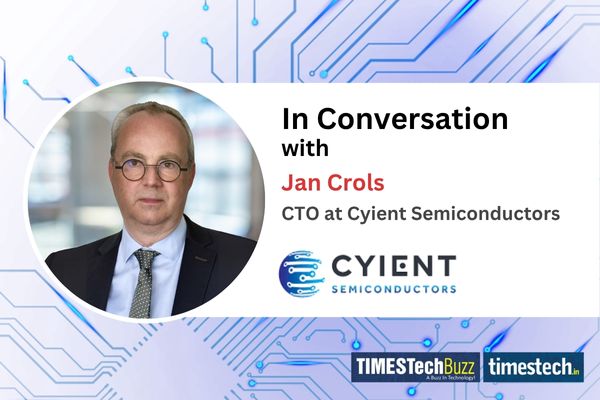
At SEMICON India 2025, TimesTech caught up with Jan Crols, CTO at Cyient Semiconductors, to discuss India’s growing semiconductor ecosystem, the company’s focus on chip design, and the role of AI and global partnerships in shaping the nation’s semiconductor future.
Read the full interview here:
TimesTech: India is moving toward becoming a full-stack semiconductor nation—covering design, manufacturing, and packaging. How is Cyient Semiconductors contributing to this vision?
Jan: Cyient Semiconductors is a fabless semiconductor company. That means we focus on chip design and supply while relying on foundry and OSAT partners for fabrication and testing. We manage the entire process and guarantee its quality—from development to delivery—for our customers.
We’ve deliberately chosen to focus on design and high quality volume supply because we believe that’s where we can add the most value. Our strength lies in our design expertise, and we continue to expand our capabilities to serve both global and Indian markets effectively.
TimesTech: The Indian government has approved over $18 billion worth of semiconductor projects through initiatives like the National Single-Window System and Plug-and-Play Infrastructure. How do such reforms influence your approach to project planning and execution?
Jan: These reforms are game-changers. The growing production capacity being developed in India gives us important opportunities for local collaboration.
For chips developed specifically for the Indian market, having access to local manufacturing and testing will enable cost-effective, high-quality, and locally supported solutions. It strengthens the entire ecosystem and makes India a more attractive base for semiconductor innovation.
TimesTech: Prime Minister Narendra Modi called chips the “Digital Diamonds of the 21st Century.” What does this idea mean for Cyient Semiconductor’s long-term technology and supply chain strategy?
Jan: The Prime Minister’s phrase highlights the immense value of semiconductors in today’s digital economy. For India, it’s not just about manufacturing chips but also about capturing value across the full chain—from design to end-market applications.
At Cyient Semiconductors, we focus on enabling this value creation by developing solutions for medical, industrial, robotics, communications, high-performance computing , and automotive applications. These sectors are where silicon solutions generate real impact. Our aim is to ensure that India not only produces chips but also innovates with them.
TimesTech: A big focus at SEMICON India this year is reducing the “file-to-factory” lag so wafer production can start faster. What steps is Cyient Semiconductors taking to accelerate the design-to-production journey?
Jan: Speed is everything in semiconductor development. We continuously optimize our processes to move faster from design to production.
One major enabler here will be AI-driven chip design. We’re actively exploring how AI can enhance our design workflows—improving efficiency, accuracy, and time to market. I’m particularly excited about India’s young engineering talent, who are quick to adopt new technologies. With the right training, they’ll play a key role in making AI-assisted semiconductor design a strength for both Cyient Semi and India.
TimesTech: SEMICON India 2025 has attracted global leaders like ASML, Micron, Applied Materials, and Infineon. How do you plan to leverage such international collaborations to strengthen India’s position in the global semiconductor landscape?
Jan: Cyient Semiconductors is already globally active, and several of these companies are our customers. Events like SEMICON India give us the perfect platform to meet partners, strengthen relationships, and explore new collaborations.
These partnerships not only help us enhance our global reach but also help integrate India more deeply into the global semiconductor value chain.