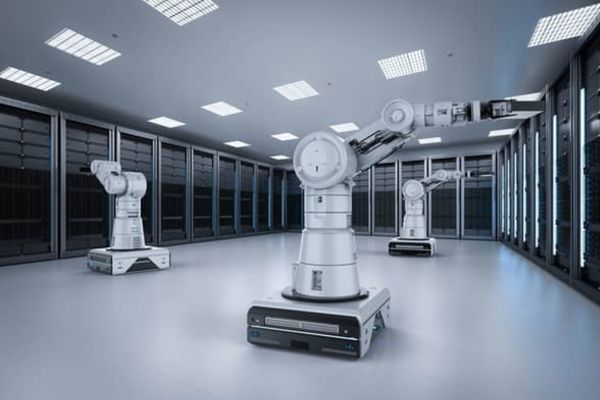
The global Data Center Robotics Market is entering a period of rapid expansion as data centers evolve into highly automated, AI-driven environments. With the explosive growth of cloud computing, generative AI workloads, and hyperscale infrastructure, operators are increasingly turning to robotics to manage complex, high-density computing environments.
According to industry estimates, the market is projected to grow from USD 2.37 billion in 2026 to approximately USD 17.14 billion by 2035, expanding at a strong CAGR of 24.60% during the forecast period. This growth reflects rising demand for operational efficiency, reduced human intervention, predictive maintenance, and continuous infrastructure monitoring across modern data centers.


As digital ecosystems scale globally, robotics is becoming a foundational technology for ensuring uptime, precision, and cost efficiency in mission-critical environments.
Quick Insights: What Is Driving the Data Center Robotics Market?
- The market is expected to grow from USD 2.37 billion (2026) to USD 17.14 billion (2035).
- It is expanding at a CAGR of 24.60% (2026–2035).
- North America leads the market with ~42% share, driven by hyperscale cloud infrastructure.
- Asia Pacific is the fastest-growing region, fueled by AI expansion and digital infrastructure growth.
- Autonomous mobile robots dominate with nearly 30% market share in 2025.
- Hyperscale data centers account for around 40% of total demand.
- Key players include ABB, Microsoft, Amazon Web Services (AWS), Google, NVIDIA, Boston Dynamics, FANUC, Siemens, ABB Robotics, and Schneider Electric.
Why Are Data Centers Turning Toward Robotics Now?
Modern data centers are no longer simple server storage facilities—they are becoming complex, high-density computing ecosystems powering AI, cloud services, and real-time digital applications.
With thousands of servers operating continuously, even minor inefficiencies can lead to significant downtime and financial losses. Robotics is emerging as a solution to handle repetitive, high-risk, and precision-based tasks such as inspection, monitoring, rack handling, and infrastructure maintenance.
The shift is also being driven by a growing shortage of skilled technical workers and the rising cost of manual operations in large-scale data facilities.
How Is AI Transforming Data Center Robotics?
Artificial intelligence is the backbone of modern robotic systems in data centers. AI enables robots to autonomously navigate server environments, detect anomalies, and perform predictive maintenance with high precision.
Machine learning algorithms help robotic systems analyze thermal patterns, airflow efficiency, vibration signals, and energy consumption data in real time. This allows operators to identify potential failures before they occur, significantly improving uptime and operational efficiency.
Additionally, AI-powered fleet management systems coordinate multiple robots across large campuses, optimizing movement, task allocation, and energy usage.
What Are the Key Drivers of Market Growth?
Why are hyperscale data centers driving robotics demand?
Hyperscale facilities operated by cloud giants require automation due to their massive scale and high-density server environments. Robotics enables efficient handling of inspection, logistics, and infrastructure monitoring across thousands of racks.
How is labor shortage influencing adoption?
The shortage of skilled data center technicians is accelerating automation adoption. Robotics reduces dependency on human labor for repetitive and hazardous tasks.
Why is operational efficiency a major priority?
Data center operators are under pressure to reduce downtime, improve energy efficiency, and optimize maintenance costs. Robotics offers a scalable solution to achieve these objectives.
What Opportunities Are Emerging in the Market?
Can edge data centers become a major robotics growth segment?
Yes. Edge data centers are rapidly expanding to support 5G, IoT, and real-time computing. These facilities often operate with limited on-site staff, making robotics essential for monitoring and maintenance.
Will autonomous inspection systems redefine data center operations?
Autonomous inspection robots equipped with thermal cameras, LiDAR, and AI sensors are becoming critical for real-time diagnostics. These systems significantly reduce the risk of system failures and operational disruptions.