



The global Digital Twin-as-a-Service (DTaaS) market is set for unprecedented expansion, projected to grow from USD 23.12 billion in 2025 to USD 399.40 billion by 2034, registering an extraordinary CAGR of 37.24%. The momentum is driven by the convergence of cloud computing, IoT, and AI-powered analytics, which are transforming how industries manage assets, optimize processes, and enhance predictive maintenance. By lowering upfront investment barriers, DTaaS unlocks enterprise-wide adoption across manufacturing, energy, healthcare, and smart city ecosystems.
What’s Driving This Growth?
The surge in DTaaS adoption stems from the need for cost-efficient digital transformation. By offering cloud-based digital twin platforms on subscription or pay-per-use models, enterprises reduce heavy infrastructure costs while accessing real-time monitoring, performance optimization, and predictive maintenance. With Industry 4.0 accelerating, demand for interoperability, scalable simulations, and data-driven decision-making is fueling widespread deployment.
Expert Viewpoint
“Digital Twin-as-a-Service is more than a technology—it’s a paradigm shift. Enterprises no longer need to invest millions upfront in simulation infrastructure. DTaaS democratizes access to real-time asset intelligence, predictive analytics, and operational agility,” said Ananya Mehta, Principal Consultant at Precedence Research. “As adoption spreads across sectors like manufacturing, healthcare, and energy, DTaaS will emerge as a cornerstone of digital enterprise resilience and competitiveness.”
Regional Outlook
How big U.S. Digital Twin As-a-Service Market?
The U.S. digital twin-as-a-service market size was exhibited at USD 4.13 billion in 2024 and is projected to be worth around USD 99.96 billion by 2034, growing at a CAGR of 37.53% from 2025 to 2034.
North America
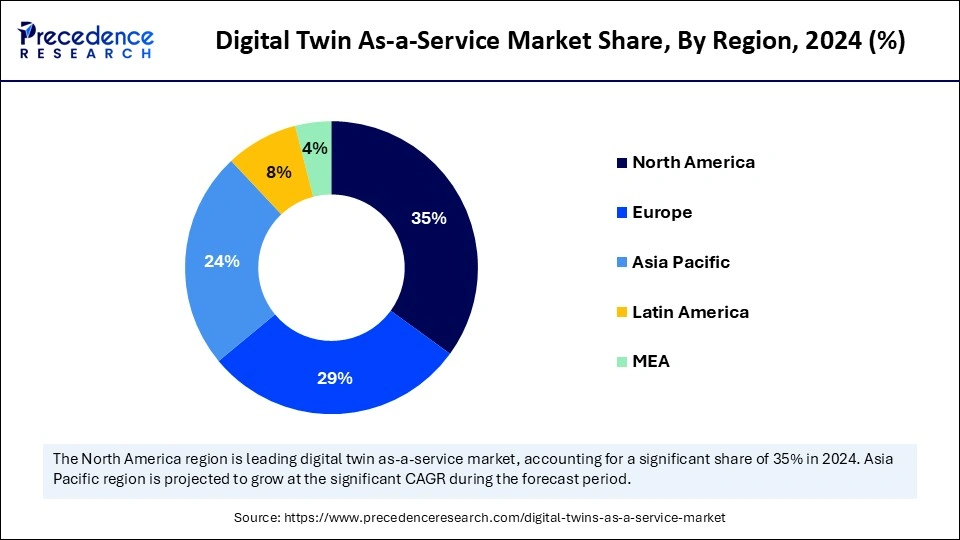
North America accounted for nearly 35% of the global DTaaS market in 2024, cementing its position as the leading region. The United States remains the powerhouse, driven by early adoption across aerospace, automotive, and healthcare industries. Strong investments from cloud leaders such as Microsoft Azure, AWS, and IBM continue to fuel innovation, while Canada has been particularly active in smart city deployments and healthcare digitalization initiatives. The region’s robust R&D ecosystem and regulatory emphasis on industrial safety further accelerate digital twin adoption, making North America the benchmark for global DTaaS deployment.
Asia Pacific (APAC)
Asia Pacific is projected to record the fastest CAGR during 2025–2034, spearheaded by China, Japan, and India. China leads the regional push with significant investments in smart manufacturing, urban digital twin projects, and IoT-driven industrial automation, aligning with its “Made in China 2025” strategy. Japan, with its advanced automotive and electronics industries, has seen early adoption of digital twin platforms for precision engineering and robotics. Meanwhile, India is emerging as a high-growth hub, supported by government-led Digital India programs, rapid infrastructure modernization, and increased adoption of cloud services among SMEs. Collectively, APAC’s rapid urbanization, expanding 5G connectivity, and strong policy support position the region as the global growth engine for DTaaS.
Europe
Europe has witnessed strong adoption of DTaaS solutions, especially across automotive, energy, and industrial sectors. Germany leads the market with its Industry 4.0 initiatives and widespread use of digital twins in automotive engineering and factory automation. The UK and France follow closely, driven by advancements in healthcare digitalization, renewable energy projects, and government-backed smart city programs. The European Union’s focus on sustainability and regulatory frameworks for data security further supports DTaaS expansion. Countries like the Netherlands and Sweden are also investing heavily in green infrastructure and logistics digitization, enhancing Europe’s role as a mature and diversified DTaaS market.
Segmental Insights
Component
Within the DTaaS market, the platform segment holds the dominant share as enterprises increasingly rely on comprehensive cloud-based solutions that integrate digital replicas, IoT connectivity, and workflow orchestration. However, the data and analytics layer is emerging as the fastest-growing component, fueled by the rising importance of predictive insights, anomaly detection, and real-time decision-making. As organizations demand not just digital replication but also actionable intelligence, analytics-driven solutions are expected to become the backbone of competitive differentiation.
Technology
From a technology perspective, IoT and sensor integration lead adoption, enabling real-time monitoring of equipment, supply chains, and infrastructure. These connected ecosystems provide the raw data that powers simulations and digital twin modeling. Looking ahead, AI/ML and predictive analytics are expected to experience a surge, transforming how digital twins forecast asset performance, detect risks, and enable scenario-based optimization. This convergence of IoT with AI is set to redefine digital twin intelligence across industries.
Deployment
In terms of deployment, the public cloud currently accounts for the largest market share, driven by cost efficiency, scalability, and widespread accessibility. Yet, as enterprises balance flexibility with regulatory compliance, hybrid cloud models are projected to gain accelerated traction. By combining public and private cloud infrastructures, hybrid deployments offer the dual advantage of security and scalability, positioning them as a critical enabler of next-generation DTaaS adoption across regulated industries like healthcare and finance.
Application
Among applications, predictive maintenance stands as the leading use case, helping industries reduce downtime, extend equipment life, and optimize resource allocation. The economic impact of minimizing unplanned outages has made predictive maintenance the top driver of DTaaS investments. At the same time, supply chain and logistics management is quickly gaining momentum, with companies leveraging digital replicas of logistics networks to enhance efficiency, improve traceability, and mitigate risks—an especially critical trend in today’s globally interconnected trade environment.
Verticals
By vertical, manufacturing continues to dominate DTaaS adoption, supported by Industry 4.0 initiatives, smart factory deployments, and the demand for operational visibility. However, the healthcare and life sciences sector is emerging as the fastest-growing vertical, as hospitals, pharmaceutical companies, and medical device firms turn to digital twins for patient monitoring, clinical trial optimization, and precision healthcare delivery. This shift underscores how DTaaS is no longer confined to traditional industrial domains but is increasingly central to healthcare innovation.
End-users
When analyzing end-users, large enterprises hold the lion’s share of the DTaaS market due to their ability to invest in advanced technologies and scale digital twin deployments across multiple facilities. However, small and medium-sized enterprises (SMEs) are rapidly catching up, aided by subscription-based models and cloud-native solutions that minimize upfront costs. As DTaaS providers introduce more flexible, pay-as-you-go offerings, SMEs are expected to play a bigger role in driving future adoption.
Service Model
In terms of service models, subscription-based DTaaS dominates today’s landscape, offering enterprises predictable costs and continuous access to evolving cloud services. Nevertheless, the pay-per-use model is gaining momentum, particularly among SMEs and startups that require scalability without committing to long-term contracts. This shift reflects a broader trend in digital transformation, where businesses increasingly prioritize agility, cost optimization, and the freedom to scale resources on demand.
Opportunities and Trends
“Will AI and Predictive Analytics Redefine DTaaS Adoption?”
Absolutely. AI/ML-driven predictive analytics are the fastest-growing technology driver in DTaaS. By enabling real-time forecasting, anomaly detection, and scenario modeling, AI enhances operational efficiency and reduces downtime. Integration with IoT and cloud platforms further amplifies value creation, making DTaaS indispensable for industries navigating digital transformation.
Breakthroughs from Top Companies
- Siemens launched advanced DTaaS platforms integrating predictive maintenance with real-time IoT sensors.
- Microsoft Azure Digital Twins expanded to support healthcare and logistics enterprises, focusing on hybrid cloud adoption.
- IBM announced AI-driven digital twin services with advanced interoperability for manufacturing plants.
- General Electric (GE) continues to refine industrial DTaaS offerings for aerospace and energy.
- Amazon Web Services (AWS) provides scalable DTaaS services to SMEs via subscription and pay-per-use models.
Case Study: DTaaS in Healthcare
A leading global healthcare provider implemented a subscription-based Digital Twin-as-a-Service (DTaaS) platform to enhance the performance and reliability of its hospital equipment fleet. The initiative focused on creating digital replicas of critical assets such as MRI machines, ventilators, and surgical robots, enabling real-time monitoring, predictive maintenance, and lifecycle management.
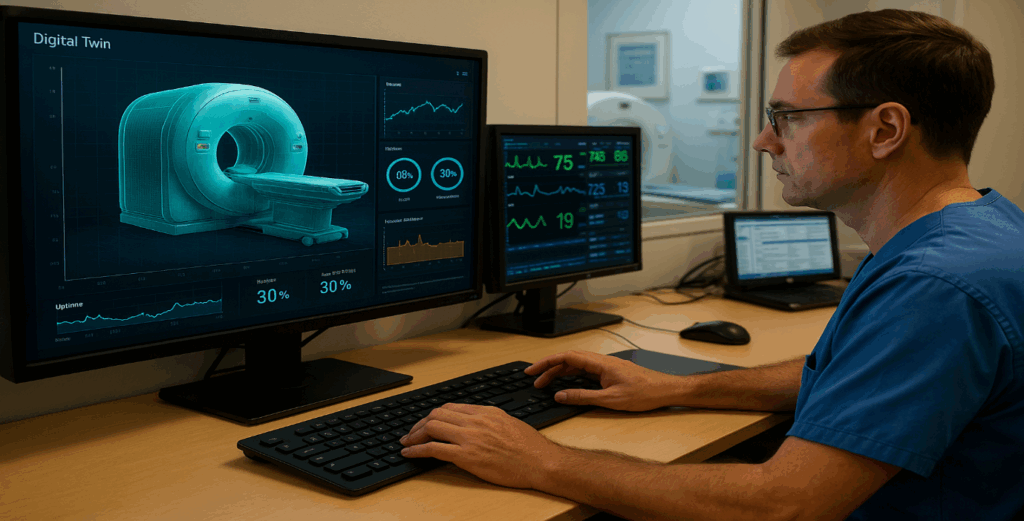
By integrating IoT sensors with cloud-hosted digital twin models, the hospital was able to capture continuous streams of performance data. This data was analyzed through AI-driven predictive analytics, which detected anomalies and forecasted potential failures before they occurred. The result was a 30% reduction in equipment downtime, ensuring uninterrupted access to critical medical devices and significantly improving operational efficiency.
Moreover, the platform allowed the hospital to simulate usage patterns and test different maintenance schedules, optimizing costs and reducing unnecessary service interventions. The improved asset utilization not only enhanced patient care delivery but also contributed to a 15% reduction in operating expenses related to equipment management.
This case study underscores the transformative impact of DTaaS in healthcare. By shifting from a reactive to a predictive and preventive maintenance model, hospitals can safeguard patient outcomes, improve staff productivity, and extend the lifespan of high-value medical equipment. It highlights how cloud-based DTaaS solutions democratize access to advanced technologies, enabling healthcare providers of all sizes to achieve enterprise-level operational efficiency without heavy upfront investments.