


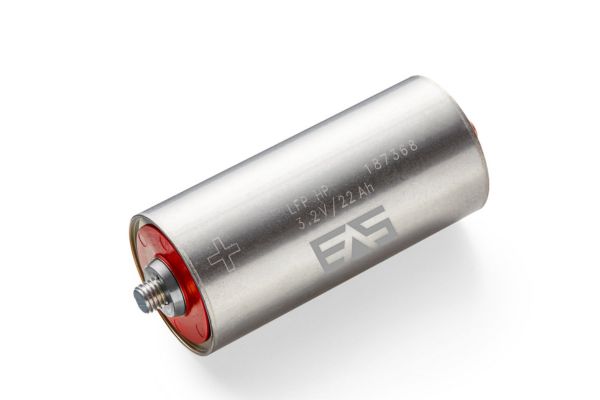
German battery manufacturer EAS Batteries has commercialized its ultra-high-power lithium-ion LFP cell, initially launched in March 2026. The cell incorporates Asahi Kasei’s novel acetonitrile-containing electrolyte Acetolyte, whose high ionic conductivity reduces internal resistance and improves rate capability, especially under demanding temperature conditions.
In November 2025, Asahi Kasei signed a licensing agreement with EAS Batteries covering the use of its electrolyte in the German manufacturer’s cylindrical LFP cells. The launch of the UHP601300 LFP 22 marks another milestone in the diversified global company’s licensing strategy for Acetolyte. With a nominal capacity of 22 Ah, the cell delivers 2,550 W/kg under continuous discharge, representing a 60% increase compared with cells using conventional electrolytes. Under a 2-second pulse discharge, specific power reaches 3,760 W/kg, an improvement of approximately 10%. The cell also delivers a cycle life of 2,400 cycles at 5C/5C and 100 % DoD at room temperature, reaching 80% of its initial capacity. Samples are currently being evaluated by customers across industries.
| UHP-601300-LFP-22(using Asahi Kasei electrolyte) | EAS Cell using conventional electrolyte | ||||
| Continuous discharge | 2,550 W/kg; 880 A (40C) | 1,550 W/kg; 550 A (25C) | |||
| Pulse discharge (2-sec) | 3,760 W/kg; 1,320 A (60C) | 3,420 W/kg; 1,320 A (60C) |
Asahi Kasei and EAS Batteries have agreed to sublicense their combined technologies to global OEMs and battery manufacturers, aiming to expand into mobility applications. The companies are also advancing their collaboration by evaluating the electrolyte’s application in the 46xxx cell format, with a product launch targeted for 2026. Prototypes of the 46xxx cell are already available for testing and are primarily designed for low-voltage electric vehicle batteries. “The successful commercialisation of our new cell featuring Asahi Kasei’s Acetolyte marks another important milestone in our strategic partnership. Our collaboration on the new 46xxx cell format is also progressing smoothly, underscoring the strength of our joint development approach and our ability to accelerate innovation from concept to market readiness.”, underlines EAS’ Managing Director Michael Deutmeyer.
Osamu Matsuzaki, Senior Executive Officer of Asahi Kasei and Head of Corporate R&D and IP commented: “The short time from signing our license agreement in November 2025 to the start of serial production in March 2026 reflects the focused and highly collaborative efforts between EAS Batteries and Asahi Kasei. Together, we have translated advanced electrolyte technology into a commercially viable high-power cell within just a few months. Building on this momentum, we are already working on the next cell format and look forward to further advancing high-performance battery solutions.” Asahi Kasei’s novel acetonitrile-containing electrolyte, Acetolyte, with high ionic conductivity, enables increased battery power output even at low temperatures and improved durability at high temperatures—an ongoing challenge for current LIBs. Furthermore, this technology reduces costs and enables smaller battery packs, thereby further increasing energy density.
Asahi Kasei announced a medium-term management plan (MTP) in April 2025, outlining the company’s strategy across its three sectors of Healthcare, Homes, and Material. Under the MTP, Asahi Kasei is pursuing Technology-value Business Creation (TBC), an initiative to monetize the company’s extensive intangible assets, including patents, know-how, data, and algorithms, by providing them in various forms, including licensing. This approach enables speed and asset-light commercialization, accelerating new business creation and maximizing value for customers and partners. Through such licensing-based business development, Asahi Kasei aims to conclude at least 10 new license agreements during fiscal 2025–2027, with a cumulative profit contribution of ¥10 billion or more by around 2030. Moving forward, the company aims to achieve a better future for people and the Earth by creating intangible assets and providing value through R&D with a vision of “Where transforming tomorrow begins.