

The Future of Electric Trucks Is Moving Beyond Urban Deliveries
The global trucking industry is approaching a major technological transition.
For years, electric trucks were primarily associated with short-distance deliveries, municipal operations and predictable urban routes. Limited battery range, lengthy charging times and high acquisition costs restricted their suitability for demanding freight applications.
That situation is beginning to change.
Advancements in battery technology, megawatt charging infrastructure and electric powertrains are creating new opportunities for battery-powered trucks across regional and long-haul transportation.
Leading commercial vehicle manufacturers are introducing electric trucks capable of traveling several hundred kilometers on a single charge, while charging technology developers are working to reduce charging interruptions to durations compatible with scheduled driver breaks.
These developments could fundamentally change the economics of road freight transportation.
According to Acumen Research and Consulting, the global Electric Truck Market was valued at USD 80.25 billion in 2025 and is projected to reach USD 1,042.44 billion by 2035, expanding at a 29.2% CAGR during 2026–2035.
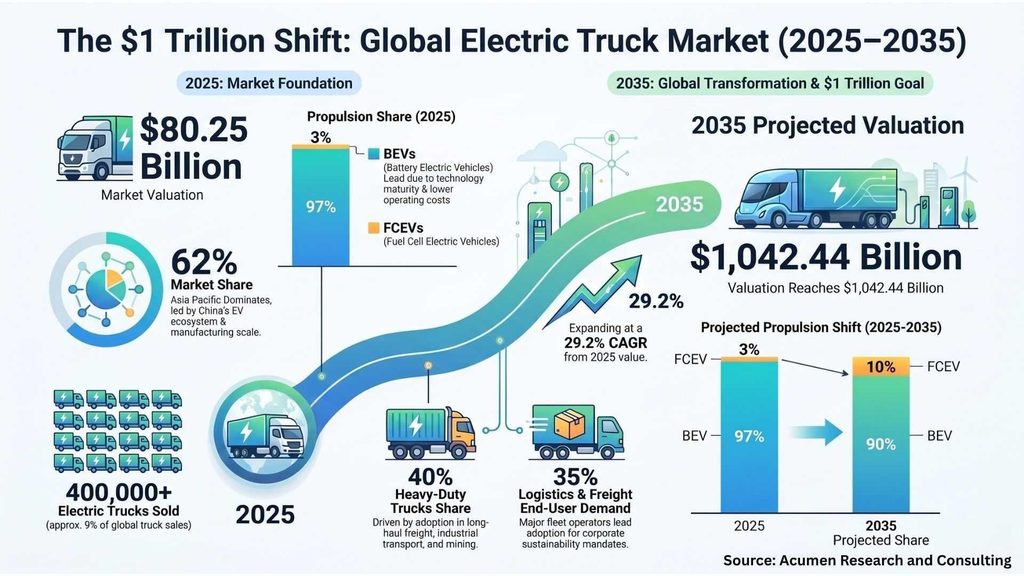
The projected growth reflects increasing adoption of battery-electric and fuel-cell electric trucks, supported by fleet decarbonization, improvements in battery performance and expansion of commercial vehicle charging infrastructure.
However, the most important transformation may not be the replacement of diesel engines with electric motors.
It could be the emergence of an entirely new freight operating model built around electricity costs, charging availability, vehicle utilization and intelligent fleet management.
Electric Truck Market Could Exceed USD 1 Trillion by 2035
The global Electric Truck Market is projected to expand more than thirteenfold between 2025 and 2035.
Acumen Research and Consulting estimates that electric truck market revenue will increase from USD 80.25 billion in 2025 to approximately USD 1.04 trillion by 2035.
This forecast reflects expectations of substantial growth from a developing commercial vehicle electrification market.
Several structural factors support the outlook.
First, logistics companies are facing increasing pressure to reduce transportation-related emissions.
Second, advances in battery technology are improving the operating range and performance of electric commercial vehicles.
Third, charging infrastructure is evolving to support larger vehicles and more demanding freight schedules.
Fourth, fleet operators are increasingly evaluating vehicle purchases using total cost of ownership rather than acquisition price alone.
These factors are creating opportunities across vehicle manufacturing, battery systems, charging infrastructure, power electronics and fleet-management software.
The market’s expansion will nevertheless depend on overcoming important challenges involving vehicle costs, electricity infrastructure and operational flexibility.
Megawatt Charging Could Transform Long-Haul Electric Freight
One of the most significant developments in the Electric Truck Market is the commercialization of megawatt charging technology.
Conventional charging systems can create substantial downtime for heavy-duty electric trucks equipped with large battery packs.
For commercial freight operators, downtime directly affects vehicle productivity.
A truck that spends several hours charging may complete fewer deliveries than a comparable diesel vehicle.
Megawatt Charging System (MCS) technology is designed to address this limitation by delivering substantially higher charging power.
In September 2026, Daimler Truck, MAN Truck & Bus, Scania and charging infrastructure operator Milence demonstrated megawatt charging capabilities at IAA Transportation in Hannover.
The demonstration showed that compatible electric trucks could reach high states of charge within approximately 30–45 minutes under the demonstrated conditions.
This is particularly important because charging could increasingly be coordinated with legally required driver rest periods.
The commercial implications are significant.
Instead of treating charging as a separate operational interruption, freight operators could incorporate it into existing transportation schedules.
However, the benefits depend on several factors, including vehicle compatibility, battery condition, charger power, electricity availability and route planning.
Megawatt charging is therefore an important technological enabler, but its commercial impact will depend on widespread infrastructure deployment.
Volvo’s 700-Kilometer Electric Truck Signals a New Competitive Phase
Electric truck manufacturers are increasingly focusing on operating range and charging performance.
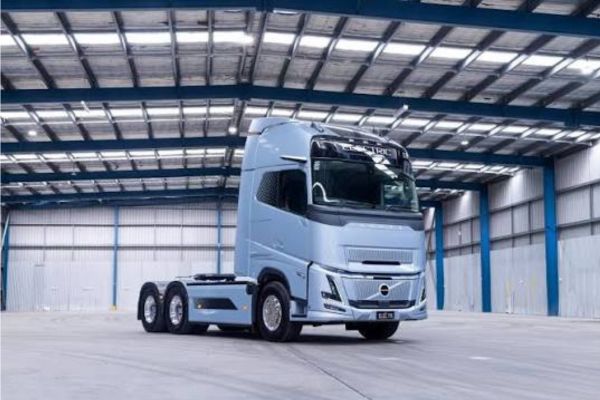
In April 2026, Volvo Trucks introduced an expanded electric truck portfolio, including the Volvo FH Aero Electric with extended range.
The company announced a driving range of up to 700 kilometers on a single charge for the long-distance model under specified conditions.
The truck uses an e-axle architecture that integrates electric motors and transmission components, creating additional space for battery capacity.
Volvo also designed the model for megawatt charging.
According to the manufacturer, the vehicle can charge from 20% to 80% in approximately 50 minutes using a 700-kW charging system.
This development highlights an important engineering transition.
Increasing battery capacity alone is not sufficient.
Manufacturers must optimize vehicle architecture, powertrain efficiency, battery placement and charging performance simultaneously.
The resulting improvements could make electric trucks suitable for a broader range of freight applications.
Actual driving range will still depend on payload, weather, road conditions, driving speed and operating patterns.
BYD Is Bringing Megawatt Charging Competition to Heavy-Duty Trucks
Chinese manufacturers are also accelerating development of long-range electric commercial vehicles.
At IAA Transportation 2026, BYD introduced its ETT 44 heavy-duty electric tractor.
The model was presented with a claimed driving range of up to 600 kilometers and support for charging power exceeding 1.5 megawatts.
BYD stated that its charging architecture could replenish the battery from 20% to 80% in approximately 20 minutes under suitable conditions.
The truck incorporates a large lithium iron phosphate battery pack and high-voltage electrical architecture.
The development illustrates how battery manufacturers and commercial vehicle producers are becoming more closely integrated.
BYD benefits from its established battery manufacturing capabilities, allowing it to develop vehicles and energy-storage systems within a connected technology ecosystem.
This could become an important competitive advantage.
As electric trucks require larger battery packs and faster charging, manufacturers with expertise in battery chemistry, thermal management and power electronics may be better positioned to optimize complete vehicle systems.
Battery-Electric Trucks Dominate With 97% Market Share
Battery-electric vehicles accounted for approximately 97% of the Electric Truck Market in 2025, making them the dominant propulsion category.
Their leadership reflects the relative maturity of lithium-ion battery technology, expanding charging infrastructure and improving electric drivetrain efficiency.
Battery-electric trucks are particularly suitable for operations involving predictable routes and centralized depots.
Examples include urban deliveries, retail distribution, municipal transportation and regional freight.
These applications allow operators to plan charging schedules around established vehicle usage patterns.
Battery-electric trucks also offer potential advantages through regenerative braking, reduced drivetrain maintenance and lower energy costs in suitable operating environments.
However, these advantages vary by electricity prices, vehicle utilization and local infrastructure.
Acumen projects that battery-electric trucks will retain approximately 90% market share by 2035.
This indicates that battery-electric propulsion is expected to remain the leading technology even as alternative zero-emission truck technologies expand.
Could Hydrogen Fuel-Cell Trucks Challenge Battery-Electric Vehicles?
Fuel-cell electric trucks represented approximately 3% of the market in 2025.
Their share is projected to increase to 10% by 2035.
Fuel-cell electric vehicles generate electricity onboard using hydrogen and a fuel-cell system.
They offer potential advantages in applications where refueling time, vehicle weight or extended operating range creates challenges for battery-electric alternatives.
However, fuel-cell trucks face substantial commercialization barriers.
Hydrogen production costs, refueling infrastructure availability and energy-conversion efficiency remain important considerations.
Battery-electric vehicles generally offer higher energy efficiency across the electricity-to-wheel pathway.
Hydrogen-based transportation may therefore be more attractive in selected applications rather than across the entire trucking market.
The long-term relationship between battery-electric and fuel-cell trucks will depend on infrastructure investment, energy prices, technology development and fleet operating requirements.
For now, battery-electric propulsion remains the clear market leader.
Heavy-Duty Electric Trucks Lead With 40% Market Share
Heavy-duty electric trucks accounted for approximately 40% of global market revenue in 2025, making them the largest vehicle category.
The segment includes vehicles used for freight transportation, industrial logistics, construction and other demanding commercial applications.
Heavy-duty trucks typically require larger battery systems and more powerful electric drivetrains than light-duty vehicles.
Their relatively high selling prices also contribute to market revenue.
Commercial interest is increasing as manufacturers introduce electric vehicles designed for demanding transportation requirements.
However, the operational requirements of heavy-duty trucks vary considerably.
A truck transporting goods between nearby distribution centers may be easier to electrify than one operating continuously across long-distance routes.
Successful adoption therefore depends on matching vehicle capabilities with specific transportation requirements.
Medium-Duty Electric Trucks Could Grow at 31.8% CAGR
Medium-duty electric trucks accounted for approximately 25% of the electric truck market in 2025.
Acumen projects that the segment will expand at a 31.8% CAGR during 2026–2035, making it the fastest-growing vehicle category.
Medium-duty trucks are widely used in regional distribution, urban logistics, refrigerated transportation and municipal services.
These applications often involve predictable daily routes and centralized operating facilities.
Such characteristics can simplify charging infrastructure planning.
For fleet operators, medium-duty electric trucks may offer an attractive balance between vehicle capability, battery requirements and operating costs.
The segment could therefore become an important bridge between established urban electric vehicle applications and more demanding heavy-duty freight operations.
Long-Range Electric Trucks Are the Fastest-Growing Driving-Range Segment
Short-range electric trucks accounted for approximately 45% of the market in 2025, making them the largest driving-range category.
These vehicles are typically used for urban logistics, last-mile deliveries and municipal operations.
However, the fastest growth is expected in long-range electric trucks.
Acumen projects that the segment covering vehicles operating beyond 500 kilometers per day will expand at a 37.3% CAGR during 2026–2035.
This reflects growing expectations that electric trucks will become commercially viable for longer-distance freight operations.
Several developments support the outlook.
Battery energy density is improving.
Electric drivetrains are becoming more efficient.
Manufacturers are optimizing vehicle aerodynamics and battery integration.
Megawatt charging infrastructure is also beginning to address the limitations associated with large commercial vehicle batteries.
Nevertheless, long-haul electrification remains dependent on reliable charging corridors and sufficient grid capacity.
The ability to complete a long journey with predictable charging stops will be critical to commercial adoption.
Total Cost of Ownership Will Determine Electric Truck Adoption
For commercial fleet operators, the most important consideration is not simply the purchase price of an electric truck.
It is the total cost of ownership.
Electric trucks generally involve higher upfront acquisition costs than comparable diesel vehicles.
However, operating expenses may be lower depending on electricity prices, maintenance requirements and annual vehicle utilization.
A comprehensive comparison should consider:
- Vehicle acquisition and financing costs
- Electricity or fuel expenditure
- Charging infrastructure investment
- Maintenance and repair expenses
- Battery durability and replacement requirements
- Insurance and residual value
- Vehicle downtime and productivity
- Payload and route suitability
Electric drivetrains contain fewer conventional mechanical components than diesel powertrains, potentially reducing certain maintenance requirements.
Regenerative braking can also reduce brake wear in suitable operating conditions.
However, charging infrastructure and electricity demand charges can introduce additional expenses.
Fleet operators must therefore evaluate the economics of electrification based on actual operating conditions.
The commercial success of electric trucks will depend on whether they can deliver competitive freight transportation costs over their operating lives.
Depot Charging Could Be the First Major Infrastructure Opportunity
Public megawatt charging networks are important for long-haul transportation.
However, depot charging is likely to remain essential for many commercial fleets.
Distribution centers, warehouses and logistics hubs offer opportunities to charge vehicles during scheduled periods of inactivity.
Depot charging can be particularly effective when vehicles follow predictable routes.
Operators can estimate daily energy consumption and schedule charging around fleet requirements.
However, electrifying an entire depot can create substantial electricity demand.
Large fleets may require upgrades to transformers, electrical connections and distribution equipment.
This creates opportunities for companies supplying commercial charging systems, electrical infrastructure and energy-management software.
Battery energy storage systems may also help operators manage electricity demand and charging schedules.
The infrastructure opportunity therefore extends beyond installing individual charging points.
It involves developing integrated energy systems capable of supporting commercial vehicle fleets.
Grid Capacity Could Become a Major Constraint on Electric Truck Growth
The expansion of electric trucking will increase electricity demand at freight depots, logistics hubs and highway charging locations.
A charging facility serving multiple heavy-duty trucks simultaneously may require several megawatts of electrical capacity.
In some locations, the existing electricity grid may not be able to support such demand without upgrades.
This introduces challenges involving grid connections, infrastructure costs and project timelines.
Charging operators may need to coordinate with utilities years before opening new facilities.
Energy-management systems could help optimize charging schedules and reduce peak demand.
Onsite battery storage and renewable electricity generation may provide additional flexibility in selected applications.
However, these solutions do not eliminate the need for reliable grid infrastructure.
The pace of electric truck adoption will therefore depend partly on how quickly electricity networks can accommodate commercial vehicle charging demand.
Asia-Pacific Dominates With 62% Market Share
Asia-Pacific accounted for approximately 62% of global Electric Truck Market revenue in 2025, making it the largest regional market.
The region benefits from extensive electric vehicle manufacturing capabilities, established battery supply chains and growing commercial fleet electrification.
China plays a particularly important role.
The country has developed substantial manufacturing capacity for electric commercial vehicles and lithium-ion batteries.
Manufacturers such as BYD, Dongfeng, Foton, FAW Jiefang and SANY participate in the electric truck ecosystem.
China’s domestic market also provides manufacturers with opportunities to achieve production scale.
Beyond China, countries including India, Japan and South Korea are expanding their electric commercial vehicle ecosystems.
However, regional adoption patterns differ according to vehicle requirements, charging availability and government policies.
Asia-Pacific’s leadership reflects both manufacturing capacity and domestic market demand.
North America Could Expand at 33.4% CAGR
North America accounted for approximately 15% of the global market in 2025.
Acumen projects that the regional market will expand at a 33.4% CAGR during 2026–2035.
The United States represents a major opportunity due to its large freight transportation industry and extensive logistics networks.
Electric truck adoption is developing across regional freight, urban distribution and selected heavy-duty applications.
Manufacturers including Tesla, PACCAR and established commercial vehicle suppliers are developing electric truck offerings.
In September 2026, Tesla outlined plans to expand its Semi truck into Europe, highlighting the growing international competition in heavy-duty electric transportation.
However, North American adoption faces challenges involving long freight distances, charging infrastructure availability and regulatory uncertainty.
The market’s development will depend on improvements in vehicle economics and the expansion of reliable charging networks.
Middle East and Africa Could Record the Fastest Regional Growth
The Middle East and Africa represented approximately 1% of global Electric Truck Market revenue in 2025.
Despite its relatively small initial market size, the region is projected to expand at a 39.5% CAGR during 2026–2035.
Growth opportunities are emerging in logistics, construction, municipal transportation and industrial applications.
Countries including the United Arab Emirates and Saudi Arabia are investing in transportation modernization and infrastructure development.
Commercial vehicle electrification could become increasingly relevant for logistics hubs, ports and large industrial facilities.
However, the region’s market development will depend on charging infrastructure, vehicle availability and operating economics.
High growth rates from a small base should not be confused with immediate market leadership.
India’s Electric Truck Market Offers Long-Term Opportunities
India’s commercial transportation sector presents a significant opportunity for electric truck adoption.
The country has a large freight industry, expanding logistics infrastructure and growing interest in transportation electrification.
Electric trucks could find early applications in port operations, industrial transportation, urban distribution and predictable regional freight routes.
Government initiatives, including PM E-DRIVE and automotive manufacturing support programs, aim to encourage electric mobility and domestic production.
However, heavy-duty electric truck adoption faces important challenges.
Vehicle acquisition costs remain substantial.
Commercial charging infrastructure is still developing.
Grid capacity, financing availability and fleet operating economics will influence adoption.
India’s opportunity extends beyond vehicle assembly.
Domestic companies could participate in battery packs, power electronics, electric drivetrains, charging systems and fleet-management technologies.
As the market matures, partnerships between commercial vehicle manufacturers, energy companies and logistics operators may become increasingly important.
Logistics and Freight Companies Lead With 35% Market Share
Logistics and freight companies accounted for approximately 35% of the Electric Truck Market in 2025, making them the largest end-user category.
The segment’s leadership reflects the growing importance of fleet electrification within transportation and supply-chain operations.
Large logistics companies operate extensive vehicle fleets and may benefit from economies of scale when deploying charging infrastructure.
They can also evaluate electric vehicles across multiple routes and operating environments.
Retail and e-commerce fleets represented approximately 20% of market revenue in 2025.
These businesses often operate vehicles across predictable distribution networks, making selected routes suitable for electrification.
As vehicle performance improves, adoption could expand into construction, industrial transportation and fleet leasing.
Leading Companies Are Competing on More Than Driving Range
Competition in the Electric Truck Market increasingly involves complete vehicle and energy-management systems.
Volvo Trucks is expanding its electric commercial vehicle portfolio with longer-range models and advanced charging capabilities.
Daimler Truck is developing battery-electric heavy-duty vehicles and testing megawatt charging for long-haul transportation.
BYD combines battery manufacturing expertise with electric commercial vehicle development.
Tesla is positioning its Semi platform for demanding freight applications.
MAN Truck & Bus and Scania are participating in megawatt charging development and commercial vehicle electrification.
SANY and other Chinese manufacturers are expanding electric truck offerings across industrial and commercial applications.
The competitive landscape also includes battery suppliers, charging infrastructure developers and power electronics companies.
Manufacturers capable of integrating efficient vehicles with dependable charging and service infrastructure may gain an advantage.
Battery Technology Remains Central to Electric Truck Economics
Battery systems represent one of the most important cost and performance components of electric trucks.
Large battery packs provide the energy required for extended transportation operations.
However, additional battery capacity increases vehicle weight and acquisition cost.
Manufacturers must therefore balance driving range, payload, charging performance and durability.
Lithium iron phosphate batteries are attractive for applications prioritizing cost, durability and thermal stability.
Nickel-rich lithium-ion chemistries may offer advantages where higher energy density is particularly important.
Future battery innovations could improve commercial vehicle performance.
However, the economic value of battery technology depends on the complete vehicle system.
A battery with greater energy density may improve range or payload, but its benefits must be evaluated against cost, lifespan and charging characteristics.
For fleet operators, reliable battery performance over the vehicle’s operating life is more important than laboratory specifications alone.
Electric Truck Market Investment Opportunities Extend Across the Value Chain
The projected expansion of the Electric Truck Market creates opportunities beyond vehicle manufacturing.
Battery manufacturers could benefit from increasing demand for high-capacity commercial vehicle battery systems.
Power electronics suppliers may see growth in high-voltage components, inverters and electric drivetrains.
Charging equipment manufacturers could benefit from depot charging and megawatt charging infrastructure.
Electrical infrastructure companies may participate in transformer upgrades, grid connections and energy-management systems.
Software providers could develop fleet charging optimization, route planning and battery-health monitoring solutions.
The market also creates opportunities for financing and leasing providers capable of addressing the high upfront costs of electric commercial vehicles.
However, each opportunity carries different risks.
Vehicle manufacturers face intense competition and capital requirements.
Charging infrastructure providers depend on utilization and electricity economics.
Battery suppliers must manage technology changes and manufacturing costs.
Investors should therefore evaluate the electric truck ecosystem as several interconnected markets rather than one uniform growth opportunity.
What Could Slow the Electric Truck Market?
Despite its strong growth outlook, the industry faces significant barriers.
High acquisition costs: Electric trucks can be substantially more expensive than comparable diesel vehicles.
Charging infrastructure gaps: Long-haul freight requires reliable high-power charging along major transportation corridors.
Grid constraints: Commercial charging facilities may require substantial electricity infrastructure upgrades.
Payload limitations: Large battery packs can affect vehicle weight and cargo capacity.
Battery durability: Commercial vehicles require dependable performance across demanding operating cycles.
Financing challenges: Fleet operators must justify substantial upfront investments.
Policy uncertainty: Changes in incentives, emissions standards and infrastructure programs can influence adoption.
Residual-value uncertainty: Rapid technological development may complicate long-term vehicle valuation.
These challenges do not eliminate the market opportunity.
However, they highlight why electric truck adoption will vary across regions and freight applications.
Electric Truck Market Outlook: From Vehicle Electrification to Electric Freight Ecosystems
The Electric Truck Market is projected to grow from USD 80.25 billion in 2025 to USD 1,042.44 billion by 2035, reflecting a 29.2% CAGR.
The forecast reflects increasing commercial vehicle electrification, improvements in battery performance and expansion of charging infrastructure.
However, the market’s most important transformation may be the development of integrated electric freight ecosystems.
Several transitions are becoming increasingly important.
Urban delivery to long-haul freight: Electric trucks are expanding beyond short-distance operations toward regional and long-distance transportation.
Conventional charging to megawatt charging: High-power charging could reduce downtime and improve vehicle utilization.
Vehicle acquisition price to total cost of ownership: Fleet operators are increasingly evaluating operating costs, maintenance and productivity.
Individual vehicles to integrated fleet energy systems: Charging infrastructure, energy storage and fleet-management software are becoming more important.
Battery performance to complete vehicle efficiency: Manufacturers are optimizing drivetrains, aerodynamics, thermal management and charging capabilities together.
These developments suggest that the next phase of electric trucking will be defined by operational performance rather than vehicle electrification alone.
For manufacturers, this means developing trucks that meet demanding commercial requirements.
For logistics companies, it means evaluating routes, charging infrastructure and total transportation costs.
For technology suppliers, it means identifying opportunities across batteries, charging equipment, power electronics and software.
The long-term winners in electric trucking may not simply be the companies producing the most electric vehicles. They may be those enabling freight operators to move goods more efficiently, reliably and economically using electricity.
Electric Truck Market Statistics
| Market indicator | Statistics |
| Global market size, 2025 | USD 80.25 billion |
| Global market forecast, 2035 | USD 1,042.44 billion |
| CAGR, 2026–2035 | 29.2% |
| Asia-Pacific share, 2025 | 62% |
| North America share, 2025 | 15% |
| North America CAGR | 33.4% |
| Middle East & Africa share, 2025 | 1% |
| Middle East & Africa CAGR | 39.5% |
| Battery-electric trucks share | 97% (2025) → 90% (2035) |
| Fuel-cell electric trucks share | 3% (2025) → 10% (2035) |
| Heavy-duty electric trucks share, 2025 | 40% |
| Medium-duty electric trucks share, 2025 | 25% |
| Medium-duty trucks CAGR | 31.8% |
| Short-range electric trucks share, 2025 | 45% |
| Long-range electric trucks CAGR | 37.3% |
| Logistics and freight companies share, 2025 | 35% |
| Retail and e-commerce fleets share, 2025 | 20% |
Source: Acumen Research and Consulting, Electric Truck Market, July 2026. Figures represent market estimates and forecasts.
Frequently Asked Questions
What is the Electric Truck Market?
The Electric Truck Market includes battery-electric and fuel-cell electric trucks used in commercial transportation, logistics, construction, municipal services and industrial applications.
How big is the global Electric Truck Market?
The global Electric Truck Market was valued at USD 80.25 billion in 2025 and is projected to reach USD 1,042.44 billion by 2035, growing at a 29.2% CAGR during 2026–2035.
Which region dominates the Electric Truck Market?
Asia-Pacific led the market with approximately 62% revenue share in 2025, supported by extensive electric vehicle manufacturing and commercial fleet electrification.
Which electric truck propulsion technology leads the market?
Battery-electric trucks accounted for approximately 97% of market revenue in 2025 and are projected to retain a 90% share by 2035.
What is megawatt charging for electric trucks?
Megawatt charging is a high-power charging technology designed to replenish large commercial vehicle batteries more rapidly, potentially reducing charging interruptions during freight operations.
Can electric trucks be used for long-haul transportation?
Yes. Manufacturers are introducing heavy-duty electric trucks designed for long-distance transportation. However, practical deployment depends on vehicle range, payload, charging availability and route conditions.
What is the fastest-growing electric truck segment?
Long-range electric trucks are projected to expand at a 37.3% CAGR during 2026–2035, while medium-duty electric trucks are expected to grow at 31.8%.
What are the major challenges facing electric trucks?
Major challenges include high upfront costs, charging infrastructure availability, grid capacity, battery weight, financing requirements and vehicle utilization.