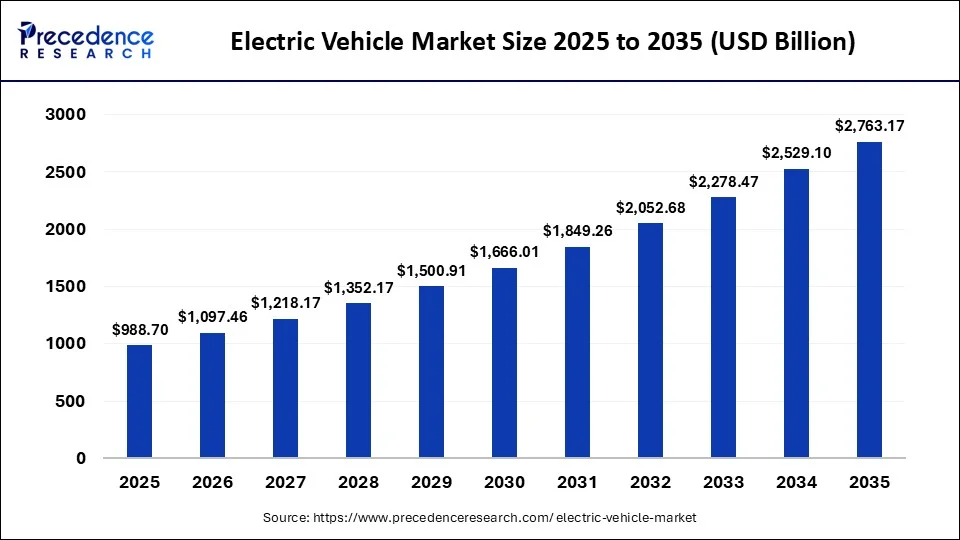
The global electric vehicle market size was estimated at USD 988.70 billion in 2025 and is predicted to increase from USD 1,097.46 billion in 2026 to approximately USD 2,763.17 billion by 2035, expanding at a CAGR of 10.82% from 2026 to 2035. The market is driven by ongoing advances in battery technology and government initiatives to promote EVs.
Key Takeaways
- By region, Asia Pacific led the electric vehicle market in 2025.
- By region, North America is expected to grow at the fastest rate between 2026 and 2035.
- By propulsion type, the battery electric vehicles segment held a 67.7% share of the market in 2025.
- By propulsion type, the PHEV segment is expected to grow at the fastest rate between 2026 and 2035.
- By vehicle type, the passenger car segment held the highest share of the market in 2025.
- By vehicle type, the trucks segment is predicted to grow at the fastest CAGR in the market between 2026 and 2035.
- By vehicle class, the low-price electric vehicle segment held the highest market share in 2025.
- By vehicle class, the mid-price electric vehicle segment is predicted to grow at a significant rate from 2026 to 2035.
- By vehicle speed, the 100MPH-125MPH segment dominated the market in 2025.
- By vehicle speed, the less than 100MPH segment is expected to grow at a rapid pace between 2026 and 2035.
- By drive type, the front wheel drive segment acquired the largest share in 2025.
- By drive type, the all-wheel drive segment is expected to grow at a significant CAGR from 2026 to 2035.
- By end-use, the personal segment dominated the market in 2025.
- By end-use insights, the commercial use segment is expected to expand rapidly from 2026 to 2035.
Market Overview
The electric vehicle (EV) industry is transforming the global transportation landscape, driven by rapid technological innovation, stringent emission regulations, and growing demand for sustainable mobility solutions. Expanding charging infrastructure, increasing availability of smart EV models, and strategic partnerships among automakers, technology providers, and charging network operators are accelerating market growth. Investments in ultra-fast charging stations across highways and urban areas are improving accessibility and convenience for consumers. Additionally, fluctuating fossil fuel prices and rising environmental awareness are encouraging the adoption of EVs. Manufacturers are introducing a wide range of affordable and feature-rich electric vehicles that align with evolving consumer preferences, further strengthening market demand.
Impact of AI on the Electric Vehicle Market
Artificial intelligence (AI) is playing a critical role in advancing the electric vehicle market by enhancing vehicle performance, efficiency, and user experience. AI-powered systems and machine learning algorithms improve battery management by optimizing charging and discharging cycles, extending battery life, and maximizing driving range. AI also enhances regenerative braking systems, enabling more efficient energy recovery and utilization.
AI-driven navigation and route-planning tools help drivers locate charging stations, estimate energy consumption, and identify optimal charging opportunities. In the energy ecosystem, AI supports smart grid management by balancing electricity demand and integrating renewable energy sources, allowing EV charging to occur during the most efficient and cost-effective periods.
Regional Outlook of the Electric Vehicle Market
North America
North America is expected to grow at the fastest CAGR over the forecast period, driven by increasing investments in advanced battery technologies, expanding charging infrastructure, and supportive government policies aimed at reducing transportation emissions. The region is witnessing significant research and development activities in areas such as solid-state batteries, lithium-sulfur batteries, and fast-charging technologies, which are expected to improve EV performance and accelerate adoption. Strategic collaborations among automakers, technology providers, and charging network operators are further supporting market expansion.
Asia Pacific
Asia Pacific dominated the electric vehicle market by holding the largest share in 2035. The region’s dominance is supported by strong government policies, extensive manufacturing capabilities, rapidly expanding charging infrastructure, and continuous advancements in battery technology. Major EV-producing countries, including China, Japan, South Korea, and India, are investing heavily in research, production capacity, and supply chain development. Government initiatives such as subsidies, tax incentives, and local manufacturing programs continue to accelerate EV adoption. Additionally, the integration of AI-powered battery management systems and vehicle technologies is enhancing battery performance, driving range, and overall vehicle efficiency.
Europe
Europe is anticipated to witness significant growth during the forecast period, supported by stringent emission regulations, strong government incentives, and rising adoption of battery electric vehicles (BEVs). The region is becoming a major hub for EV innovation, battery production, and sustainable mobility solutions. Increasing demand for electric SUVs and compact EVs, along with ongoing investments in battery gigafactories and localized supply chains, is contributing to regional market expansion. Industry partnerships and advancements in charging infrastructure are further supporting the transition toward electrified transportation.
Electric Vehicle Market Companies
Ampere Vehicles
Ampere Vehicles is one of India’s leading electric two-wheeler manufacturers, known for affordable electric scooters designed for urban and last-mile mobility. The company continues to strengthen its presence in the growing EV market through innovation, expanded distribution, and sustainable transportation solutions. Its FY2025 operating revenue stood at approximately ₹659 crore.
Hyundai Motor Company
Hyundai Motor Company is a global automotive leader actively expanding its electric vehicle portfolio through models such as the IONIQ series and other next-generation EVs. The company is investing heavily in electrification, battery technology, and smart mobility solutions to strengthen its position in the global EV industry. Hyundai reported KRW 186.3 trillion in revenue for 2025.
Benling India Energy and Technology Pvt. Ltd.
Benling India specializes in electric scooters and focuses on providing eco-friendly mobility solutions for the Indian market. The company has expanded its dealer network and product portfolio to cater to increasing demand for affordable electric transportation. 2025 revenue figures are not publicly disclosed.
BMW AG
BMW AG is a premium automotive manufacturer with a rapidly growing electric vehicle lineup under the BMW i brand, including models such as the i4, i5, and iX. The company continues to accelerate its transition toward sustainable mobility through electrification and advanced battery technologies. 2025 revenue: approximately €142 billion (BMW Group annual revenue).
General Motors
General Motors is one of the world’s largest automakers and is investing billions of dollars in electric vehicles through brands such as Chevrolet, GMC, Cadillac, and BrightDrop. Its Ultium battery platform is central to the company’s strategy to achieve an all-electric future. 2025 revenue: approximately US$187 billion.
Hero Electric
Hero Electric is among India’s pioneering electric two-wheeler companies, offering a wide range of electric scooters for personal and commercial mobility. The company focuses on affordable EV adoption and has established an extensive dealer and service network across India. 2025 revenue figures are not publicly disclosed.
Karma Automotive
Karma Automotive is a luxury electric vehicle manufacturer based in the United States, recognized for combining premium design with advanced electrified powertrain technologies. The company focuses on high-performance EVs and extended-range electric vehicles aimed at the luxury automotive segment. 2025 revenue figures are not publicly disclosed.
Kia Corporation
Kia Corporation is a global automotive company rapidly expanding its EV lineup through models such as the EV3, EV5, EV6, and EV9. The company is pursuing an aggressive electrification strategy and aims to become a leading player in sustainable mobility solutions worldwide. 2025 revenue: approximately KRW 113 trillion.
Segmental Insights of the Electric Vehicle Market
Propulsion Type Insights
The battery electric vehicle (BEV) segment dominated the electric vehicle market with the largest share of 67.7% in 2025. This is mainly due to continuous technological advancements in batteries, increasing environmental awareness, and stringent emission regulations aimed at reducing greenhouse gas emissions from the transportation sector. BEVs offer superior energy efficiency, lower operating costs, and simplified vehicle architecture compared to conventional vehicles. The absence of components such as internal combustion engines, spark plugs, and transmission systems significantly reduces maintenance requirements, making BEVs an attractive and cost-effective option for consumers.
Vehicle Type Insights
The passenger cars segment held the largest market share in 2025, supported by expanding charging infrastructure, favorable government incentives, and growing consumer acceptance of electric mobility. Rising demand for electric SUVs and passenger vehicles, particularly in major markets such as Europe and China, further strengthened segment growth. In addition, government initiatives aimed at reducing dependence on internal combustion engine (ICE) vehicles have accelerated the adoption of electric passenger cars.
The trucks segment is anticipated to grow at a significant rate during the forecast period, driven by the increasing electrification of logistics and transportation fleets, coupled with efforts to reduce total cost of ownership and carbon emissions. Growing adoption across light-duty, medium-duty, and heavy-duty commercial vehicle categories is expected to create substantial growth opportunities for the segment.
Drive Type Insights
The front-wheel drive (FWD) segment led the electric vehicle market, accounting for the largest share in 2025, as FWD systems integrate the motor, inverter, and gearbox into a compact configuration, eliminating the need for complex drivetrain components. This design improves interior space utilization, enhances energy efficiency, and reduces manufacturing costs, making FWD vehicles particularly suitable for urban and everyday driving applications.
The all-wheel drive (AWD) segment is projected to grow at the fastest rate during the forecast period. Electric AWD systems utilize independent motors to power multiple wheels, providing enhanced traction, stability, and performance. Advances in software-based torque vectoring and vehicle control systems are further improving driving dynamics and accelerating adoption among premium and performance-oriented EV models.