


Healthcare IoT depends on more than sensors and smart medical devices. Once a device captures a heartbeat, oxygen level, glucose reading, temperature, or other health signal, that information needs a reliable way to move from the device to a smartphone, gateway, hospital network, or cloud platform.
This is where connectivity becomes the backbone of connected healthcare. Technologies such as Bluetooth, Wi-Fi, Zigbee, LoRaWAN, cellular networks, and 5G provide different ways for medical electronics to exchange data.
Why Connectivity Matters in Healthcare IoT
A connected medical device typically follows a simple data path:
Sensor → Signal Processing → Microcontroller → Wireless Module → Gateway/Network → Cloud or Healthcare System
Each layer has a specific role. Sensors collect biological or physical information, while embedded electronics process the signal. The wireless module then transmits the processed data to another device or network.
The connectivity technology must match the application. A wearable may need extremely low power, while an ambulance device may require reliable cellular communication. A hospital monitoring system may prioritize network capacity, security, and low latency.
Technologies Used in Healthcare IoT
Different wireless technologies support different healthcare applications:
- Bluetooth Low Energy (BLE): Used for low-power communication between wearables, medical patches, glucose monitors, pulse oximeters, smartphones, and gateways.
- Wi-Fi: Provides higher data rates and is commonly used in hospitals, clinics, connected medical equipment, and home healthcare systems.
- Zigbee: Supports low-power communication between multiple connected devices and can be useful for hospital equipment and smart healthcare environments.
- LoRaWAN: Enables long-range, low-power communication for sensors that transmit relatively small amounts of data over large areas.
- NB-IoT: A cellular IoT technology designed for low-power devices that need wide-area network connectivity, making it relevant to remote monitoring applications.
- 4G LTE: Provides established cellular connectivity for mobile healthcare devices, remote monitoring systems, and connected medical equipment.
- 5G: Offers higher data rates, low latency, and support for large numbers of connected devices, opening possibilities for advanced remote monitoring and connected healthcare applications.
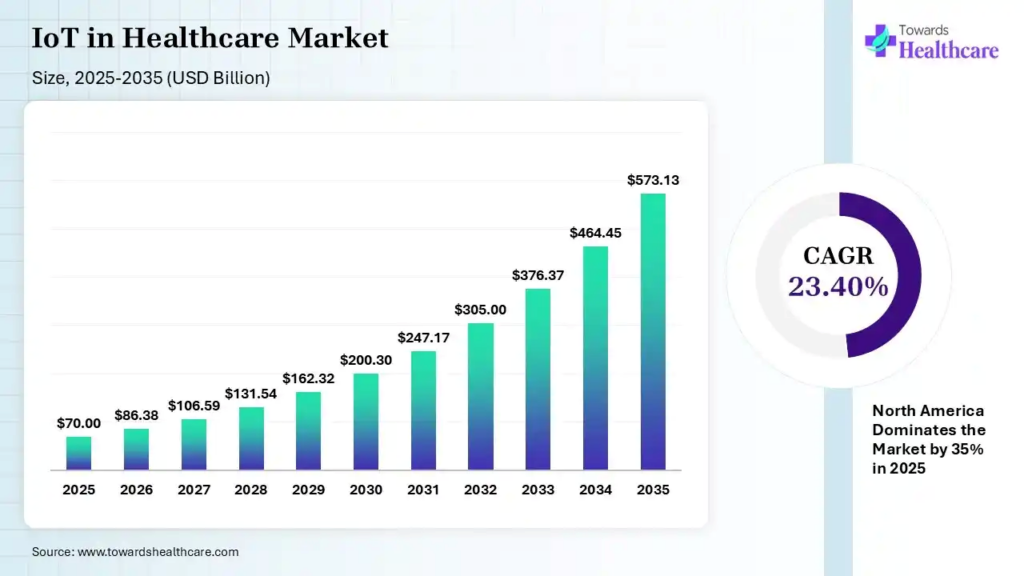
According to Towards Healthcare Research and Consulting, IoT in healthcare market is forecast to grow at a CAGR of 23.4%, from USD 86.38 billion in 2026 to USD 573.13 billion by 2035, over the forecast period from 2026 to 2035.
Bluetooth: Connecting Devices Close to the Patient
Bluetooth, particularly Bluetooth Low Energy, is well suited to short-range healthcare applications. It allows devices such as wearable monitors, glucose sensors, pulse oximeters, and medical patches to communicate with smartphones, tablets, or local gateways.
BLE is designed for low-power communication, making it useful for battery-operated medical electronics that need to operate for long periods.
Its main limitation is range. It generally works best when the connected device and receiving system are relatively close.
Wi-Fi: Higher Data Rates Inside Healthcare Facilities
Wi-Fi provides greater bandwidth than many low-power wireless technologies and is already widely deployed in hospitals, clinics, laboratories, and homes.
Connected patient-monitoring systems, medical equipment, healthcare gateways, and other devices can use Wi-Fi to transmit larger volumes of information.
The trade-off is power consumption. Continuous Wi-Fi communication can place a greater load on small batteries, making it less suitable for some compact wearable devices.
Zigbee and LoRaWAN: Designed for Specific IoT Needs
Zigbee can support low-power communication between multiple devices within a local network. This can be useful for connected hospital equipment, environmental sensors, and smart building systems.
LoRaWAN takes a different approach. It is designed for long-range, low-power communication and can support sensors that send small amounts of data over extended distances.
These technologies highlight an important principle of healthcare IoT: there is no single wireless standard for every medical application.
5G: Bringing Cellular Connectivity Closer to Medical Devices
5G introduces high data rates, low latency, and the ability to connect large numbers of devices. These characteristics can support applications such as remote patient monitoring, connected ambulances, remote diagnostics, and data-intensive healthcare services.
For medical IoT, the value of 5G is not simply speed. Network reliability, device density, latency, and the ability to support different service requirements can also matter.
However, 5G-enabled hardware can introduce additional power, cost, antenna, and network-design considerations.
Challenges and Opportunities
Challenges
- Power consumption: Wireless transmission can significantly affect battery life in small medical devices.
- Interoperability: Devices using different communication standards need to exchange data reliably.
- Cybersecurity: Wireless healthcare devices must protect sensitive health information from unauthorized access.
- Network reliability: Medical applications may require stable communication, particularly for continuous monitoring.
- Electromagnetic interference: Nearby electronic equipment can affect wireless and sensor performance.
- Antenna limitations: Small device sizes and body placement can make antenna design more difficult.
- Connectivity coverage: Remote and rural healthcare applications may face limited network availability.
Opportunities
- Remote patient monitoring: Connected devices can transmit health information outside hospitals and clinics.
- Wearable medical electronics: Low-power wireless technologies can support continuous monitoring through compact devices.
- Connected ambulances: Cellular connectivity can enable medical information to be transmitted while patients are in transit.
- Smart hospitals: Networked equipment and sensors can improve monitoring of patients, assets, and healthcare environments.
- Edge healthcare: Local processing can analyze sensor data before sending selected information to the cloud.
- 5G-enabled applications: Higher bandwidth and lower latency can support new connected medical use cases.
- Multi-network devices: Combining Bluetooth, Wi-Fi, cellular, or other protocols can provide greater flexibility across healthcare environments.
Conclusion
From short-range Bluetooth links to wide-area 5G networks, connectivity provides the communication layer that turns standalone medical electronics into connected healthcare systems.
The future will not depend on one technology replacing another. Instead, healthcare IoT will increasingly combine wireless standards, embedded processors, sensors, antennas, and power-management technologies to create medical devices that can collect, process, and securely move health information wherever it is needed.