


The agricultural sector is undergoing a profound transformation as sustainability, productivity, and operational efficiency become central priorities for modern farming. At the heart of this shift is the rapid evolution of electric farm equipment, including electric tractors, harvesters, sprayers, and autonomous field machinery. While electrification is often associated with cleaner energy and lower emissions, the real catalyst behind this transition is the emergence of advanced manufacturing technologies that are making electric agricultural equipment more powerful, reliable, and commercially viable.
The global agricultural electric tractor market was valued at approximately USD 624.8 million in 2025 and is projected to reach USD 2.4 billion by 2033, growing at a CAGR of 18.9%. Asia-Pacific currently accounts for nearly 40% of the global market, reflecting strong demand from agricultural economies such as India and China.

One of the most significant drivers of this growth is Industry 4.0 manufacturing. Smart factories equipped with Industrial Internet of Things (IIoT) systems, artificial intelligence, robotics, and digital twins enable manufacturers to optimize production processes, improve quality control, and reduce costs. Advanced sensors monitor every stage of production, ensuring precision manufacturing of critical components such as battery packs, electric motors, power electronics, and drivetrain systems. Research shows that IIoT-enabled manufacturing is helping agricultural equipment producers move toward zero-defect production models while improving reliability and durability.
Battery technology is another area benefiting from advanced manufacturing. Modern automated battery assembly lines can produce high-density lithium-ion battery packs with greater consistency and safety than traditional methods. Improvements in battery management systems, thermal controls, and cell design have increased energy density while reducing production costs. As a result, electric tractors can now operate for longer durations, making them increasingly suitable for commercial farming operations. The battery electric tractor segment accounted for more than 61% of the agricultural electric tractor market in 2025, highlighting growing confidence in battery-powered farm machinery.
Additive manufacturing, commonly known as 3D printing, is also reshaping the industry. Manufacturers can rapidly prototype components, reduce material waste, and develop lightweight parts that improve energy efficiency. Complex components such as motor housings, cooling systems, and structural brackets can be produced with greater design flexibility than conventional manufacturing methods. This accelerates product development cycles and allows manufacturers to respond quickly to changing farmer requirements.
Robotics and automation have become equally important in production facilities. Advanced robotic systems perform precision welding, assembly, painting, and quality inspection tasks with exceptional accuracy. This not only improves consistency but also reduces manufacturing defects and production downtime. Studies on industrial robotics indicate that connected robotic systems are becoming a cornerstone of next-generation manufacturing environments, helping companies scale production while maintaining quality standards.
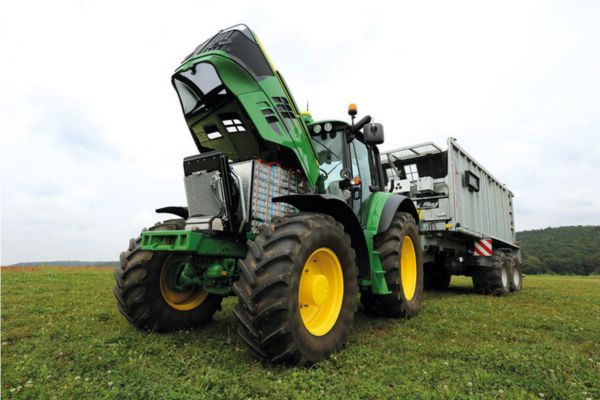
The integration of advanced manufacturing technologies is also enabling the development of autonomous electric farm equipment. Electric tractors are particularly well-suited for autonomous operations because their electronic control architecture can seamlessly integrate with GPS guidance systems, machine-learning algorithms, cameras, and precision sensors. Manufacturers are increasingly embedding smart technologies that allow equipment to perform seeding, spraying, and harvesting tasks with minimal human intervention. This is especially valuable as agriculture faces growing labor shortages worldwide.
In India, the opportunity is particularly significant. The country recorded a historic 10.9 lakh domestic tractor sales in 2025, reflecting strong demand for farm mechanization. As manufacturers invest in electric platforms and smart manufacturing capabilities, India is well-positioned to emerge as a major hub for next-generation agricultural machinery production.
Looking ahead, advanced manufacturing will continue to play a decisive role in accelerating electric farm equipment adoption. From AI-driven production systems and automated battery assembly to robotics, digital twins, and additive manufacturing, these innovations are reducing costs, improving performance, and enabling smarter machines. The result is a new generation of electric farm equipment that not only supports sustainability goals but also enhances productivity, profitability, and resilience for farmers worldwide.
As agriculture moves toward a future defined by precision, automation, and clean energy, advanced manufacturing technologies will remain the foundation upon which the next era of electric farming is built.

By: Pankaj Goyal, Co-Founder and the COO, AutoNXT