
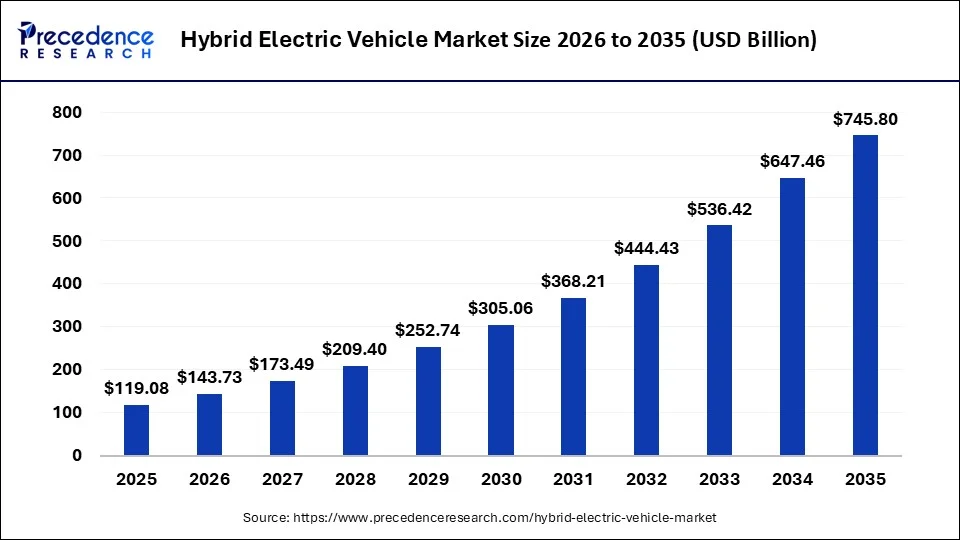
The global hybrid electric vehicle (HEV) market is experiencing a transformative growth phase as governments worldwide intensify emission reduction efforts, automakers accelerate electrification strategies, and consumers increasingly seek fuel-efficient transportation solutions. According to Precedence Research, the global hybrid electric vehicle market size was valued at USD 119.08 billion in 2025 and is projected to surge from USD 143.73 billion in 2026 to approximately USD 745.8 billion by 2035, registering a robust CAGR of 20.14% during the forecast period from 2026 to 2035.
Hybrid electric vehicles have emerged as a critical bridge between conventional internal combustion engine vehicles and fully electric vehicles. Their ability to deliver enhanced fuel efficiency, lower emissions, and reduced operating costs continues to attract consumers, fleet operators, and policymakers globally.

Why Are Hybrid Electric Vehicles Becoming a Mainstream Mobility Solution?
The rapid rise of environmental concerns, increasing fuel costs, and stringent government regulations are reshaping the automotive industry. Hybrid electric vehicles offer a practical solution by combining electric propulsion with conventional engines, enabling lower fuel consumption without relying entirely on charging infrastructure.
Governments across North America, Europe, and Asia Pacific are implementing favorable policies including tax credits, subsidies, emission standards, and investments in charging networks to accelerate adoption. These initiatives are creating a supportive ecosystem that encourages both manufacturers and consumers to transition toward cleaner mobility alternatives.
Furthermore, urbanization, rising disposable incomes, and growing awareness regarding carbon emissions are significantly influencing purchasing decisions, driving demand for hybrid vehicle technologies across developed and emerging economies.
Artificial Intelligence Revolutionizing the Hybrid Electric Vehicle Industry
Artificial intelligence is playing an increasingly important role in improving vehicle efficiency, safety, and operational performance. AI-powered energy management systems optimize power distribution between electric motors and internal combustion engines, enhancing fuel economy while reducing emissions.
Advanced battery management systems leverage machine learning algorithms to predict battery degradation, regulate temperature, balance cell performance, and maximize battery lifespan. AI is also supporting predictive maintenance, autonomous driving capabilities, adaptive cruise control, and advanced driver assistance systems (ADAS), creating a more intelligent and personalized driving experience.
Beyond vehicle operations, AI is streamlining manufacturing processes through demand forecasting, defect detection, precision assembly, and supply chain optimization, helping manufacturers improve productivity while reducing costs.
What Makes This Market an Attractive Investment Opportunity?
The hybrid electric vehicle industry represents one of the most compelling investment opportunities within the global automotive sector. Several structural growth drivers continue to create long-term value for investors:
- Accelerating global transition toward low-emission transportation.
- Rising government incentives and policy support for vehicle electrification.
- Continuous advancements in battery technology and energy storage systems.
- Expanding hybrid vehicle portfolios from leading automakers.
- Increasing consumer acceptance of sustainable mobility solutions.
- Growing demand from commercial transportation and fleet operators.
- Strong penetration opportunities across emerging economies.
Investors are particularly attracted to companies operating across the HEV value chain, including battery manufacturers, electric motor suppliers, power electronics providers, software developers, and vehicle manufacturers. As battery costs continue to decline and technology improves, the profitability potential across the ecosystem is expected to strengthen significantly.
The market’s projected addition of more than USD 600 billion in new value between 2026 and 2035 highlights the substantial revenue creation opportunity available for stakeholders and investors alike.
How Are Government Regulations Accelerating Market Growth?
Environmental regulations remain among the strongest catalysts supporting hybrid vehicle adoption. Governments worldwide are introducing stricter fuel economy standards and carbon emission mandates to combat climate change and reduce urban pollution.
Automakers are increasingly investing in hybrid and electrified powertrains to comply with evolving regulations. Policies such as Corporate Average Fuel Economy (CAFE) standards in the United States, European Union emission targets, and China’s stringent pollution control regulations are compelling manufacturers to accelerate electrification programs.
In addition to regulatory requirements, governments are offering purchase incentives, tax benefits, registration discounts, and investments in charging infrastructure, making hybrid vehicles more accessible and affordable for consumers.
Technological Innovation Creating New Growth Opportunities
Rapid technological advancements continue to improve vehicle performance, affordability, and consumer appeal. Significant progress in battery chemistry, regenerative braking systems, power electronics, and energy management technologies is enhancing overall vehicle efficiency.
Regenerative braking systems, in particular, are becoming increasingly important by capturing kinetic energy and converting it into electrical energy to recharge vehicle batteries. These innovations reduce energy loss and improve fuel economy while lowering operational costs.
As battery costs continue to decline and energy density improves, hybrid vehicles are becoming more competitive against traditional gasoline-powered alternatives, opening new growth opportunities across both passenger and commercial vehicle segments.
Segment Analysis
Full Hybrid Vehicles Maintain Market Leadership
The full hybrid segment is expected to maintain the largest market share throughout the forecast period. These vehicles provide superior fuel efficiency and lower emissions while offering the ability to operate on electric power alone for short distances.
Consumers increasingly prefer full hybrids due to their balance of performance, efficiency, and convenience, particularly in urban environments where stop-and-go traffic allows greater utilization of electric driving modes.
Mild Hybrids Witness Rapid Adoption
Mild hybrid systems are projected to experience strong growth owing to their lower cost and ease of integration. These systems provide supplemental electric power to support the combustion engine and improve fuel efficiency without requiring external charging.
Their affordability makes them particularly attractive in price-sensitive markets and among consumers seeking incremental improvements in fuel economy.
Commercial Vehicles Drive Application Growth
The commercial vehicle segment is expected to account for a significant share of market expansion. Rising fuel costs, sustainability initiatives, and fleet electrification programs are encouraging logistics operators and transportation companies to adopt hybrid solutions.
Commercial fleet operators are increasingly recognizing the economic benefits of lower fuel consumption and reduced maintenance costs associated with hybrid technologies.
Asia Pacific Emerges as the Global Growth Engine
Asia Pacific accounted for approximately 42% of total market revenue in 2025, establishing itself as the largest regional market. Countries including China, Japan, and South Korea continue to lead global adoption through strong manufacturing capabilities, favorable government policies, and substantial investments in vehicle electrification.
China remains the dominant force within the region, supported by aggressive subsidies, tax incentives, procurement programs, and advancements in battery technology. The country continues to play a pivotal role in both hybrid vehicle manufacturing and consumer adoption.
The Asia Pacific hybrid electric vehicle market is expected to grow from USD 50.01 billion in 2025 to approximately USD 317.55 billion by 2035, representing one of the most lucrative growth opportunities globally.
North America Strengthens Market Position Through Regulatory Support
North America continues to demonstrate strong growth potential, with the U.S. market expected to expand at a CAGR of 8.2% through 2035. Government incentives, stricter environmental regulations, and rising consumer preference for fuel-efficient vehicles are driving adoption across the region.
Expanding charging infrastructure and continuous innovation by leading automotive manufacturers further reinforce North America’s position as a key growth market.
Europe Accelerates Transition Toward Sustainable Mobility
Europe remains a strategically important market due to ambitious emission reduction targets and stringent environmental regulations. High consumer awareness regarding sustainability and strong support for green transportation continue to stimulate hybrid vehicle demand.
The region’s established automotive manufacturing ecosystem and commitment to technological innovation position Europe as a major contributor to future market expansion.
Competitive Landscape
The hybrid electric vehicle market remains highly competitive, with leading automotive manufacturers and component suppliers investing heavily in electrification technologies, battery systems, and software-driven mobility solutions.
Key companies operating in the market include:
- ZF
- Delphi
- BorgWarner
- Continental
- Schaeffler
- Ford
- Toyota
- Volvo
- Honda
- Hyundai
- Daimler
- Nissan
Strategic partnerships, product launches, and investments in battery innovation continue to shape the competitive environment as companies race to capture market share in the rapidly expanding hybrid mobility ecosystem.
Recent Industry Developments
Recent developments highlight the accelerating momentum within the hybrid vehicle sector. In June 2025, BYD introduced the Seal 05 DM-i plug-in hybrid sedan in Poland and Slovakia, strengthening its European presence. Hyundai also launched the Inster compact electric vehicle in Japan as part of its broader electrification strategy.
Additionally, Lynk & Co. introduced its 08 Plug-In Hybrid SUV in Europe, featuring an extended electric driving range and fast-charging capabilities, reflecting the industry’s focus on enhancing vehicle performance and consumer convenience.
The global hybrid electric vehicle market is entering a decade of unprecedented growth driven by environmental regulations, technological innovation, government support, and evolving consumer preferences. As automakers continue expanding hybrid vehicle offerings and battery technologies become increasingly efficient and affordable, hybrid electric vehicles are expected to play a central role in the global transition toward sustainable transportation.
With a projected market value approaching USD 745.8 billion by 2035, the industry presents substantial opportunities for manufacturers, technology providers, suppliers, and investors seeking exposure to one of the fastest-growing segments of the automotive market.