


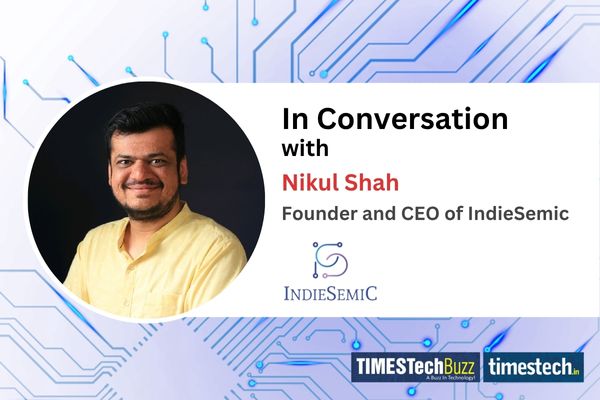
In an interview with TimesTech, Nikul Shah, Founder and CEO of IndieSemic, shares how the company has rapidly emerged as a force in India’s IoT, automotive, and industrial sectors. He discusses IndieSemic’s pioneering IoT Evolution Board with C-DAC, the shift toward system-level products, and a bold roadmap featuring RISC-V, AI-at-the-edge, and indigenous hardware innovation driving India’s semiconductor self-reliance.
Read the full interview here:
TimesTech: IndieSemic has quickly established itself, working with over 60 customers since its founding in 2023. What do you think has been the key to building such strong traction in IoT, automotive, and industrial sectors in such a short span?
Nikul: Our rapid traction since 2023, serving a robust roster of over 60 customers in the competitive IoT, automotive, and industrial sectors, is not merely a stroke of luck but the result of two interconnected, strategic advantages. Fundamentally, we began IndieSemic with the conviction that innovation must be practical and must achieve a measurable market impact, focusing relentlessly on solving real customer pain points rather than simply chasing technological fads. We strategically tailored our modular, reliable, and customisable RF solutions to the needs of OEMs and solution providers, thereby significantly shortening their product time to market. This customer-centric approach is amplified by our organisational agility, achieved through a unique cross-functional team, comprising hardware, firmware, and mechanical experts under one roof, which eliminates developmental silos, enables faster iteration cycles, and grants us complete ownership over our solutions, establishing technical trust far beyond a simple product catalogue.
TimesTech: At SEMICON India 2025, IndieSemic launched India’s first IoT Evolution Board in collaboration with C-DAC. Could you elaborate on how this platform, powered by the indigenous VEGA processor with Bluetooth and VeRa connectivity, will accelerate innovation for enterprises and startups?
Nikul: The IoT Evolution Board is a truly seminal achievement for IndieSemic and for the nation, proudly recognised as India’s first indigenously powered IoT development platform. Developed in collaboration with C-DAC and built around their powerful VEGA processor, featuring integrated Bluetooth and LoRa connectivity, this board is designed as a crucial bridge between academic research and industrial adoption. Its core function is to accelerate innovation by providing startups, research labs, and enterprises with a pre-validated, ready-to-deploy hardware base for rapid prototyping. This approach allows innovators to bypass complex hardware integration challenges, focus their valuable engineering resources solely on application logic, and move from a concept to a final product dramatically faster, supporting everything from smart meters to AI-enabled edge devices.
TimesTech: The IoT Evolution Board is positioned as a ready-to-use hardware platform. What specific applications in smart cities, healthcare, defence, and aerospace do you see as immediate opportunities?
Nikul: The IoT Evolution Board is engineered to be a scalable and secure hardware foundation, making it ideal for a diverse range of immediate, high-impact applications across critical sectors. We are already seeing robust interest from organisations specialising in smart city infrastructure, where the board can power intelligent solutions for environmental monitoring, smart street lighting, or parking management systems. In the healthcare domain, it is perfectly suited for sophisticated remote patient monitoring and connected diagnostic devices. Crucially, for defence and aerospace, the combination of indigenous computing with long-range communication capabilities makes it an essential component for secure sensor networks and mission-critical field data collection, establishing domestic technological sovereignty in strategic applications.
TimesTech: IndieSemic is moving from RF modules into system-level products. How does this transition reflect your long-term vision for becoming a complete hardware platform company?
Nikul: Our evolution from developing foundational RF connectivity modules to engineering complex system-level products is a deliberate and essential step that fully embodies our long-term vision. We recognised that as customer requirements grew more sophisticated, limiting our focus to the module level would stifle true innovation, prompting us to pivot beyond the initial IoT foundation. Therefore, this transition is about integrating three key pillars, compute, connectivity, and intelligence, into a singular, optimised system. This move fundamentally reflects our ultimate aspiration: to become a complete hardware platform company dedicated to enabling entire edge ecosystems. Our vision is to ensure that every layer, from sensors and embedded AI to the core connectivity, is designed, developed, and optimised entirely in India, providing unmatched control, security, and performance.
TimesTech: Your roadmap includes AI-at-the-edge processors, RISC-V SoCs, and expansion into cellular modules. How do these developments align with India’s larger goals for semiconductor self-reliance and global competitiveness?
Nikul: Our technology roadmap, featuring advanced AI-at-the-edge processors, RISC-V SoCs, and cellular models, is perfectly synchronised with India’s national vision for semiconductor self-reliance, which is centred on owning design IP and creating global impact from Indian innovation. We are firm believers that the RISC-V open architecture represents the next paradigm of democratised compute, providing a unique opportunity for India to leapfrog traditional proprietary architectures. By combining RISC-V with AI and domain-specific acceleration, we are directly contributing to the nation’s strategic goal of technological independence. Furthermore, our commitment to developing indigenous cellular models and AI-edge compute directly translates to reducing national dependency on critical imports, thereby strengthening India’s position and competitiveness in the global semiconductor value chain.
TimesTech: IndieSemic is targeting $5 million in revenue by FY27-28, with one million modules and half a million SoCs in sales. What strategies and partnerships will be most critical in achieving these ambitious milestones?
Nikul: Our ambitious financial target of $5 million in revenue by FY27-28 is an aggressive but achievable goal, underpinned by a rigorous, three-pronged growth strategy. The most critical factor is the continuous cultivation of deep technology partnerships, a collaborative model exemplified by our engagements with global leaders like Nordic, Semtech, and the foundational partnership with C-DAC. Secondly, we are applying a strong vertical focus, strategically doubling down on the high-growth, high-value markets of automotive, industrial IoT, and smart infrastructure to maximise our impact rather than diffusing our efforts. Finally, achieving this scale, one million modules and half a million SoCs, mandates robust, scalable manufacturing and distribution, involving the onboarding of strategic channel partners and a dedicated move towards localised production for essential cost efficiency and sustained supply chain resilience.