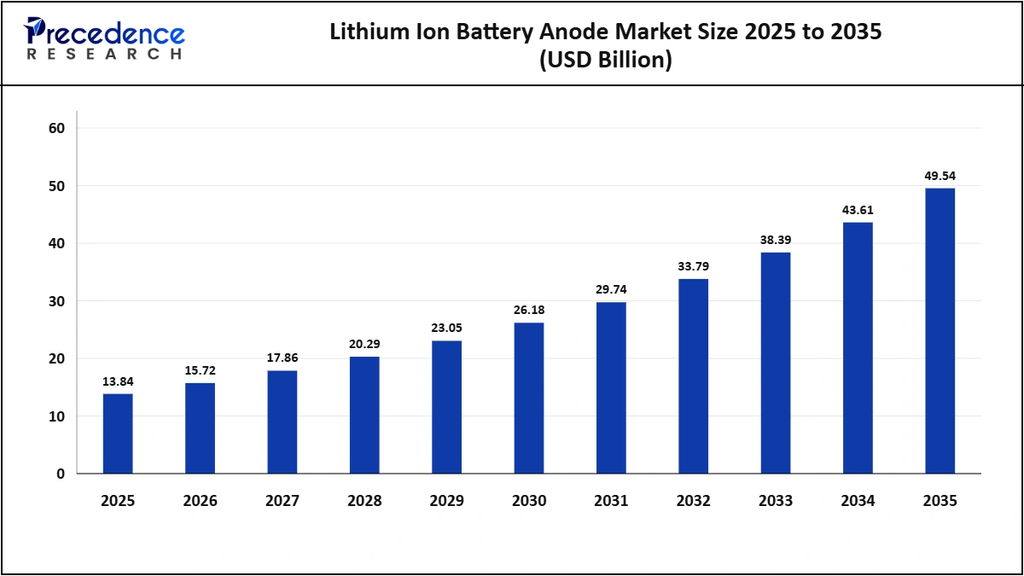
The lithium ion battery anode market is expected to grow from USD 13.84 billion in 2025 to USD 49.54 billion by 2035. This growth is mainly linked to the increasing production of electric vehicle batteries and energy storage batteries. Every gigawatt-hour of battery production requires a large amount of anode material, creating more demand as battery production increases.
Lithium Ion Battery Anode Market Key Insights
Market Size & Growth Outlook
- Market size in 2025: USD 13.84 billion
- Estimated market size in 2026: USD 15.72 billion
- Projected market size by 2035: USD 49.54 billion
- CAGR (2026-2035): 13.60%
Regional Market Spotlight
- Asia Pacific led the market in 2025, accounting for 88.20% of the market, worth USD 12.21 billion.
- North America accounted for 5.20% of the market in 2025, worth USD 0.72 billion. It is expected to be the fastest-growing region, with a CAGR of 17.24% from 2025 to 2035.
- Europe accounted for 4.80% of the market in 2025, worth USD 0.66 billion.
Drivers, Restraints and Opportunities
Driver
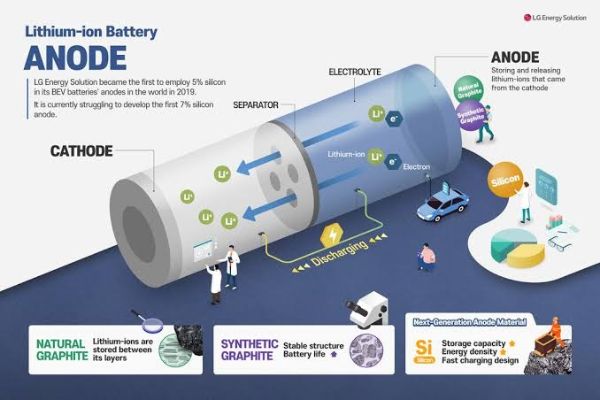
The growing production of electric vehicles and energy storage batteries is increasing demand for anode materials. Every lithium-ion battery needs an anode. Silicon-based anodes can help batteries store more energy and charge faster, increasing the value of the materials used. Chinese export controls and domestic sourcing requirements are also encouraging battery manufacturers and automakers to sign supply agreements with producers outside China.
Restraint
China has a large amount of graphite production capacity, which has pushed anode material prices down. This limits market value growth. Silicon anodes also expand during charging, so they need careful design and testing before they can be widely used. In addition, new production plants outside China often face higher costs and long approval and testing periods before battery manufacturers can use their materials.
Opportunity
Silicon-carbon materials have an opportunity to gain a larger share of the electric vehicle and premium electronics markets. Long-term supply agreements with automakers could help support graphite production plants in North America and Europe. Anode materials used in sodium-ion batteries, including hard carbon, also offer an opportunity to serve a new market.
Regional Outlook for Lithium Ion Battery Anode Market
Asia Pacific held the largest share of the lithium ion battery anode market in 2025, accounting for 88.20%, or USD 12.21 billion. China produces most graphite anode materials, while Japan and South Korea supply specialised graphite and silicon-based materials.
North America accounted for 5.20% of the market, worth USD 0.72 billion. It is expected to be the fastest-growing region, supported by new synthetic graphite and silicon anode plants and rules encouraging the use of locally produced materials.
Europe accounted for 4.80% of the market, worth USD 0.66 billion. The growth of battery gigafactories and planned graphite and silicon production projects is expected to support the regional market.
Latin America accounted for 0.90% of the market, worth USD 0.12 billion. Its graphite resources provide opportunities for early-stage mining and processing projects.
The Middle East and Africa also accounted for 0.90% of the market, worth USD 0.12 billion. Graphite mining activities in countries such as Mozambique, Tanzania and Madagascar may support the development of local processing projects.
Asia Pacific accounted for 88.20% of the market in 2025, worth USD 12.21 billion. China is the leading producer of graphite anode materials.
North America accounted for 5.20% of the market in 2025, worth USD 0.72 billion, and is expected to be the fastest-growing region. New synthetic graphite and silicon anode plants are expected to support this growth.
Europe accounted for 4.80% of the market in 2025, worth USD 0.66 billion. New battery gigafactories and planned graphite and silicon projects are expected to increase demand.
Latin America accounted for 0.90% of the market in 2025, worth USD 0.12 billion. The region’s graphite resources could support early-stage production projects.
The Middle East and Africa accounted for 0.90% of the market in 2025, worth USD 0.12 billion. Graphite mining in Mozambique, Tanzania and Madagascar could support the growth of early processing activities.
Analyst View: Regional market shares were estimated using anode production capacity and output in each region, along with the types of materials produced and their prices. Asia Pacific leads because China has most of the world’s graphite anode production capacity. North America is expected to grow the fastest because its new anode plants are starting from a relatively small base. Government rules supporting domestic production and China’s graphite export controls may also encourage battery manufacturers to buy more materials from North American suppliers.
Top 10 Companies in the Lithium Ion Battery Anode Market
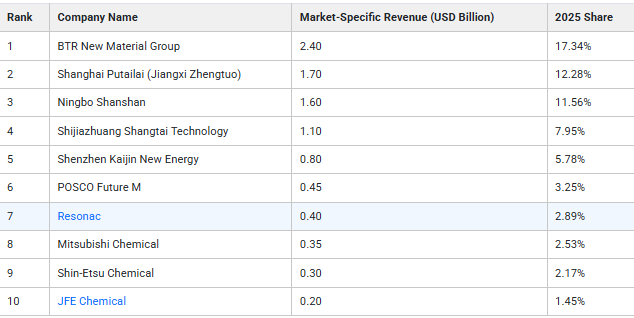
Note: Company revenues and market shares are estimates for 2025.
Sources: Company press releases, expert interviews, secondary sources, Precedence Research database and Precedence Research analysts.
BTR New Material Group was the leading company in the lithium ion battery anode market in 2025, with an estimated market share of 17.34% and revenue of USD 2.40 billion. Shanghai Putailai ranked second, with a 12.28% share and USD 1.70 billion in revenue. Ningbo Shanshan ranked third, with an 11.56% share and USD 1.60 billion in revenue.
BTR has a broad range of anode materials, including natural graphite, synthetic graphite and silicon-based materials. Shanghai Putailai and Ningbo Shanshan are major suppliers of synthetic graphite to battery manufacturers in China and other global markets.
The top 10 companies together accounted for an estimated 67.20% of the market in 2025, equal to USD 9.30 billion. The remaining 32.80%, or USD 4.54 billion, was shared by smaller Chinese graphite producers, silicon anode start-ups and newer anode material companies in North America and Europe.
The market remains heavily concentrated in China. Companies compete by offering lower costs, higher energy density, better fast-charging performance, consistent product quality and reliable supplies. Established Chinese producers are competing with Japanese and South Korean companies, as well as newer companies developing graphite and silicon-based anode materials.
Recent Developments
- April 2025: Sila began commissioning its Moses Lake plant in Washington, which will produce Titan Silicon anode material. Full production was planned for the second half of 2025, with a final target capacity of 150 GWh per year.
- March 2026: POSCO Future M signed a long-term contract worth about KRW 1 trillion to supply synthetic graphite anode materials to a global automaker.