

The global nanosatellite and microsatellite market is no longer a niche corner of the aerospace sector — it is fast becoming one of the most dynamic investment frontiers in the entire Electronics & Semiconductors industry. Driven by surging demand for cost-effective Earth observation, rapid advancements in satellite miniaturization, and the explosive growth of the NewSpace economy, this market is on a trajectory that few could have predicted a decade ago.
According to new findings published by Polaris Market Research, the global nanosatellite and microsatellite market was valued at USD 4,861.05 million in 2025 and is projected to surge to USD 30,549.41 million by 2034, expanding at a compound annual growth rate (CAGR) of 22.7% over the forecast period from 2026 to 2034. For investors, technology manufacturers, semiconductor suppliers, and defense contractors, the window of opportunity is wide open — and it is closing fast.
Why Small Satellites Are Commanding Big Attention
The appeal of nanosatellites and microsatellites lies in what they represent democratized access to space. Traditional large satellites can cost hundreds of millions of dollars to build and launch. By contrast, nanosatellites — typically weighing between 1 kg and 10 kg — and microsatellites — ranging from 10 kg to 100 kg — offer a dramatically faster, leaner, and more agile path to orbit.
These compact platforms enable rapid production cycles, lower launch costs, and flexible deployment in satellite constellations, making them ideal for a wide spectrum of missions including Earth observation, broadband connectivity, IoT data relay, maritime surveillance, environmental monitoring, and military reconnaissance.
The semiconductor and electronics supply chain is at the heart of this transformation. Miniaturized processors, advanced MEMS sensors, compact power systems, and onboard AI chips are the building blocks that make modern nanosatellites viable. As component costs continue to fall and performance continues to climb, the addressable market for small-satellite hardware expands accordingly.
Key Market Drivers Fueling Explosive Growth
- Skyrocketing Demand for Earth Observation Services
High-resolution Earth imaging is no longer the exclusive province of national space agencies. Agriculture, forestry, disaster response, infrastructure monitoring, and defense sectors all require timely, accurate geospatial data. In July 2025, NASA and the Indian Space Research Organisation (ISRO) jointly launched the NISAR mission, leveraging dual-frequency radar technology to deliver high-resolution global monitoring imagery every 12 days. Such collaborative initiatives underscore the growing appetite for satellite-derived intelligence at scale.
- The Constellation Revolution
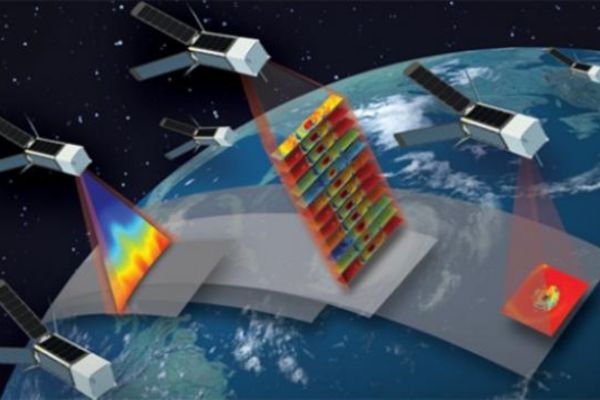
Perhaps the single most transformative trend reshaping the small satellite industry is the shift from monolithic single-satellite architectures to multi-satellite constellations. SpaceX’s Starlink network, which surpassed 10,000 operational satellites in low Earth orbit (LEO) as of March 2026, exemplifies the scale at which this transition is occurring. By distributing sensing and communication functions across hundreds or thousands of satellites, operators achieve redundancy, global coverage, and dramatically reduced latency — capabilities that no single large satellite can match.
- The NewSpace Economy and Private Sector Investment
Private capital is flooding into the small satellite ecosystem. In February 2026, Rocket Lab USA signed a multi-launch agreement with BlackSky Technology, reinforcing Rocket Lab’s position as a primary provider for small-satellite deployment missions. Startups, established defense firms, and constellation operators alike are competing to capture first-mover advantages in commercial data services, broadband access, and national security applications.
Segment Spotlight: Who Is Buying and What Are They Buying?
The nanosatellite segment dominated with a 76.41% revenue share in 2025, reflecting its lower cost and versatility for academic research, technology demonstration, and remote sensing applications. The commercial end-use segment captured the largest share at 47.1%, driven by geospatial analytics, supply chain monitoring, and asset tracking services.
By orbit, Low Earth Orbit (LEO) commanded 78% of total market revenue in 2025, favored for its low-latency performance and suitability for both communication and Earth observation constellations.
The scientific research and academic training application segment is forecast to grow at a 20.4% CAGR through 2034, as universities and research institutions increasingly adopt small satellites for cost-accessible space experiments.
Regional Outlook: North America Leads, Europe Accelerates
North America held the dominant position with a 42.4% revenue share in 2025, underpinned by robust government defense budgets, deep venture capital pipelines, and the presence of industry giants including Lockheed Martin, The Boeing Company, Planet Labs, and Raytheon. Meanwhile, Europe is projected to grow at a 24% CAGR, fueled by ESA-backed missions and academic institution partnerships targeting Earth observation and environmental monitoring. Asia Pacific continues its ascent as government space programs in India, Japan, China, and South Korea ramp up small-satellite capabilities for national sovereignty and commercial applications.
AI Integration: The Next Performance Multiplier
Artificial intelligence is rapidly becoming embedded into the small satellite value chain. AI accelerates onboard data processing, improves imaging analysis quality, enables greater satellite autonomy, and reduces dependence on constant ground-station oversight. For semiconductor manufacturers and embedded systems developers, AI-enabled satellite payloads represent a high-growth product category with strong margin potential.
Competitive Landscape: Innovation Meets Consolidation
The market features a competitive mix of legacy aerospace leaders and agile new entrants. Key players profiled in the Polaris Market Research report include Lockheed Martin Corporation, The Boeing Company, Planet Labs Inc., Surrey Satellite Technology Limited, GomSpace Group AB, Thales Group, Clyde Space Inc., Sierra Nevada Corporation, Raytheon Company, and others. Differentiation is increasingly driven by platform modularity, rapid manufacturing, AI-powered analytics integration, and end-to-end service offerings that bundle satellite operations with data insights.
Conclusion: The Small Satellite Opportunity Is Now
The nanosatellite and microsatellite market represents one of the most compelling growth stories in the Electronics & Semiconductors sector today. With a projected six-fold increase in market value by 2034, the convergence of miniaturization, AI, constellation-based services, and expanding global demand creates a rare window for stakeholders across the supply chain — from chipmakers and payload manufacturers to launch providers and data analytics firms.