
Abstract— Narrowband Internet of Things (NB-IoT) has emerged as a key enabler of massive machine-type communication (mMTC) within the 3GPP family of cellular technologies. Its ability to provide wide-area coverage, deep penetration, and ultra-low power consumption makes it ideally suited for smart metering, smart cities, agriculture, healthcare, and logistics. This article provides a comprehensive overview of NB-IoT technology, its modulation schemes, frequency operation, and comparative advantages over other LPWAN technologies. A detailed discussion of the STMicroelectronics ST87M01 NB-IoT device is provided, highlighting its architecture, security capabilities, and optimized performance for embedded IoT systems. Furthermore, the article introduces the STEVAL-874SIMCB evaluation board, which integrates the ST87M01 with both embedded eSIM (ST4SIM-300) and external SIM support, offering developers a versatile platform for rapid prototyping. By examining technical strengths, use cases, and deployment scenarios, this work demonstrates how NB-IoT and eSIM-enabled solutions together pave the way for secure, scalable, and future-ready IoT applications.
Introduction
The exponential growth of connected devices has created a pressing need for communication technologies that can balance coverage, energy efficiency, scalability, and security. While traditional cellular systems such as 2G, 3G, and 4G were primarily designed for high-speed human-centric services, they are not optimized for machine-type communication that requires periodic small data transfers, long device lifetimes, and large-scale deployments. To address these challenges, the 3rd Generation Partnership Project (3GPP) standardized [2] NB-IoT as part of Release 13(Cat-NB1), later enhanced in Releases 14 and 15, to serve as a specialized cellular IoT technology operating within licensed spectrum.
NB-IoT has gained rapid global adoption due to its ability to deliver reliable communication in deep-indoor and rural environments while ensuring secure authentication through SIM-based mechanisms. The technology has been embraced by utility providers, smart city planners, healthcare systems, and logistics operators to enable digital transformation. In this article, we explore the technical foundation of NB-IoT, compare it with other LPWAN solutions, and discuss its hardware ecosystem, focusing particularly on the ST87M01[1] device and the STEVAL-874SIMCB evaluation board.
NB-IoT Technology Overview
NB-IoT is a narrowband radio access technology that occupies 180 kHz of bandwidth, which allows it to be deployed within existing LTE carriers (in-band), in guard bands, or as a standalone carrier. The physical layer employs Orthogonal Frequency Division Multiple Access (OFDMA) for downlink transmission and Single Carrier Frequency Division Multiple Access (SC-FDMA) for uplink, enabling efficient spectrum use and robust coverage. To further enhance range and reliability, NB-IoT employs techniques such as repetition coding and power boosting, achieving a link budget of up to 164 dB. This enables connectivity in deep indoor locations and remote rural zones where conventional cellular signals are weak.
A key feature of NB-IoT is its energy efficiency. Mechanisms such as Power Saving Mode (PSM) and Extended Discontinuous Reception (eDRX) significantly reduce the energy consumed during idle periods, allowing devices to achieve lifetimes exceeding 10 years on small batteries. NB-IoT supports both data transmission and signaling optimizations, ensuring that small payloads such as meter readings or sensor values are communicated with minimal overhead. Additionally, the technology leverages licensed cellular spectrum, ensuring interference-free operation, secure data transfer, and guaranteed quality of service, distinguishing it from unlicensed LPWAN alternatives.
In NB-IoT communication, both the downlink (from the network to the device) and uplink (from the device to the network) use a set of specialized signals and channels to ensure reliable data transfer. On the downlink side, the network sends information using channels like the Narrowband Physical Downlink Control Channel (NPDCCH) for control messages, the Narrowband Physical Downlink Shared Channel (NPDSCH) for user data, and the Narrowband Primary and Secondary Synchronization Signals (NPSS and NSSS) to help devices find and synchronize with the network. For the uplink, devices use the Narrowband Physical Uplink Shared Channel (NPUSCH) to send their data and the Narrowband Physical Random Access Channel (NPRACH) to initiate a connection with the network. These channels are designed to work efficiently even in areas with weak signal coverage, making NB-IoT a good fit for connecting simple devices in challenging environments.
Comparison with Other LPWAN Technologies
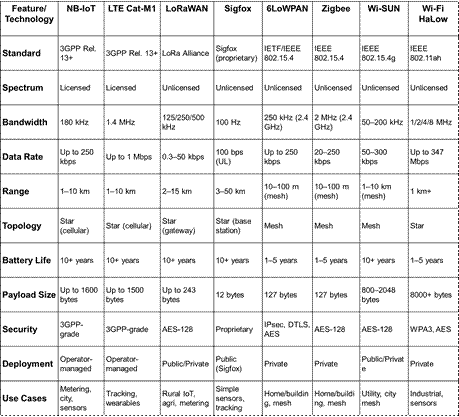
Several LPWAN technologies, including LoRaWAN and Sigfox, coexist with NB-IoT, but each has different strengths and limitations. LoRaWAN, which operates in unlicensed spectrum, offers flexible deployment for private networks but is vulnerable to interference and lacks guaranteed QoS. Sigfox, while optimized for ultra-low power, is limited in payload size and coverage depending on regional infrastructure. By contrast, NB-IoT benefits from cellular-grade reliability, strong security through SIM-based authentication, and global operator support.
In practical terms, NB-IoT ensures far greater scalability and longevity of deployments, especially in critical infrastructures like utilities and healthcare, where data confidentiality and service continuity are essential. While LoRa and Sigfox may be cost-effective for small-scale private deployments, NB-IoT positions itself as the preferred choice for regulated, secure, and wide-area applications, particularly where millions of devices must be supported within a single operator network.
ST87M01 NB-IoT Module
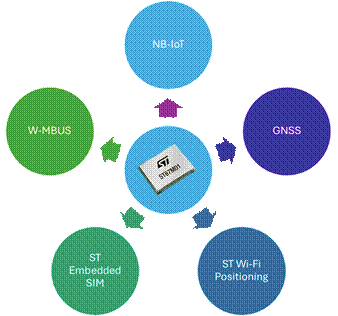
STMicroelectronics is making strong progress in the field of NB-IoT technology by developing solutions that are both innovative and practical for real-world IoT needs. The company is focusing on creating modules and chipsets that make it easier for device makers to add reliable, secure, and energy-efficient cellular connectivity to their products. One example of this is the ST87M01 module, which is designed to deliver robust NB-IoT (LTE Cat NB2) connectivity for a wide range of applications. Certified for the latest 3GPP Release 15 standard and equipped with GNSS for location services, the ST87M01 is a compact and versatile solution suitable for everything from smart meters and asset trackers to connected healthcare devices. The ST87M01 is based on Software Defined Radio (SDR) technology, which enables it to support GNSS (GPS and Galileo constellations), as well as W-MBUS (T1, C1 modes, and soon T2/C2) and Wi-Fi positioning. The module integrates an IPAD, which is required for Remote SIM Provisioning based on the SGP.32 specification.
By integrating essential components like the baseband processor, RF transceiver, and power management into a single module, ST helps manufacturers simplify their designs and reduce the number of parts needed. The ST87M01’s support for multiple NB-IoT frequency bands means it can be used in many countries without hardware changes, making global deployment much easier. Security is a key focus, with features like SIM/eSIM authentication, hardware encryption, and secure boot to protect data and devices. The module also supports firmware-over-the-air (FOTA) updates, allowing devices to stay up to date and secure even after deployment. Thanks to its small size and user-friendly AT command interface, the ST87M01 makes it straightforward for developers to add low-power, reliable cellular connectivity to their IoT projects. The ST87M01 series also integrates the PDU SMS service along with various internet protocols tailored for NB-IoT products. These protocols include TCP/IP, TLS/DTLS, CoAP, LwM2M, MQTT, and HTTP/HTTPS, supporting a wide range of IoT applications. Through products like this, ST is helping to accelerate the adoption of NB-IoT technology in smart cities, utilities, logistics, healthcare, and many other sectors.
STEVAL-874SIMCB with ESIM Support evaluation board
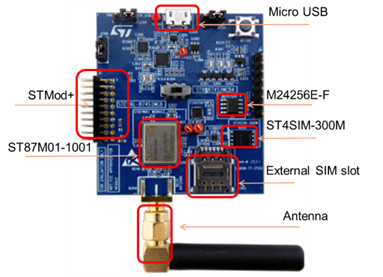
The STEVAL-874SIMCB evaluation board has been designed to accelerate the prototyping and validation of NB-IoT applications using the ST87M01 module. It offers dual SIM options: support for external plastic SIM cards and embedded eSIMs such as the ST4SIM-300M[3]. The use of profile-based eSIMs introduces significant advantages, including remote provisioning, secure operator switching, and improved reliability in harsh environments where physical SIM replacement is impractical.
The board can be connected to an B-U585I-IOT02A evaluation platform via the STMod+ interface for system-level testing, or directly to a PC through its USB interface for stand-alone evaluation. Jumper settings allow the user to easily select between these operating modes. This board comes equipped with a right-angle Penta band stubby antenna, which is designed to work across a wide range of frequencies—850 MHz, 900 MHz, 1.8 GHz, 1.9 GHz, and 2.1 GHz—making it suitable for both European and US GSM/WCDMA networks. This broad frequency support allows the board to be used in various M2M (machine-to-machine) applications, ensuring reliable connectivity in different regions. Additionally, the board features a 256-Kbit serial I2C bus EEPROM with a configurable device address. This extra memory can be very useful for data logging, storing important information, or supporting advanced features like firmware-over-the-air (FOTA) updates and profile downloads, where users may need more storage space for their applications. The platform supports both standard 3GPP AT commands for NB-IoT communication and a set of proprietary ST AT commands, which provide advanced control, debugging, and power management features. This flexibility makes the STEVAL-874SIMCB[4] a powerful tool for developers, enabling rapid prototyping of applications ranging from smart metering to logistics and industrial monitoring.
Applications of NB-IoT and ST87M01
NB-IoT has proven to be highly effective across multiple domains because it connects devices over long distances, works well even in hard-to-reach places, and uses very little power. In smart metering, NB-IoT enables reliable transmission of gas, water, and electricity usage data from meters that might be deep indoors or underground, with long battery life making it ideal for utility companies. In smart cities, it supports intelligent lighting, parking, and waste management systems, giving city planners real-time information to save energy and improve services. For healthcare, NB-IoT powers wearables and remote monitoring devices that securely send patient data to doctors, helping reduce hospital visits and ensuring timely care. In agriculture, it helps farmers with precision tasks like soil monitoring, livestock tracking, and irrigation control, which boosts productivity and saves resources. Logistics and supply chains benefit from NB-IoT by tracking goods in transit, monitoring cold-chain conditions, and optimizing fleet operations, which reduces losses and increases transparency. NB-IoT is also useful for condition monitoring in machines, predictive maintenance, and even for keeping track of pets and livestock in remote areas. All these examples show how versatile NB-IoT is, making it a strong, unified solution for connecting and managing devices across many different industries.
Conclusion
NB-IoT has established itself as one of the most reliable and scalable LPWAN technologies, offering secure, energy-efficient, and cost-effective connectivity for billions of devices. With its standardized architecture and global operator adoption, it is particularly suited for applications where reliability, coverage, and longevity are essential. The ST87M01 module from STMicroelectronics strengthens this ecosystem by providing a robust and secure hardware platform, while the STEVAL-874SIMCB evaluation board accelerates adoption through its flexible SIM options, developer-friendly interfaces, and extended AT command support.
Looking ahead, the combination of NB-IoT and eSIM-based solutions is expected to converge with the broader 5G massive machine-type communication (mMTC) ecosystem, ensuring future-proof operation and seamless scalability. By bridging the gap between standardized connectivity and application-level requirements, platforms such as the ST87M01 and STEVAL-874SIMCB will play a central role in enabling smart metering, healthcare, agriculture, logistics, and smart city infrastructures worldwide.