The global power sector is moving into a phase where adding renewable generation is no longer enough. Electricity systems increasingly need flexibility—the ability to absorb surplus power, respond rapidly to changes in supply and demand, relieve network congestion, and deliver stored electricity when renewable generation falls. This transition is turning the On-Grid Battery Energy Storage Systems Market from an emerging clean-energy segment into an increasingly important part of electricity infrastructure.
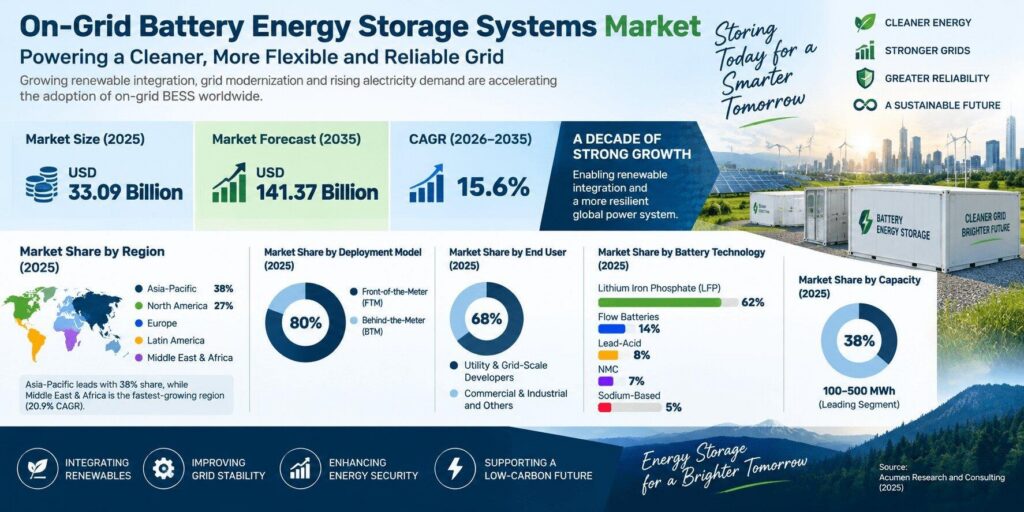
According to Acumen Research and Consulting, the global On-Grid Battery Energy Storage Systems Market was valued at USD 33.09 billion in 2025 and is projected to reach USD 141.37 billion by 2035, expanding at a CAGR of 15.6% from 2026 to 2035.

Behind those numbers is a structural change in the role of batteries. On-grid BESS is increasingly being evaluated not simply as stored energy, but as a flexible grid asset capable of renewable-energy shifting, frequency regulation, peak-load management, capacity support, congestion management and improved power-system reliability.
On-Grid BESS Market at a Glance
Key findings from Acumen Research and Consulting illustrate the scale and direction of the market:
- 2025 Global Market Size: USD 33.09 Billion
- 2035 Forecast: USD 141.37 Billion
- 2026–2035 CAGR: 15.6%
- Leading Region in 2025: Asia-Pacific, 38%
- North America Share in 2025: 27%
- Fastest-Growing Region: Middle East & Africa, 20.9% CAGR
- Leading Deployment Model: Front-of-the-Meter, 80% share
- Leading End User: Utility & Grid-Scale Developers, 68% share
- Leading Battery Technology: Lithium Iron Phosphate (LFP), 62% share
- Leading Capacity Category: 100–500 MWh, 38% share
- Leading Grid Connection: Transmission-Connected, 42% share
What Is Driving Growth in the On-Grid Battery Energy Storage Systems Market?
The central growth driver is the changing generation mix.
Solar and wind resources are variable: electricity production can rise sharply when weather conditions are favorable and decline when conditions change. As renewable penetration increases, electricity systems require resources capable of balancing these variations without waiting for conventional generation to ramp.
On-grid batteries address this problem by charging during periods of abundant electricity and discharging when power is more valuable or urgently required.
This creates several simultaneous value streams: energy arbitrage, renewable-energy shifting, frequency response, peak shaving, capacity support, voltage management and congestion relief.
Battery economics are also improving. Acumen Research and Consulting notes that average global battery costs declined 8% in 2025, while LFP battery costs fell by more than 15%. The report further notes that more than 90% of BESS deployed globally during 2025 used LFP batteries.https://timestech.in/tag/battery-technology/
The implication is significant. Lower battery costs improve project economics while increasing the range of grid applications for which storage can compete.
LFP Is Becoming the Reference Chemistry for On-Grid BESS
One of the defining On-Grid BESS Market trends is the growing importance of lithium iron phosphate.
According to Acumen Research and Consulting, LFP represented 62% of the On-Grid Battery Energy Storage Systems Market by battery technology in 2025, ahead of flow batteries at 14%, lead-acid at 8%, NMC at 7% and sodium-based technologies at 5%.
Stationary storage has different engineering priorities from electric vehicles. Extremely high volumetric energy density is less important when equipment is installed at a utility site. Safety, thermal stability, cycle life, reliability and lifetime cost become critical.
That plays directly into LFP’s strengths.
However, LFP will not necessarily own every future storage application. Flow batteries and emerging sodium-based technologies could become increasingly relevant where longer discharge duration, deep cycling, supply-chain diversification or different lifetime economics are required.
The next stage of competition will therefore be about more than cell chemistry. Power conversion systems, battery management systems, energy management software, thermal management, safety engineering and grid-forming capabilities will increasingly influence system value.
Front-of-the-Meter Storage Dominates the Market
The On-Grid Battery Energy Storage Systems Market remains overwhelmingly utility-oriented.
Acumen Research and Consulting estimates that front-of-the-meter (FTM) systems accounted for 80% of the market in 2025. The FTM segment is projected to reach approximately USD 117.34 billion by 2035, expanding at a 16.0% CAGR.
Utility and grid-scale developers similarly represented 68% of end-user demand in 2025, with their share forecast to increase to 72% by 2035.
These numbers reveal an important transition: BESS is moving from relatively small demonstrations toward infrastructure-scale projects.
The 100–500 MWh capacity category already accounted for 38% of the market in 2025, while transmission-connected installations represented the largest grid-connection category at 42%.
As project sizes increase, competitive advantage will depend increasingly on bankability, safety record, warranty structures, software capability, project execution and long-term service support—not simply battery price.
Which Countries Have the Highest Concentration of On-Grid BESS Manufacturers?
The global manufacturing landscape is heavily concentrated in China, with the wider Asia-Pacific region forming the center of the battery cell and increasingly the BESS integration ecosystem.
China’s position is supported by enormous battery manufacturing scale, domestic renewable-energy deployment, established lithium-ion supply chains and a large base of battery and power-electronics manufacturers.
Companies such as Sungrow, CATL, BYD, Envision, Trina Storage, Huawei Digital Power, EVE Energy and Hithium illustrate the depth of China’s BESS ecosystem.
South Korea represents another important battery technology base through companies such as LG Energy Solution and Samsung SDI, while the United States remains particularly influential in system integration, software, project development and utility-scale deployment through companies such as Tesla and Fluence.
Europe has important power-electronics, engineering and system-integration expertise, including companies such as Wärtsilä, but its manufacturing position differs from China’s vertically scaled battery supply chain.
The result is a geographically asymmetric market: Asia dominates manufacturing capacity, while North America and Europe remain extremely important deployment, integration, software and project-finance markets.
How Does the On-Grid BESS Market Compare Across Regions?
Asia-Pacific: Scale and Manufacturing Leadership
Asia-Pacific accounted for 38% of the global On-Grid Battery Energy Storage Systems Market in 2025, equivalent to approximately USD 12.57 billion, according to Acumen Research and Consulting.
China is central to this leadership. Large renewable additions, domestic battery manufacturing, grid investment and enormous electricity demand have created favorable conditions for storage deployment.
The region also includes rapidly developing opportunities in India and Australia. India’s expanding renewable fleet creates an increasing requirement for storage that can shift solar generation and strengthen grid flexibility, while Australia has emerged as a significant market for both utility-scale and distributed battery installations.
North America: A Market Moving Toward Global Leadership
North America represented 27% of the market in 2025, equivalent to approximately USD 8.93 billion. Acumen Research and Consulting expects the region to increase to 31% of the global on-grid BESS market by 2035, potentially making it the largest regional market, at approximately USD 43.83 billion.
The region’s growth case is increasingly about grid economics as much as decarbonization. Renewable penetration, electricity-demand growth, transmission congestion, aging infrastructure and the requirement for rapidly dispatchable capacity all strengthen the business case for BESS.
Large-scale storage can also participate in multiple electricity-market services, improving the potential utilization of a single battery asset.
Europe: Flexibility Becomes a System Requirement
Europe’s opportunity is increasingly connected to high renewable penetration and the need for electricity-market flexibility.
As solar and wind become larger components of generation, storage can help manage intraday price spreads, renewable curtailment, congestion and balancing requirements. European markets are therefore moving beyond the question of whether batteries are needed toward questions of optimal duration, revenue stacking and grid location.
Middle East & Africa: The Fastest-Growing Opportunity
The most striking regional growth rate belongs to the Middle East & Africa.
Acumen Research and Consulting projects the regional market to expand at a 20.9% CAGR, increasing from approximately USD 1.54 billion in 2026 to USD 8.48 billion by 2035.
Exceptional solar resources make storage strategically valuable across many Middle Eastern markets. Batteries can capture low-cost daytime solar electricity and shift it toward evening demand while simultaneously supporting grid stability.
This combination of rapidly expanding renewables, electricity-demand growth and grid modernization could make the region one of the most important competitive battlegrounds for BESS suppliers over the coming decade.
Who Are the Major Companies in the On-Grid Battery Energy Storage Systems Market?
The competitive landscape spans battery manufacturers, power-electronics specialists and integrated BESS solution providers.
Major companies identified in the Acumen Research and Consulting market analysis include Sungrow, Tesla, CATL, BYD, Fluence, Envision, Trina Storage, LG Energy Solution, Wärtsilä, Huawei Digital Power, Samsung SDI, EVE Energy, Hithium and Canadian Solar.
Their competitive positions are not identical.
CATL and BYD bring enormous battery manufacturing capabilities and vertical integration. Sungrow combines its power-electronics heritage with rapidly expanding storage integration capabilities. Tesla’s Megapack strategy combines standardized utility-scale storage hardware with software and energy-management capabilities. Fluence has built its position around grid-scale storage integration, controls, optimization and project execution.
The competitive question is consequently shifting from “Who makes the cheapest battery?” to “Who can deliver the lowest-risk, highest-value grid asset over its operating life?”
That distinction will become increasingly important as project capacities move into hundreds of megawatt-hours and gigawatt-hour scale.
Key On-Grid BESS Market Trends to Watch
Several developments are likely to shape the next phase of the market.
First, storage duration is increasing. Two-hour systems remain widespread, but renewable-heavy grids increasingly need four-hour and potentially longer-duration solutions.
Second, software is becoming more strategically important. An energy storage system’s economic value depends on when it charges, when it discharges, which grid services it provides and how effectively operators manage degradation.
Third, grid-forming functionality is gaining importance. As inverter-based solar, wind and batteries displace conventional synchronous generators, advanced power electronics will increasingly contribute to voltage and frequency stability.
Fourth, safety and bankability are becoming competitive differentiators. Utilities and investors evaluating large projects increasingly examine thermal management, fire protection, augmentation strategy, warranty terms, cybersecurity and long-term service capability.
Finally, supply-chain localization is reshaping regional competition. Battery sourcing is becoming intertwined with industrial policy, trade restrictions, domestic manufacturing incentives and energy-security considerations.
The Strategic Outlook: BESS Is Becoming a Grid Asset, Not Simply a Battery
The most important development in the On-Grid Battery Energy Storage Systems Market is conceptual.
A decade ago, batteries were often discussed as equipment attached to renewable generation. Increasingly, they are being treated as independent grid infrastructure.
That shift changes investment logic.
The value of an on-grid BESS project increasingly depends on its ability to perform multiple functions—moving electricity through time, providing ancillary services, reducing congestion, supporting capacity, responding to frequency events and helping network operators integrate additional renewable generation.
It also changes how suppliers compete. Battery-cell cost remains important, but the winning platforms will increasingly combine competitive cells with sophisticated power electronics, software, safety engineering, system controls and long-term lifecycle management.
What Is the Future of the On-Grid Battery Energy Storage Systems Market?
The direction is toward larger projects, longer storage durations, greater software intelligence and deeper integration with electricity markets.
Acumen Research and Consulting’s forecast—from USD 33.09 billion in 2025 to USD 141.37 billion by 2035 at a 15.6% CAGR—captures the financial scale of that transition.
But the larger story is technological.
Power systems built around predictable centralized generation are evolving toward networks containing enormous amounts of variable renewable generation, distributed resources, electrified transport and increasingly complex demand.
Those grids require flexibility.
The On-Grid BESS Market is becoming one of the technologies capable of supplying that flexibility at millisecond response speeds and at increasingly large scale. That is why battery energy storage should no longer be viewed simply as an adjunct to solar and wind.