

Market Summary
According to our Growth Market Report, the global oscilloscope probes marketsize reached USD 1.40 billion in 2025, supported by robust demand across electronics, automotive, and telecommunications sectors. The market is projected to grow at a CAGR of 6.1% during the forecast period, reaching approximately USD 2.39 billion by 2034. This growth is primarily driven by accelerating advancements in test and measurement technologies, increasing complexity in electronic devices, and the proliferation of high-speed digital communication systems globally. As per our comprehensive market analysis, the integration of advanced features in oscilloscopes and probes, coupled with rapid industrial automation, continues to bolster the oscilloscope probes market worldwide. Historical data covering 2019-2024 confirms a consistent growth trajectory that is expected to strengthen further as electronics complexity and testing requirements intensify through 2034.
Introduction: Why Oscilloscope Probes Matter More Than Ever
The Oscilloscope Probes Market is evolving into one of the most strategically important segments within the electronic test and measurement industry. While oscilloscopes often receive the spotlight for capturing and displaying electrical signals, the probe serves as the critical connection between the device under test and the oscilloscope itself. Without a high-quality probe, even the most advanced oscilloscope cannot deliver reliable data.
As industries become increasingly dependent on high-speed electronics, electric mobility, renewable energy systems, advanced medical equipment, aerospace innovations, and semiconductor manufacturing, the demand for precision signal acquisition continues to rise. Modern engineers are no longer measuring simple voltage levels—they are analyzing high-frequency signals, fast switching events, complex digital communications, and ultra-sensitive analog circuits. This shift has positioned oscilloscope probes as an indispensable component of modern engineering laboratories, production facilities, and research institutions worldwide.
Understanding Oscilloscope Probes
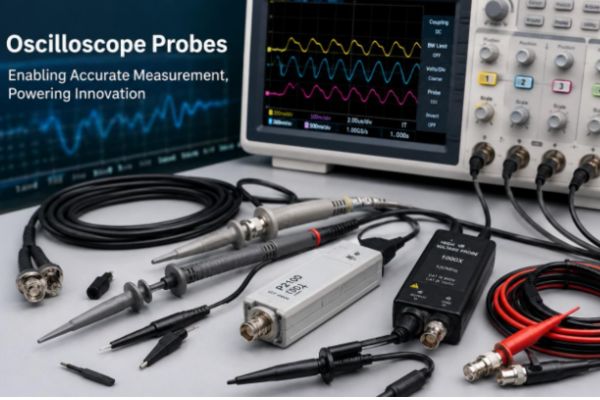
An oscilloscope probe is a specialized measurement accessory designed to transfer electrical signals from a circuit to an oscilloscope with minimal distortion. It not only provides electrical connectivity but also preserves signal integrity by reducing loading effects, minimizing interference, and maintaining bandwidth accuracy.
Today’s market includes a broad portfolio of probe technologies such as passive probes, active probes, differential probes, high-voltage probes, current probes, optical probes, RF probes, and specialized probes developed for automotive and semiconductor testing. Each category serves unique industrial applications where measurement precision directly influences product quality and operational safety.
What Is Driving the Growth of the Oscilloscope Probes Market?
The market is expanding due to the rapid advancement of electronic systems across multiple industries. Higher operating frequencies, miniaturized circuit designs, increasing semiconductor complexity, and faster communication protocols require measurement tools capable of capturing signals with exceptional accuracy.
The widespread adoption of electric vehicles, autonomous transportation technologies, industrial automation, aerospace electronics, 5G communication infrastructure, and renewable energy equipment has significantly increased demand for advanced oscilloscope probes that support high bandwidth, superior signal fidelity, and improved electrical isolation.
Manufacturers are also investing heavily in probe technologies that simplify measurements while reducing setup time, making testing faster and more efficient for engineers working in both research and production environments.
Why Signal Integrity Is Becoming a Competitive Advantage
Signal integrity has emerged as one of the defining challenges in modern electronics. As digital devices operate at increasingly higher speeds, even minor measurement errors can lead to incorrect diagnoses, delayed product launches, or expensive design modifications.
Advanced oscilloscope probes are engineered to minimize capacitance, reduce noise pickup, maintain impedance matching, and accurately reproduce fast transient events. Engineers working on high-speed digital interfaces, power electronics, RF communications, and embedded systems increasingly prioritize probe performance as much as oscilloscope performance itself.
This emphasis on accurate measurements is creating sustained opportunities for innovation across the global oscilloscope probes market.
Emerging Technologies Reshaping the Market
Technological evolution is transforming oscilloscope probe capabilities. Manufacturers are integrating smarter features that improve both measurement accuracy and user experience.
Some of the most influential developments include:
- Ultra-high bandwidth probes supporting next-generation digital communication systems.
- Differential probes designed for power electronics and high-voltage applications.
- Low-capacitance active probes for semiconductor validation.
- Current probes capable of measuring rapidly changing electrical currents.
- Optical isolation technologies for safer industrial testing.
- Probe auto-identification systems for seamless oscilloscope integration.
- Enhanced electromagnetic shielding to reduce external interference.
- Compact probe designs for densely populated circuit boards.
These innovations enable engineers to capture increasingly complex waveforms without compromising measurement reliability.
Applications Expanding Across Global Industries
The oscilloscope probes market serves a remarkably diverse customer base. Every sector relying on electronic design, testing, or maintenance benefits from precise signal measurement.
Major application areas include:
Automotive Electronics
Vehicle manufacturers use oscilloscope probes to validate battery management systems, electric powertrains, onboard charging systems, advanced driver assistance technologies, infotainment platforms, and automotive communication networks.
Semiconductor Manufacturing
Chip designers require extremely accurate probes for silicon validation, wafer testing, integrated circuit debugging, timing verification, and high-speed interface development.
Telecommunications
Telecommunication companies rely on precision probes during the development of fiber-optic equipment, wireless infrastructure, satellite communications, and next-generation networking hardware.
Aerospace and Defense
Mission-critical electronic systems demand highly reliable testing equipment capable of measuring complex electrical behavior under demanding operating conditions.
Medical Devices
Medical equipment manufacturers use oscilloscope probes to validate imaging systems, patient monitoring devices, diagnostic equipment, wearable electronics, and precision surgical technologies where safety and accuracy are paramount.
The Growing Importance of Electric Vehicles
Electric mobility represents one of the strongest growth catalysts for the oscilloscope probes market. Modern electric vehicles incorporate sophisticated power electronics operating at high voltages and fast switching frequencies.
Engineers developing traction inverters, battery management systems, charging infrastructure, motor controllers, and power converters require specialized differential and current probes capable of safely measuring complex electrical signals.
As countries continue investing in transportation electrification, testing requirements are becoming increasingly sophisticated, directly benefiting the oscilloscope probe industry.
Artificial Intelligence Is Modernizing Electronic Testing
Artificial intelligence is gradually transforming electronic measurement workflows. AI-powered software can automatically recognize waveform anomalies, identify measurement inconsistencies, recommend optimal probe configurations, and accelerate troubleshooting processes.
Future oscilloscope probe ecosystems may combine intelligent hardware with cloud-based analytics, enabling predictive diagnostics, remote collaboration, automated reporting, and machine learning-assisted validation for complex electronic systems.
This convergence of intelligent software and precision hardware represents a promising direction for the industry’s long-term evolution.
Challenges Influencing Market Development
Despite strong technological momentum, manufacturers continue addressing several industry challenges.
Key considerations include:
- Maintaining signal accuracy at ultra-high frequencies.
- Designing probes compatible with increasingly compact circuit boards.
- Managing manufacturing costs while integrating advanced technologies.
- Ensuring compatibility across multiple oscilloscope platforms.
- Meeting evolving international safety and calibration standards.
- Reducing electromagnetic interference in demanding industrial environments.
Successfully overcoming these challenges will be essential for maintaining competitive differentiation.
What Opportunities Will Shape the Future of the Oscilloscope Probes Market?
Future opportunities are expected to emerge from several transformational industries:
- Advanced semiconductor packaging.
- Quantum computing research.
- High-speed data centers.
- Space technology programs.
- Renewable energy infrastructure.
- Smart manufacturing facilities.
- Industrial robotics.
- Autonomous transportation systems.
- Advanced medical diagnostics.
- High-frequency communication networks.
Each of these sectors depends heavily on highly accurate electrical measurements, ensuring sustained demand for increasingly sophisticated oscilloscope probes
Competitive Landscape
- Tektronix
- Keysight Technologies
- Rohde & Schwarz
- Teledyne LeCroy
- Fluke Corporation
- Yokogawa Electric Corporation
- Pico Technology
- GW Instek
- Rigol Technologies
- Hantek Electronics
- Siglent Technologies
- Chauvin Arnoux
- B&K Precision
- Good Will Instrument Co.
- Testec Elektronik
- PMK Mess- und Kommunikationstechnik
- Pintech Instruments
- Emerson Electric Co.
Sustainability Is Becoming a Design Priority
According to our Growth Market Report, Environmental responsibility is becoming an important consideration for manufacturers throughout the electronic testing industry. Companies are developing probes using durable materials, recyclable packaging, energy-efficient production methods, and modular designs that extend product lifecycles while reducing electronic waste.
Long-lasting, repairable measurement accessories help organizations lower operational costs while supporting broader sustainability initiatives across manufacturing ecosystems.