
The Perovskite Solar Cell Market is rapidly emerging as one of the most transformative segments in the renewable energy industry. With the global shift toward sustainable energy solutions and increasing investments in next-generation photovoltaic technologies, perovskite solar cells are gaining strong traction across multiple industries.
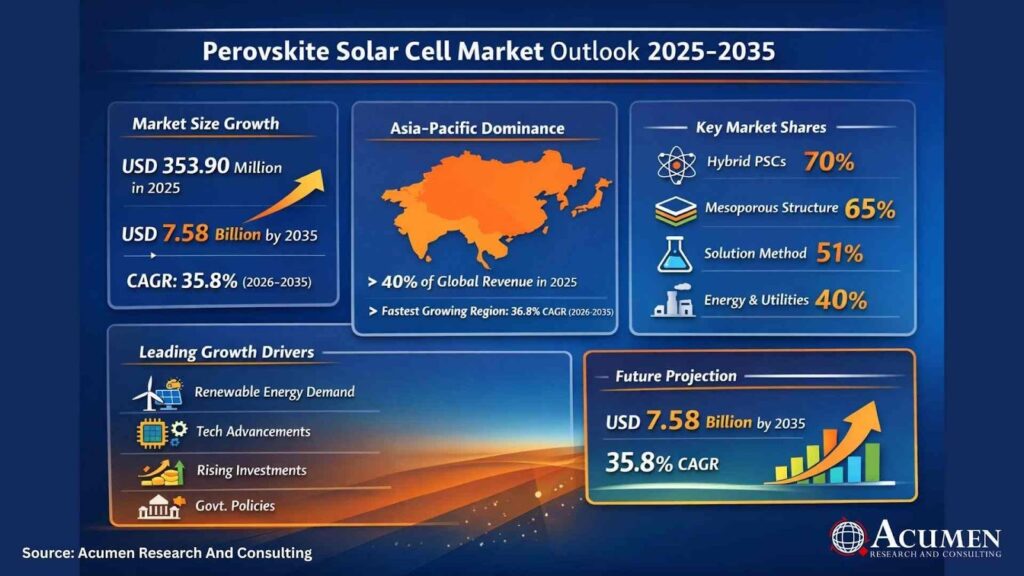
According to Acumen Research And Consulting analysis, the Global Perovskite Solar Cell Market size reached USD 353.90 million in 2025 and is projected to exceed around USD 7,584.04 million by 2035, expanding at a compound annual growth rate (CAGR) of 35.8% during the forecast period from 2026 to 2035.
Perovskite solar cells represent an advanced photovoltaic technology that uses perovskite-structured materials as the light-absorbing layer. These materials have demonstrated remarkable potential for delivering high power conversion efficiency, lower manufacturing costs, and flexible application possibilities compared with traditional silicon-based solar cells.
This rapid expansion highlights the growing importance of Perovskite Solar Cell Technology in addressing global energy demands while supporting the transition toward low-carbon power generation.
Understanding Perovskite Solar Cell Technology
Perovskite solar cells are a class of photovoltaic devices that use materials with a perovskite crystal structure to convert sunlight into electricity. These materials possess unique optoelectronic properties that enable efficient light absorption and charge transport.
Unlike conventional silicon solar cells, perovskite solar cells can be manufactured using relatively simple and cost-effective processes. The technology also offers flexibility in design, allowing solar modules to be integrated into various surfaces and materials.
Some of the key advantages of Perovskite Solar Cells include:
- High potential power conversion efficiency
- Lower manufacturing costs compared with traditional solar cells
- Lightweight and flexible module design
- Compatibility with tandem solar cell technologies
- Potential applications in building-integrated photovoltaics
These advantages are driving the rapid adoption of perovskite solar cells across renewable energy projects and advanced photovoltaic research initiatives.
Key Perovskite Solar Cell Market Highlights
Several important indicators highlight the strong growth trajectory of the Perovskite Solar Cell Market.
- The global Perovskite Solar Cell Market was valued at USD 353.90 million in 2025.
- The market is projected to exceed USD 7,584.04 million by 2035.
- The Perovskite Solar Cell Market is expected to expand at a CAGR of 35.8% from 2026 to 2035.
These statistics demonstrate the remarkable growth potential of next-generation photovoltaic technologies.
Asia-Pacific Dominates the Perovskite Solar Cell Market
Regionally, Asia-Pacific emerged as the largest market for perovskite solar cells in 2025, accounting for over 40% of the global revenue share.
The region’s dominance can be attributed to several factors, including:
- Rapid expansion of solar energy infrastructure
- Strong government support for renewable energy adoption
- Increasing investments in photovoltaic research and development
- Large-scale manufacturing capabilities for solar technologies
Countries such as China, Japan, South Korea, and India are investing heavily in solar power generation and advanced photovoltaic technologies.
In addition to leading the market in terms of revenue share, the Asia-Pacific region is also expected to remain the fastest-growing market, registering a CAGR of approximately 36.8% from 2026 to 2035.
The region’s strong manufacturing ecosystem and expanding renewable energy policies are expected to continue driving growth in the Perovskite Solar Cell Market.
Hybrid Perovskite Solar Cells Lead the Market by Type
Based on technology type, Hybrid Perovskite Solar Cells (PSCs) dominated the Perovskite Solar Cell Market, accounting for approximately 70% of the total market share.
Hybrid PSCs combine organic and inorganic materials to create highly efficient photovoltaic devices. These solar cells are widely adopted due to their:
- Enhanced efficiency performance
- Improved material stability
- High compatibility with advanced solar cell architectures
The continued development of hybrid perovskite materials is expected to further enhance the efficiency and durability of solar modules.
As research progresses, hybrid PSCs are likely to remain a key component in next-generation solar technologies.
Mesoporous Structures Dominate the Market
By structure, Mesoporous Perovskite Solar Cells accounted for the largest share of the Perovskite Solar Cell Market, representing around 65% of the overall structure segment.
Mesoporous structures incorporate a porous scaffold layer that improves charge transport within the solar cell. This design enhances energy conversion efficiency and stability.
The widespread adoption of mesoporous structures is driven by several advantages:
- Improved electron transport efficiency
- Enhanced material stability
- Higher power conversion efficiency
- Better compatibility with hybrid perovskite materials
These characteristics make mesoporous structures one of the most widely used architectures in perovskite photovoltaic development.
Solution Method Leads Manufacturing Techniques
When analyzed by manufacturing method, the solution processing method accounted for the largest share of the Perovskite Solar Cell Market, holding approximately 51% of total adoption.
Solution-based manufacturing techniques offer several advantages compared with traditional fabrication processes:
- Lower production costs
- Simpler manufacturing procedures
- High scalability for industrial production
- Compatibility with flexible substrates
These advantages make the solution method a preferred approach for producing large-scale perovskite solar modules.
As research continues to improve material stability and processing techniques, solution-based fabrication methods are expected to play a major role in the commercialization of perovskite solar technologies.
Energy and Utilities Sector Drives Market Demand
By end-use industry, the Energy and Utilities sector emerged as the largest consumer of perovskite solar cells, accounting for approximately 40% of the total market share in 2025.
Energy utilities are increasingly adopting advanced photovoltaic technologies to expand renewable energy capacity and reduce dependence on fossil fuels.
Key factors supporting the adoption of perovskite solar technology in the energy sector include:
- Increasing demand for clean electricity generation
- Government policies supporting renewable energy expansion
- Declining solar power generation costs
- Integration of solar technologies into national energy grids
As utilities continue to invest in solar power infrastructure, the demand for high-efficiency photovoltaic technologies such as perovskite solar cells is expected to grow significantly.
Key Growth Drivers in the Perovskite Solar Cell Market
Several major factors are driving the rapid expansion of the Perovskite Solar Cell Market worldwide.
Increasing Demand for Renewable Energy
Global energy demand continues to rise as economies expand and industrial activities increase. At the same time, governments and international organizations are implementing policies aimed at reducing greenhouse gas emissions.
Solar power has become one of the most important renewable energy sources due to its scalability and sustainability. Perovskite solar technology is expected to play a key role in improving solar energy efficiency and reducing overall costs.
Technological Advancements in Photovoltaic Materials
Continuous advancements in photovoltaic materials are improving the efficiency and performance of perovskite solar cells.
Researchers are developing new material compositions that enhance durability, reduce environmental impact, and increase energy conversion efficiency.
These technological improvements are expected to accelerate the commercialization of perovskite solar modules.
Rising Investments in Solar Energy Infrastructure
Global investments in renewable energy infrastructure are growing rapidly as countries seek to diversify their energy sources and reduce reliance on fossil fuels.
Public and private sector organizations are increasingly funding research and development initiatives aimed at advancing next-generation solar technologies.
Such investments are expected to significantly support Perovskite Solar Cell Market Growth during the forecast period.
Emerging Trends in the Perovskite Solar Cell Market
Tandem Solar Cell Development
One of the most promising developments in the solar industry is the emergence of tandem solar cells, which combine perovskite materials with traditional silicon solar cells.
This hybrid approach enables solar modules to capture a broader spectrum of sunlight, significantly improving power conversion efficiency.
Building-Integrated Photovoltaics (BIPV)
Perovskite solar cells are also gaining attention for their potential applications in building-integrated photovoltaics.
Because perovskite materials can be fabricated into lightweight and flexible structures, they can be incorporated into:
- Building facades
- Windows
- Roof materials
This technology could transform buildings into self-sustaining energy generators.
Challenges Facing the Perovskite Solar Cell Market
Despite its strong growth prospects, the Perovskite Solar Cell Market still faces several challenges.
Material Stability
Perovskite materials can degrade when exposed to environmental factors such as moisture, heat, and ultraviolet radiation. Improving long-term stability remains a major focus of ongoing research.
Environmental Concerns
Some perovskite solar cells contain lead, which raises environmental concerns. Researchers are actively exploring alternative materials and improved encapsulation techniques to address this issue.