India has built worldclass systems before the railways, the highways, one of the fastestgrowing airline industriesnEarth. What it has never built is a heavy electric aircraft that can rise straight off the ground, hover under its own closed-loop control, and repeat it. Until now.
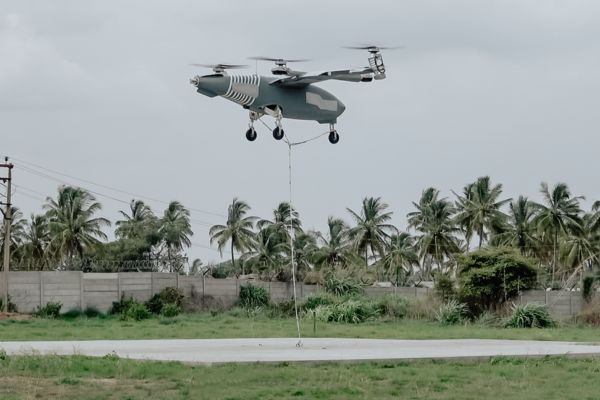
Sarla Aviation, announces the successful completion of the flighttest campaign for Sylla, its halzscale electric vertical takeoff and landing (eVTOL) technology demonstrator. Acrossix months of field testing, Sylla logged more than 500 tests and over 18 hours of flight testing making the 700 kgclass, 7.5metrewingspan aircraft the heaviest electric aircraft ever to take off in India.
Commenting on the milestone, Rakesh Gaonkar, CoFounder and CTO at Sarla Aviation, said “Sylla 1.0 was never built simply to hover. It was built to answer engineering questions that simulations alone cannot. Flying Sylla is the moment a thousand simulations become real, validating our aircraft architecture under real flight conditions. We achieved this in under a year, on a fraction of the capital our global peers have spent, with a team that has helped build some of the world’s most advanced aircraft. That combination of global engineering expertise and Indian speed of execution is our edge. Sylla has given us the data we set out to capture, and those learnings are already shaping our next-gen aircraft as we move towards transition and sustained wing-borne flight on our journey to our 6+1 air taxi ‘Shunya’.”
Sylla 1.0 is a halfscale technology demonstrator built to validate aircraftlevel and systemlevel integration under real operating conditions. Throughout the programme, Sarla Aviation successfully evaluated the interaction between the aircraft’s electric propulsion system, battery architecture, distributed propulsion, flightcontrol algorithms, airframe and landing gear as a fully integrated aircraft.
With the successful completion of its integrated flight test campaign, Sylla 1.0 has successfully achieved the engineering objectives it was designed to accomplish. As the monsoon season arrives over southern India, the programme now transitions to its next chapter. Having captured the complete set of flight data required, Sarla will incorporate these learnings into its nextgeneration technology demonstrator designed to achieve controlled transition from hover to sustained wing-borne flight.
The Sylla programme also marks several national firsts in electric aviation: first in India to build and fly a 700 kg-class electric aircraft capable of vertical takeoff; first in India to fly a 400volt electric powertrain architecture; first in India to demonstrate a distributedpropulsion wing system; and first in India to complete fullstack ground testing in accordance with airworthiness regulations.
Sylla 1.0 went from design to flight in under 12 months, a development pace that few eVTOL programmes globallyhave matched. More striking is the cost. Sarla reached this milestone, a fullscale mockup unveiled at the Bharat Mobility Global Expo in Delhi in 2025, and now a flying halfscale demonstrator on less than $13 million. This represents a level of capital efficiency unmatched globally for an eVTOL programme of this class. Capital efficiency and rapid technology progress has also recently drawn IndiGo Ventures to acquire a stake in the company.
About 30% of Sarla’s engineering team comes from the world’s leading eVTOL companies, including Lilium, Volocopter and Wisk. That concentration of frontier flight experience, combined with an Indiabased engineering culture built for speed, is what allowed the company to compress a development timeline that typically runs for years into months.
The successful completion of the Sylla 1.0 campaign marks the beginning of Sarla Aviation’s next phase of flight testing. The company has already begun development of Sylla 2.0, an upgraded technology demonstrator that incorporates the engineering learnings from the current programme. While Sylla 1.0 focused on validating integrated aircraft systems and controlled hover, Sylla 2.0 will pursue controlled transition between vertical and wing-borne flight, the defining technological milestone required before developing a certifiable passenger eVTOL.
Every flight completed by Sylla 1.0 has directly reduced technical uncertainty for the next generation of aircraft, bringing Sarla Aviation one step closer to ‘Shunya’, the company’s passenger eVTOL designed for regional and urban air mobility.