
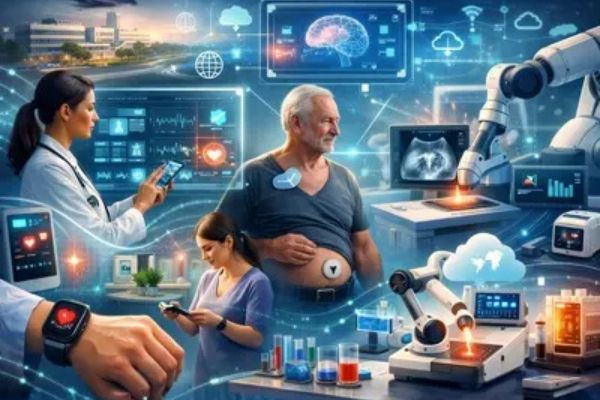
Medical devices are moving beyond basic measurement., smart medical devices can sense physiological signals, process information, identify patterns and communicate data with healthcare platforms.
Two technologies are central to this shift smart sensors and System-on-Chip (SoC) technology. Together, they allow compact medical devices to collect and process health information while reducing the need for large external hardware.

What Are Smart Sensors?
Smart sensors combine a sensing element with electronics that can process or condition the collected signal. Instead of simply detecting a physical or biological parameter, they can help convert it into usable digital information.
In healthcare, these sensors can measure parameters such as heart rate, ECG signals, body temperature, blood oxygen, glucose, movement, pressure and other physiological signals.
What Role Do Medical SoCs Play?
A System-on-Chip integrates several computing functions into a compact semiconductor device. Depending on the application, an SoC can combine processing cores, memory interfaces, communication modules, signal-processing functions and other components.
In a smart medical device, the SoC acts as a central processing unit. It receives information from sensors, processes the signals and can prepare the data for local analysis or wireless transmission.
How Sensors and SoCs Work Together
The basic workflow is:
Patient → Smart Sensor → Signal Processing → Medical SoC → AI/Analytics → Wireless Connectivity → Healthcare Platform
For example, a wearable cardiac monitor can capture electrical signals through electrodes. The SoC can filter and process these signals before transmitting selected information to a smartphone or remote monitoring platform.
This reduces the need to continuously send raw data and can support faster analysis at the device level.
Connection With Smart Medical Devices
Smart medical devices depend on the ability to sense, compute and communicate. This is where sensors and SoCs become important building blocks.
Wearable monitors, smart patches, connected glucose monitoring systems, portable diagnostic devices and remote patient monitoring equipment can use these technologies to collect and process information continuously.
As devices become smaller, manufacturers also need compact, low-power electronics that can perform multiple functions without significantly increasing size or energy consumption.
According to Towards Healthcare Research and Consulting, the global smart medical devices market size is calculated at US$ 26.62 billion in 2025, grew to US$ 28.55 billion in 2026, and is projected to reach around US$ 53.65 billion by 2035. The market is expanding at a CAGR of 7.26% between 2026 and 2035.
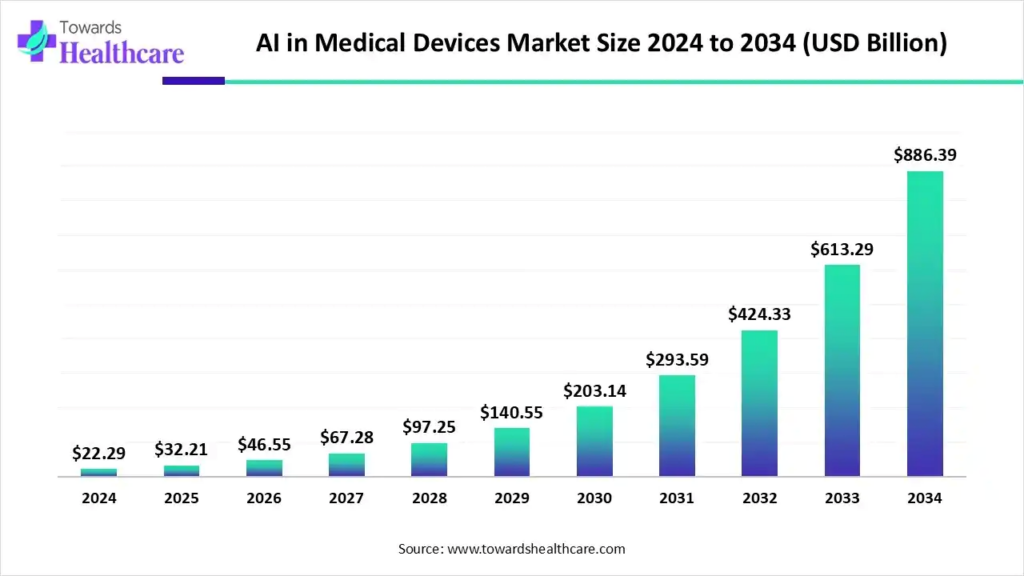
Role of AI in Smart Medical Devices
AI adds another layer of intelligence to connected medical electronics. Once sensor data is processed by the SoC, AI algorithms can identify patterns, detect changes or classify signals for specific applications.
For example, AI can support ECG signal analysis, activity recognition or anomaly detection. When some of this processing happens directly on the device, it is known as edge AI.
This approach can reduce data transmission, support faster responses and potentially improve privacy by keeping more information closer to the device.
Technologies Used in Connected Medical Devices
Several technologies work together to create these systems:
- MEMS Sensors: Measure motion, pressure and other physical parameters.
- Biosensors: Detect biological or biochemical signals.
- Analog Front-End Circuits: Condition weak physiological signals before processing.
- Medical SoCs: Integrate processing and multiple electronic functions.
- Edge AI: Enables local analysis of health data.
- Bluetooth Low Energy: Provides low-power wireless connectivity.
- Low-Power Memory and Processors: Support continuous operation.
- Cloud Platforms: Store and analyze data when remote processing is required.
Advantages of Smart Sensors and Medical SoCs
The combination can make medical devices smaller, more power-efficient, connected and intelligent. It also supports continuous monitoring and can reduce dependence on bulky external equipment.
For manufacturers, integrated electronics can simplify device architecture and create opportunities for multifunctional medical products.
Challenges to Consider
Medical electronics must meet demanding requirements for accuracy, reliability, safety and cybersecurity. Sensor noise, calibration, battery limitations and wireless interference can affect device performance.
SoC-based devices also require careful thermal and power management. Most importantly, AI-enabled functions used for clinical purposes need appropriate testing and validation before they can be relied upon in healthcare settings.
The Road Ahead
The development of smart medical devices is increasingly becoming an electronics challenge as much as a healthcare one. Sensors provide the data, SoCs provide the computing capability, connectivity moves the information and AI adds intelligence.
As semiconductor integration improves, more functions can fit into smaller devices. This could support a new generation of connected medical electronics capable of continuously sensing, processing and communicating health information closer to the patient.