As electronics manufacturers push toward higher throughput, tighter tolerances, and fully connected production lines, traditional benchtop LCR meters are becoming a bottleneck. They deliver the required precision, but they are expensive, occupy valuable bench real estate, and are difficult to integrate seamlessly into automated test and inspection systems.
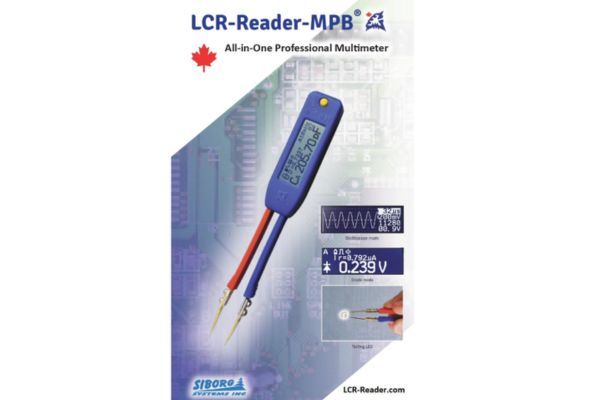
Siborg Systems has developed an alternative the LCR-Reader-MPB, a 36 g tweezers-style LCR/multimeter that combines benchtop-class accuracy with native CAN-protocol output and optional Bluetooth connectivity. This combination makes the MPB well suited to in-line quality control, automated test fixtures, and Industry 4.0-ready manufacturing environments.

From Manual Bench Testing to Connected, Point-of-Use Measurement
The LCR-Reader concept began as a practical tool for SMT rework: a pair of precision tweezers with an integrated LCR engine, allowing technicians to pick up a component and see its key parameters immediately. The MPB takes this core idea and builds it into an instrument that fits naturally into modern production and test workflows.
The device provides a 0.1% basic accuracy LCR engine with test frequencies up to 250 kHz at 1 Vrms, enabling precise characterization of low-value capacitors and inductors commonly used in high-density, high-speed, and RF-adjacent designs. Gold-plated tweezers tips grip 0201 and smaller SMD components directly on the PCB, greatly reducing contact errors and eliminating the need for leads and clips in many test scenarios.
For manufacturers, this translates into faster in-process checks, more reliable sample inspection, and less time spent moving assemblies between workstations just to access a fixed benchtop meter.
Designed for Production, Not Just the Lab
While the MPB is compact enough for an engineer’s pocket, it is designed with production and test engineers in mind:
- 0.1% basic accuracy, comparable to many benchtop LCR meters
- Wide test frequency range (100 Hz to 250 kHz at 1 Vrms)
- Measurement of sub-1 pF capacitance and sub-10 nH inductance
- Automatic identification of L, C, and R with auto-selection of optimal test conditions
- Manual override for parameter control when test procedures demand it
This combination makes the MPB a practical tool at multiple points on the factory floor: incoming inspection of passive components, SMT line sampling, rework verification, and final test support.
CAN Protocol: A Direct Path into Automated Test Systems
The standout feature for manufacturing environments is the LCR-Reader-MPB’s CAN-protocol data output. While many handheld meters are effectively stand-alone devices, the MPB is built to be a node in a larger test and automation network.
Through its CAN interface, the instrument can:
- Stream structured measurement data into PLC-based fixtures
- Participate as a smart sensor in automated end-of-line test stations
- Feed measurements directly into MES, SPC, and custom manufacturing analytics systems
- Support pass/fail decisions and traceable records without manual transcription
Instead of treating LCR measurements as isolated steps performed only on benchtops, production engineers can embed them directly into automated stations, with the tweezers contacts providing a fast, repeatable mechanical interface to the board or component.
For manufacturers standardizing on CAN within their test architecture, the MPB offers a straightforward integration path: it speaks the same protocol as their existing industrial controllers and equipment.
Bluetooth and PC Integration for Engineering and QA
For engineering teams and standalone QA stations, an optional Bluetooth-enabled configuration (LCR-Reader-BT) allows measurements to be streamed wirelessly to PCs or tablets. Siborg’s software and APIs support:
- Real-time logging of LCR and ESR data
- Creation of automated test scripts and pass/fail criteria
- Export of measurement records for analysis, traceability, and audits
This dual approach—CAN for hard-wired, industrial integration and Bluetooth for flexible lab and QA workflows—makes the MPB adaptable across the product lifecycle, from R&D through NPI and into volume manufacturing.
All-in-One Instrument for Line and Lab
Beyond LCR measurement, the MPB replaces several tools commonly found on benches and mobile carts:
- L, C, R, and ESR measurement
- AC/DC voltage and current (for low-power circuits)
- Frequency and duty cycle measurements
- LED and diode testing
- A simple oscilloscope-style viewing mode for basic signal checks
- A built-in signal generator up to 500 kHz for stimulus in diagnostics and characterization
By consolidating these capabilities into one compact instrument, manufacturers can reduce their tool count at each station, simplify training, and lower overall test equipment costs.
Analog Signature Analysis for Fast Board Diagnostics
For repair, rework, and failure analysis, the MPB includes Analog Signature Analysis (ASA). In ASA mode, the instrument applies a known stimulus and captures an I-V signature of the circuit under test. Comparing signatures between known-good and suspect boards allows technicians to localize faults quickly, often without desoldering components.
This capability is particularly helpful in:
- Debugging early production runs
- Supporting field returns and warranty analysis
- Diagnosing intermittent or hard-to-reproduce failures on complex assemblies
Calibrated for Quality-Controlled Environments
Each LCR-Reader-MPB is shipped with a NIST-traceable Calibration Certificate, making it suitable for use in calibration-controlled manufacturing and QA environments. This documentation simplifies inclusion of the MPB in ISO/AS-certified quality systems and customer audits.