


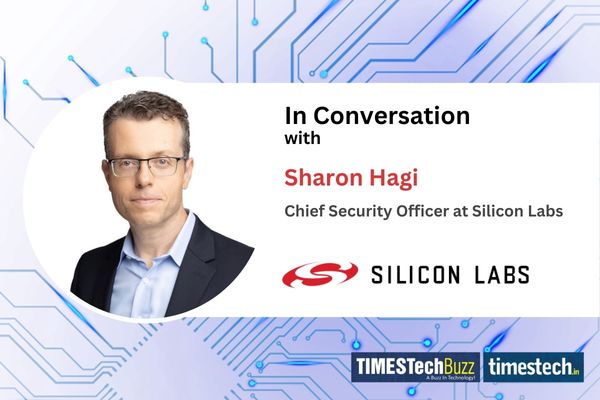
In an interview with TimesTech, Sharon Hagi, Chief Security Officer at Silicon Labs, shared insights on the company becoming the world’s first to achieve PSA Level 4 certification. He explained what this milestone means for global IoT security, how it supports compliance with evolving regulations, and why resilient device-level security is critical for India’s smart city and Industry 4.0 ambitions.
Read the full interview here:
TimesTech: Silicon Labs has become the first company globally to achieve PSA Level 4 certification. Can you explain what PSA Level 4 means in simple terms and why this milestone is such a big deal for the IoT industry?
Sahron: Think of PSA Level 4 as the highest security rating a connected device can earn, similar to a car receiving a five-star crash test rating. It means that Silicon Labs’ technology has been rigorously tested against the toughest and most rigorous production security platform standards, As the first company globally to achieve PSA Level 4 certification, this milestone with our Series 3 SiXG301 SoC and Secure Vault™ technology shows that we can protect IoT systems against advanced threat capabilities that were once thought to be extremely difficult to resist or mitigate effectively.. For the industry, it’s a big deal because it sets a new global benchmark for trust and gives device makers the confidence to build smarter, safer products—from medical devices to smart meters and industrial machines—without compromising on security.
TimesTech: Governments across the EU, US, and Asia are tightening IoT security regulations like RED, CRA, and the US Cyber Trust Mark. How will PSA Level 4 help device makers meet or exceed these evolving global standards?
Sahron: For governments today, the baseline security of an IoT product is now as obligatory as its core functionality. New rules in Europe, the US, and Asia are regulating device makers to ensure and demonstrate that their products are resilient against modern cyber threats. PSA Level 4 certification essentially demonstrates the product capabilities to meet those emerging requirements and higher levels of trust—it demonstrates that our chips already meet and may in fact even exceed many of these requirements. This means companies using our technology won’t be merely reacting to new regulations; instead, they will be in a better position to proactively respond and ensure their product security meets future standards. It simplifies compliance, reduces the risk of product recalls or penalties, and helps device makers reach global markets faster with products that customers can trust.
TimesTech: With India’s push towards smart cities, Industry 4.0, and large-scale public sector digitization, how critical is it to have resilient, secure IoT infrastructure at the core?
Sahron: India’s digital growth story is remarkable, but with opportunity comes responsibility. Whether it’s a smart traffic light, a connected healthcare device, or a payment gateway, these systems are all linked to people’s everyday lives. Insecure systems pose risks that go far beyond data theft, threatening public safety, eroding trust, and potentially compromising national infrastructure.
That’s why building resilience at the device level is so important. PSA Level 4-certified solutions provide the kind of robust protection that India needs as it builds digital-first cities, factories, and services. Security cannot be an afterthought—it must be the foundation of India’s digital ecosystem.
TimesTech: Cyber threats are becoming more sophisticated every year. How does Silicon Labs’ Secure Vault technology and the SiXG301 SoC future-proof connected systems against these evolving risks?
Sahron: The threat landscape is constantly evolving, meaning a solution that is secure today may be vulnerable tomorrow. To address this, our Secure Vault technology and the SiXG301 SoC are engineered for long-term resilience against evolving threats. This is accomplished through strong, built-in defenses designed to protect for years and the ability to deploy secure over-the-air updates. As new threats emerge, our customers can strengthen their devices without replacing hardware. This ensures our technology doesn’t just protect devices today—it keeps them secure for the future.
TimesTech: India is aiming to be a hub for design-led semiconductor innovation. What role do you see for India’s engineering talent and R&D ecosystem in shaping the next generation of secure IoT solutions?
Sahron: India has one of the world’s most dynamic engineering talent pools. As the country invests further in design-led semiconductor initiatives, this talent will be pivotal in elevating not just the volume, but also the quality of global innovation.
Security, in particular, is a key area for this innovation. Indian engineers are already creating cutting-edge security solutions. By embedding this expertise at the core of the semiconductor design process, India can ensure the next generation of IoT devices is secure by design, which will be paramount as billions of new devices come online worldwide.
TimesTech: Silicon Labs has an R&D center in Hyderabad and is growing local partnerships. How do these collaborations contribute to both India’s and Silicon Labs’ global IoT security goals?
Sahron: Our Hyderabad R&D center is more than just a development hub—it’s a bridge between India’s innovation ecosystem and our global security mission. The teams here contribute to our core technologies, including security features that now power PSA Level 4 certification.
We also work with local partners and customers to understand the unique challenges of the Indian market, from smart city deployments to digital payments. This two-way exchange strengthens India’s capabilities and ensures Silicon Labs remains a trusted partner worldwide. This collaboration embodies our broader belief that solving global security challenges requires local talent and local insights.