Thermal Scanners Market Poised for Strong Growth with Rising Demand for Contactless Temperature Screening
The global Thermal Scanners Market is witnessing significant growth as organizations across healthcare, transportation, industrial manufacturing, and public infrastructure increasingly adopt non-contact temperature monitoring technologies.
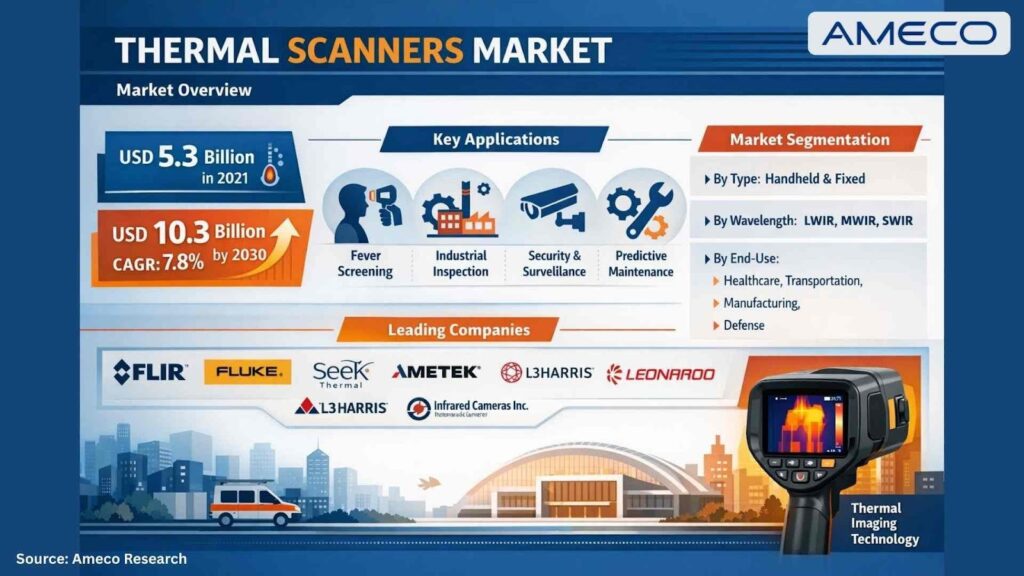
According to Ameco Research analysis, the Global Thermal Scanners Marketwas valued at USD 5.3 billion in 2021 and is projected to reach USD 10.3 billion by 2030, expanding at a compound annual growth rate (CAGR) of 7.8% between 2022 and 2030.
Thermal scanners have become critical tools for public health screening, industrial diagnostics, and security surveillance due to their ability to detect temperature variations without physical contact.
The increasing need for temperature monitoring, predictive maintenance, and safety inspections across multiple industries is expected to accelerate the adoption of thermal imaging technologies over the coming years.
What Are Thermal Scanners and How Do They Work?
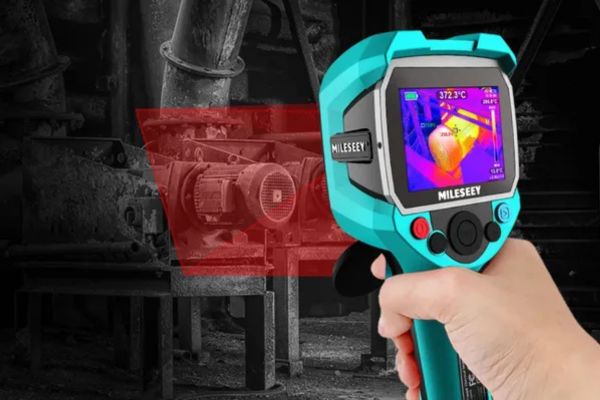
Thermal scanners are devices designed to measure temperature using infrared radiation detection. These systems capture infrared energy emitted by objects or human bodies and convert it into temperature readings or thermal images.
Thermal scanning technology allows operators to quickly identify abnormal temperature patterns, which can indicate:
- Fever in individuals
- Equipment overheating
- Electrical faults
- Industrial system failures
Because these devices do not require direct contact, they are widely used in public health screening, industrial inspection, and surveillance applications.
Why Is the Thermal Scanners Market Growing Rapidly?
Several key factors are driving the expansion of the Thermal Scanners Market globally.
Rising Demand for Fever Detection and Public Health Monitoring
One of the major drivers of the thermal scanners market is the growing need for mass temperature screening in public spaces.
Thermal scanners are widely deployed in:
- Airports
- Hospitals
- workplaces
- shopping malls
- public transport hubs
They enable rapid identification of individuals with elevated body temperatures, helping prevent the spread of infectious diseases.
Increasing Use in Industrial Predictive Maintenance
Thermal imaging technologies are increasingly used in industrial environments to detect abnormal heat patterns in machinery and electrical systems.
Industrial applications include:
- Equipment diagnostics
- predictive maintenance
- process monitoring
- quality control
By identifying overheating components early, thermal scanners help companies reduce downtime and maintenance costs.
Growing Adoption in Security and Surveillance
Thermal scanners are also widely used in security and surveillance systems, particularly in low-light environments.
Their ability to detect heat signatures enables security teams to monitor activity even in complete darkness, making them valuable tools for:
- border surveillance
- military monitoring
- critical infrastructure protection
These capabilities are contributing to rising demand across defense and public safety sectors.
Thermal Scanners Market Segmentation
The global thermal scanners market is segmented based on type, wavelength, end-use, and region, allowing companies to target specific application areas more effectively.
By Type
The market is divided into two main categories:
- Handheld Thermal Scanners
- Fixed Thermal Scanners
Handheld devices offer flexibility and portability, making them ideal for field inspections and maintenance tasks. Fixed scanners, on the other hand, are commonly used for continuous monitoring in high-traffic environments such as airports or factories.
By Wavelength
Thermal scanners operate across different infrared wavelengths, including:
- Long-Wave Infrared (LWIR)
- Mid-Wave Infrared (MWIR)
- Short-Wave Infrared (SWIR)
Each wavelength range provides different imaging capabilities and is used in various industrial and security applications.
By End-Use Industry
Thermal scanners are widely used across multiple sectors, including:
- Healthcare
- Transportation
- Industrial manufacturing
- Defense and security
- Commercial buildings
The growing demand for safety monitoring and predictive maintenance technologies is driving adoption across these industries.
Regional Outlook of the Thermal Scanners Market
The global thermal scanners market covers several major regions:
- North America
- Europe
- Asia-Pacific
- Latin America
- Middle East & Africa
North America and Europe have been early adopters of thermal imaging technologies due to strong investments in defense, healthcare, and industrial automation.
Meanwhile, the Asia-Pacific region is expected to witness significant growth as governments invest in public safety infrastructure and manufacturing industries continue to expand.
The increasing adoption of smart manufacturing and surveillance technologies across emerging economies is also contributing to regional market expansion.
What Challenges Are Affecting the Thermal Scanners Market?
Despite strong growth potential, several factors may restrict market expansion.
High Cost of Advanced Thermal Scanners
Thermal imaging systems can be expensive, particularly high-resolution models used for industrial or defense applications.
This cost barrier may limit adoption among small and medium-sized businesses.
Lack of Technology Standardization
Different thermal scanners use varying measurement techniques and temperature ranges, which can create confusion for buyers when selecting suitable products.
Standardization across the industry could help accelerate adoption.
Environmental Sensitivity
Thermal scanners can be affected by environmental conditions such as:
- ambient temperature
- humidity
- atmospheric interference
These factors may sometimes reduce measurement accuracy and affect performance.
Key Companies Operating in the Thermal Scanners Market
The global thermal scanners market includes several prominent technology providers focused on innovation and product development.
Key companies operating in the market include:
- AMETEK Land
- Seek Thermal
- 3M
- Fluke Corporation
- FLIR Systems
- Leonardo S.p.A.
- L3Harris Technologies
- Infrared Cameras Inc.
- Optotherm
These companies are investing heavily in research and development to improve thermal imaging accuracy, expand application areas, and integrate advanced technologies such as artificial intelligence and IoT.
Future Outlook of the Thermal Scanners Market
The outlook for the Thermal Scanners Market remains highly positive as industries increasingly adopt non-contact monitoring technologies.
Key trends expected to shape the market include:
- Integration of thermal scanners with AI-based analytics
- Use of thermal imaging in smart city surveillance systems
- Expansion of industrial predictive maintenance solutions
- Increasing deployment in public health monitoring infrastructure
As global industries prioritize safety, efficiency, and automation, thermal scanners are expected to become an essential component of modern monitoring systems.
Frequently Asked Questions (FAQs)
What Is the Current Size of the Thermal Scanners Market?
The global thermal scanners market was valued at USD 5.3 billion in 2021.
What Is the Forecast for the Thermal Scanners Market?
The market is expected to reach USD 10.3 billion by 2030, growing at a CAGR of 7.8% between 2022 and 2030.
What Are Thermal Scanners Used For?
Thermal scanners are widely used for:
- fever detection
- industrial maintenance
- security surveillance
- equipment monitoring
- infrastructure inspections
Which Industries Use Thermal Scanners the Most?
Major industries using thermal scanners include healthcare, transportation, manufacturing, and defense sectors.
What Technologies Are Used in Thermal Scanners?
Thermal scanners use infrared sensing technologies, including LWIR, MWIR, and SWIR wavelengths, to detect temperature differences.