In an interview with TimesTech, Sai Pattabiram, Founder & MD of ZUPPA, outlined how the company is building India’s only deep-tech cyber-physical drone stack. He explained how ZUPPA’s proprietary Adaptive AI delivers secure autopilot systems, its role in India’s defense ecosystem, and why indigenous innovation is critical for national security. Sai also shared ZUPPA’s global expansion plans and his vision for India to lead the micro and nano drone markets by 2030.
Read the full interview here:
TimesTech: ZUPPA is described as India’s only deep-tech cyber-physical drone stack provider. Could you walk us through what this full-stack capability entails and how it sets you apart from global competitors like DJI, Parrot, and Skydio?
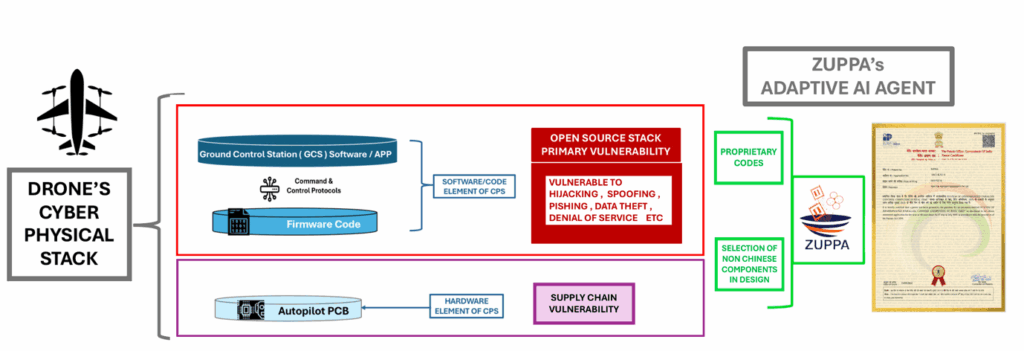
Sai: The Cyber Physical Stack of a drone is the most critical and vulnerable subsystem of a drone. Within the Cyber Physical stack the code/software layers are where all the vulnerabilities of hacking, spoofing, Data Theft, Denial of service etc lie. ZUPPA’s proprietary ADAPTIVE AI. on which it enjoys total is the foundation of its Cyber Physical Stack there by assuring total Cyber Security of all its products. Apart from the India this USP has been recognised by US as well by way of selecting us for their I2A dual tech program.
Our proprietary ADAPTIVE AI AGENT is what differentiates us from global competitors like Skydio, Parrot etc. This is also the foundation of our global expansion ambitions as with this we offer the world a China +1 alternative to the like of DJI .
TimesTech: You’ve developed the proprietary “Disseminated Parallel Control Computing in Real Time” ADAPTIVE AI . How does this innovation enhance drone performance, and what real-world applications has it enabled so far in defense and civilian sectors?
Sai: The Autopilot of a Drone is that piece of embedded electronics that replace the human pilot in an aircraft there by enabling unmanned flight. The fact that the man was replaced in the aircraft by a piece of electronics requires that the autopilot needs to mimic the actions of the human pilot and control the drone.
ZUPPA’s patented Adaptive AI is Bio Mimicry of the Human Pilots control system which in itself is based on 3 millennia of evolution.
ZUPPA’s Adaptive AI Agent trained on two types of data namely :
- Sensory Data for the likes of GPS, IMU, Accelerometers, Gyros, Barometer, Magnetometer etc the outcome of which is NAVGATI drone autopilot
- Video Data ie live camera feed the outcome of which is ZUPPA’s vision guidance system DRISHYA.
Both NavGati and Drishya have been deployed across multiple solutions that are deployed across various stakeholders in the Indian Defence ecosystem from frontline units to DRDO.
TimesTech: ZUPPA is supplying secure micro drones and autopilots to the Indian Army, even competing head-to-head with Chinese DJI drones. What were the biggest technological and strategic challenges in achieving this level of parity and how did you overcome them?
Sai: Achieving parity with global micro drone leaders like DJI demanded a deep rethinking of key technologies and relentless innovation. Our greatest challenges lay in (a) decoupling from Chinese supply chains; (b) Getting customers who were used to DJI’s to accept that Ajeet performed as well at similar pricing levels (c) winning trust in a market long dominated by low-cost, open-source/foreign components. The 2024 Army drone hacking incident revealed just how vulnerable imported autopilots are, leading to mass suspensions and a hard pivot toward secure, indigenous tech by the end uses. Our years of investment in R&D paid off with us achieving compliance with demanding Indian Army security specs,. Our Adaptive AI is now being leveraged to build resilient systems capable of operating even in complex electromagnetic environments, making ZUPPA’s micro drones both a technological and strategic equal to the world’s best, with the added advantage of being Atmanirbhar.
TimesTech: You’ve openly called for a ban on imported foreign autopilots, citing deep technological and security concerns. Could you elaborate on the risks these imported controllers pose, especially in light of incidents like the Hezbollah Pager Attacks?
Sai: Imported autopilots—especially those built on open-source architectures like PX4 or Ardupilot—pose profound national security risks. Their firmware and communication protocols are easily available on GITHUB, inadequately audited, and susceptible to malicious code insertion both at hardware and software layers. Incidents like the Hezbollah Pager Attacks and recent drone hijackings underline how attackers can remotely exploit these vulnerabilities, causing drones to be commandeered, disabled, or turned into weapons. Unlike user-facing hardware, the real threat sits within the embedded control software—which can include secret backdoors or be remotely updated to trigger catastrophic failures on demand. Our call for a ban is based on the clear evidence that national security can never hinge on opaque, untrusted supply chains. Only through indigenous, verifiable, and secure autopilot stacks can India’s drone infrastructure be truly safeguarded .
TimesTech: Operation Sindoor is seen as a turning point for India’s drone ambitions. From your perspective, what impact has it had on national security, indigenous manufacturing, and India’s vision of becoming a global drone hub by 2030?
Sai: Operation Sindoor was a watershed in India’s strategic Defence Tech. For the first time, our defense forces experienced the need fordrone deployment at scale, the inadequacy of the assembled imported drones in their inventory and to a large extent the true nature of future warfare first hand. Multiple Learning’s from Ops Sindoor that are documented in a recent report published CENJOWS are leading to a major shift in India’s defence leadership looking inwards for fully indigenous solutions. This shift has disrupted the Indian drone ecosystem by requiring critical technology to be indigenous at the component level .
This shift will result in the development of an indigenous drone component level ecosystem which will go a long way in India developing into supply source for global drone manufacturers .
TimesTech: ZUPPA has plans to expand to the US and UK within 24 months and is seeking a $15 million fundraiser to support this. What’s your global market entry strategy, and how will you balance export growth with India’s self-reliance goals?
Sai: The foundation for our $15 million fundraiser is our unique Adaptive AI Agent Aquila. Globally and more specifically the US and UK—two of the largest drone markets recently restricting Chinese players require reliable non Chinese DEEP TECH tore build their existing drone ecosystem on . Our go-to-market strategy is to leverage security, reliability, and cost-customization—partnering with defense primes, systems integrators, and trusted distribution networks that are actively searching for non-Chinese, secure drone alternatives. We have ongoing dialogues with military and homeland security agencies globally and see immediate traction in border surveillance, critical infrastructure inspection, and disaster response. Yet, our international growth will never compromise India’s self-reliance aims; all core R&D and IP will stay in India, serving both domestic needs and global customers, positioning ZUPPA as both a trusted national champion and an export-ready innovator.
TimesTech: Cybersecurity is a recurring theme in your work. How is ZUPPA embedding cyber secure design principles into its drones from the ground up, and how receptive are defense and commercial clients to paying a premium for security?
Sai: Cybersecurity is integrated from the silicon upwards in every ZUPPA product. We begin with secure boot architectures, hardware root-of-trust, encrypted communication real-time anomaly detection using AI, and zero-trust supply chain practices. We continuously test for firmware vulnerabilities and use our own Indian-origin, auditable codes. This approach is not merely cosmetic—defense clients, after facing high-profile hacks, are now clear that secure-by-design is worth the premium. Today, over 80% of our new defense prospects cite cyber resilience as the number one value driver; commercial clients in infrastructure and logistics are rapidly following suit, especially those with critical data exposure and liability risks. ZUPPA’s reputation as the only full-stack, secure drone provider is both a competitive differentiator and an ethical imperative.
TimesTech: Looking at the broader industry, what will it take for India’s drone manufacturers to not only meet domestic demand but also dominate globally in the micro and nano drone segment?
Sai: For India to truly lead, several imperatives must converge such as deep-tech R&D funding for indigenous autopilots, chips, and AI systems; strong, enforced IP protection for drone innovations; and cohesive government procurement favoring homegrown tech with export readiness. Additionally, regulatory reforms for fast-track Type Certification and export compliance & global trust-building, leveraging India’s non-aligned status and reputation as a responsible tech partner.
If the industry and policymakers move in lockstep—prioritizing security, quality and scale—India can be the world’s foremost supplier of trusted micro and nano drones by 2030, cementing its role as both a security leader and tech exporter.