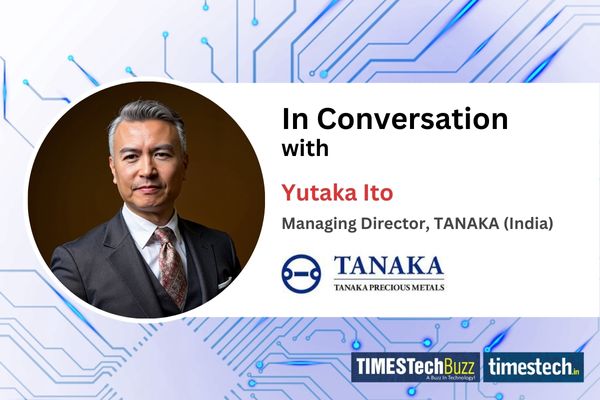
In an interview with TimesTech, Yutaka Ito, Managing Director of TANAKA (India), spoke about how the company is positioning itself in India’s fast-growing semiconductor market. From bonding wire and silver pastes to probe pins, sputtering targets, electroplating solutions, and advanced recycling technologies, TANAKA is uniquely placed as a global provider of precious metals solutions for both front-end and back-end semiconductor applications.
Read the full interview here:
TimesTech: India’s semiconductor market is projected to triple to USD 161 billion by 2033. How is TANAKA positioning itself to meet the surging demand for ultra-high purity precious metals in applications like chip packaging, advanced sensors, and automotive electronics?
Yutaka Ito: At TANAKA, we first developed bonding wire back in the 1960s. And we improved this technology over the last 60 years. And then, we have factories all across the world, including Japan, as a mother plant located in Japan. As well as two Taiwanese factories. And two in China. And one in Singapore. As well as Malaysia. And right now, we are supplying bonding wire from most locations to India. For example, Japan. And with the initiation of this India Semiconductor Mission, which started back in 2023. Since then, we have received so many inquiries from major manufacturers. And majority of companies are evaluating the adoption of our bonding wire material.
TimesTech: As electronic materials grow more complex, ensuring secure and trackable sourcing becomes critical. How does TANAKA support OEMs and fabs in India to guarantee purity, sustainability, and performance in mission-critical devices?
Yutaka Ito: For us, when it comes to mission-critical devices, traceability and ensuring purity is really an essential part as a precious metals supplier. Purity and traceability are critical. TANAKA is a certified Good Delivery Refiner accredited by LBMA and LPPM, and also Japan’s only Good Delivery Referee—one of the few worldwide authorized to evaluate accredited refiners. We are also ISO 17025 certified for analytical verification.
Ensuring responsible material sourcing. With the establishment of its Responsible Mineral Management Policy, TANAKA is committed to the responsible procurement of minerals and actively promotes the elimination of human rights abuses, including the use of child labor in the supply chain. TANAKA employs tTechnologies which ensure all those recycled metals are duly recycled and back into these ecosystems. This technology of recycling is very dispensable for these precious metals treatments. So, we don’t miss out. We try to reduce, minimize all those losses deriving from those recycling processes.
The process: we collect those materials from the industries. And it is called urban mining. We collect the industrial scraps globally from the industries. And we have state-of-the-art technology which we use to recycle at high speed. We strive to minimize the use of newly mined resources by reducing reliance on traditional mining and instead promoting the practice of urban mining. Anyway, we use the same products again to make our own products.
Actually, there are three points for the recycling of precious metals. One is to secure the procurement of precious metals. Because the amount of precious metals is limited. And the second is the time to recover precious metals of these—meaning the regular kind of waste. And the third point is achieving carbon neutrality as well. Because India is big for its prominent mining resources. And the recycling materials of urban mining is already in the market. So, using the recycling resources and the materials can be helpful when we reduce the CO₂ levels. So, this is an advantage.
TimesTech: Precious metals are not only scarce but also highly valuable. Could you elaborate on TANAKA’s recycling and closed-loop precious metal recovery initiatives, and how they can benefit India’s semiconductor ecosystem?
Yutaka Ito: There are three points for the recycling of precious metals. One is to secure the procurement of precious metals, because the amount of precious metals is limited. The second is the recovery time of precious metals from these—regular waste. And the third point is achieving carbon neutrality. Because India is big for its electronics market, and the recycling materials of urban mining are already in the market. Using these resources helps reduce CO₂ and contributes to sustainability.
TimesTech: Technologies such as 5G, EVs, and AI require miniaturized, high-performance chips. What role do precious metals like gold, platinum, and palladium play in advanced packaging, wire bonding, and thermal management?
Yutaka Ito: For gold bonding wire, we try to develop the ultra-thin, ultra-fine wire, which minimizes this wire diameter down to 10 microns, which is almost one-tenth of your diameter. This is the highly dense packaging of the semiconductor chips. So, semiconductors are becoming more and more dense, and as well as very much minimizing the size of chips. So, those ultra-fine wires are highly contributing to the miniaturization of semiconductor chips.
For front-end, we have those target. We call them sputtering targets. We use a vector technology to deposit those target materials and deposit to form a thin film on the wafers. It’s an implanted process where the small circuits vary. The connections are so small as nanometers. So, those gold particles are deposited in those links and create those circuits.
Normally, the minimum size of the circuits is 7nm or 14nm for mass production right now, but advanced is 2nm. The chemical compounds for CVD (Chemical Vapor Deposition) and ALD (Atomic Layer Deposition) are advanced technologies to make very big electrons. Many companies such as TSMC are trying to adapt to such technologies for the 2nm. We have developed over 20 years for that kind of material. It’s time-consuming, but finally, the age is coming.
At the moment, we talk more about bonding wires, silver pastes, and probe pin materials. But when advanced nodes come in, we will be proposing more of these nanometer-scale solutions.
TimesTech: With India setting up fabs and OSAT facilities, local sourcing and supply chain transparency are becoming key priorities. How is TANAKA collaborating with Indian and global partners to build resilient and sustainable material supply chains?
Yutaka Ito: Right now, we are in the process of conducting some due diligence, to assess the feasibility of the Indian market right now. And we have received a lot of inquiries for our existing products. But those products are coming from overseas right now. We are actively looking for ways to support Indian FABs and OSATs with our cutting-edge precious metal materials to set up their factories. And right now, it’s a kind of transition phase. And we are actively seeing India as a global powerhouse for semiconductor hubs.
We have a huge expectation that India will play this role in the future. Right now, we are assessing reliable partners and looking for ways to directly contribute to India in the semiconductor hub. More precious metals are imported. As of now, Indian regulations are too much regulated for in and out of precious metals. Purchasing and so on. But as the demand increases, we have to see very decent stages of such precious metals investments. If OSAT companies grow, and at what level they reach, accordingly we will improve.
If you think of the semiconductor industry globally, the power products in this precious metals space are very critical. Once fabs and OSATs come in, our solutions, which are globally already providing key solutions, will directly support the Indian market.
TimesTech: How does TANAKA ensure that its solutions in India align with global benchmarks for quality, traceability, and sustainability while enabling India to strengthen its position in the global semiconductor supply chain?
Yutaka Ito: As I mentioned, we are accredited with the Good Delivery Referee. We are one of seven Good Delivery referees in the world, by LBMA and LPPM, which is already evidence that showcases our capability to ensure our traceability and sustainability. And also, we set up the huge recycling and refining supply chains across the world, outside of India already. And we ensure almost all the materials are properly recycled back into pure bullion.
We ourselves are the benchmark. We are a global company and a major leader globally. The role of Good Delivery Referee of LBMA and LPPM are very difficult to achieve. In fact, we are one of only seven referees of LBMA who can check and analyze which companies are worth this certification. So, we are doing business as both supplier and referee, certifying whether others follow the right purity standards. That sets us apart.