


According to projections presented at CES 2025, physical AI technologies autonomous guided vehicles, humanoid robots, robotic arms, and AI-driven wearables are set to revolutionize the US$ 50 trillion manufacturing and logistics sectors. But perhaps the most promising evolution lies in healthcare, where robot-assisted surgery, intelligent monitoring systems, and AI-powered rehabilitation tools are redefining patient care delivery.
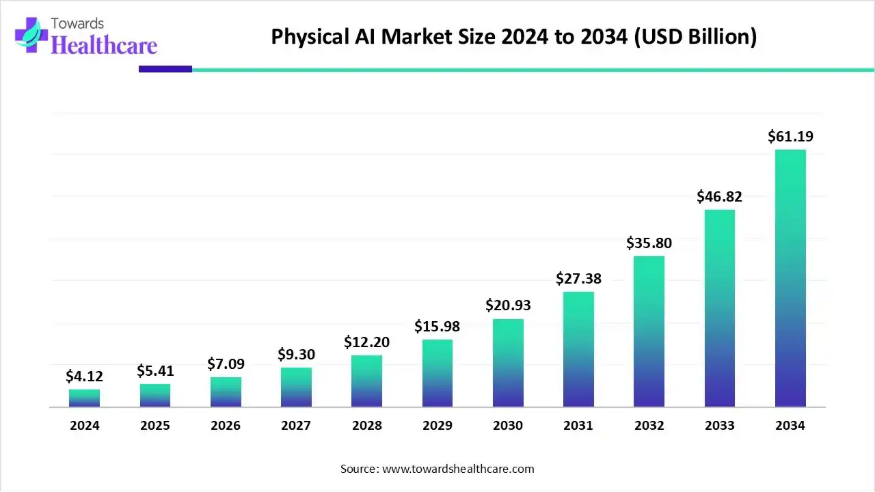
The global physical AI market is undergoing a paradigm shift, evolving from concept to large-scale commercialization. Valued at US$ 4.12 billion in 2024, it is estimated to reach US$ 5.41 billion in 2025 and soar to US$ 61.19 billion by 2034, expanding at a striking CAGR of 31.26%. This exponential rise underscores the fusion of robotics, automation, and artificial intelligence in transforming industries as diverse as healthcare, logistics, and manufacturing.
The Foundation of Physical AI: Intelligence in Motion
Physical AI can be described as the convergence of cognitive intelligence with embodied action machines capable not only of learning and decision-making but also of acting upon those decisions in the physical world. In healthcare, this translates into surgical robots, rehabilitation assistants, and AI-enabled wearables that support diagnosis, chronic disease management, and clinical decision-making.
By merging perception, reasoning, and physical dexterity, physical AI enhances precision diagnostics, accelerates treatment planning, and augments the capabilities of healthcare professionals. From operating theaters to rehabilitation centers, intelligent robotics are bridging the gap between human expertise and machine precision.
Market Dynamics and Growth Drivers
The rise of the physical AI market is strongly linked to labor shortages, aging populations, and the increasing demand for precision medicine. Both private enterprises and government bodies are investing heavily in AI research and development to meet these needs.
Tech giants such as Amazon Web Services (AWS), Google (Alphabet), Johnson & Johnson, Microsoft, and NVIDIA have become major investors in AI-enabled diagnostics and robotic-assisted systems. This wave of investment fuels innovation and accelerates the integration of AI into critical sectors of healthcare and manufacturing.
Furthermore, growing emphasis on sustainability and ethical technology adoption driven by ESG (Environmental, Social, and Governance) mandates encourages transparency, resource efficiency, and responsible use of AI in industrial and clinical settings.
The Rise of Robotic-Assisted Surgery
In 2024, robotic-assisted surgery systems emerged as the dominant segment within the physical AI landscape. These systems are enhancing preoperative planning, providing real-time intraoperative guidance, and improving surgical training. The benefits are significant reduced surgeon fatigue, higher precision, and improved patient outcomes.
The neurosurgical and orthopedic robotic segment is projected to experience the fastest growth during the forecast period, thanks to its ability to perform minimally invasive procedures with exceptional accuracy. These systems employ frameless navigation and data-driven surgical mapping, enabling optimal implant placement and reducing postoperative complications.
Hospitals and Rehabilitation Centers: Dual Growth Engines
Hospitals and surgical centers currently account for the largest share of the market. The use of robotic nurses, logistics assistants, and AI-driven workflow management systems has optimized operations, patient scheduling, and care coordination.
At the same time, rehabilitation and physiotherapy clinics are emerging as the fastest-growing segment. The integration of AI-powered wearables, virtual rehabilitation platforms, and predictive analytics allows therapists to develop personalized, adaptive treatment plans. Through telerehabilitation and remote monitoring, patients can now receive effective therapy beyond hospital walls.
Regional Dynamics: North America Leads, Asia-Pacific Accelerates
North America commanded 41.30% of the global market share in 2024, fueled by government initiatives and robust infrastructure for AI innovation. The White House AI Action Plan (2025) aims to expand AI resources, establish AI centers of excellence, and advance AI adoption across public health and manufacturing sectors.
In the United States, the Advanced Research Projects Agency for Health (ARPA-H) and National Institutes of Health (NIH) are pioneering research into AI-based drug discovery, multimodal health data, and women’s health initiatives.
Canada, on the other hand, is ramping up AI adoption through direct funding programs and a new National AI Strategy, launched in 2025, to accelerate responsible innovation in health IT.
Meanwhile, Asia-Pacific is on track to become the fastest-growing region. With nations like Japan, South Korea, India, and China spearheading digital transformation, the region is embracing Software as a Medical Device (SaMD) frameworks, telemedicine, and AI-assisted diagnostics.
- India has joined the Health AI Global Regulatory Network (GRN), ensuring safe and ethical deployment of AI in healthcare.
- China invested $3.4 billion in robotics ventures, planning to manufacture over 10,000 humanoid robots in 2025, supported by Beijing’s AI innovation roadmap.
In Europe, the implementation of the European Artificial Intelligence Act (EU AI Act) in 2024 has provided a structured regulatory environment for medical AI technologies. Countries like Germany and France are advancing through digital healthcare acts, AI education initiatives, and sustainable innovation frameworks.
Recent Industry Developments
- Cera secured $150 million (February 2025) to scale its AI-driven home healthcare platform capable of predicting patient risks, hospitalizations, and falls using data modeling.
- CMR Surgical achieved record installations of its Versius robotic system (January 2024) and announced plans for new product launches, reinforcing its leadership in surgical robotics.
- Dexterity raised $95 million (March 2025) for developing physical AI capabilities in robotic automation.
- Sensi.AI attracted $45 million (October 2025) to enhance AI-driven care intelligence for the aging population.
Leading Companies and Technological Footprints
- Intuitive Surgical: Known for its da Vinci 5 and Ion systems, integrating AI navigation and 3D surgical mapping.
- CMR Surgical: Developer of the Versius robotic system with real-time imaging and data integration.
- Medtronic: Innovator behind Hugo RAS System and AiBLE Ecosystem, integrating analytics and surgical automation.
- Diligent Robotics: Creator of the Moxi robot, designed to streamline hospital logistics and support medical staff.
- NDR Medical Technology: Pioneer in automated needle targeting systems for image-guided medical procedures.
About Author
Rohan Patil is a seasoned market research professional with over 5+ years of focused experience in the healthcare sector, bringing deep domain expertise, strategic foresight, and analytical precision to every project he undertakes.