


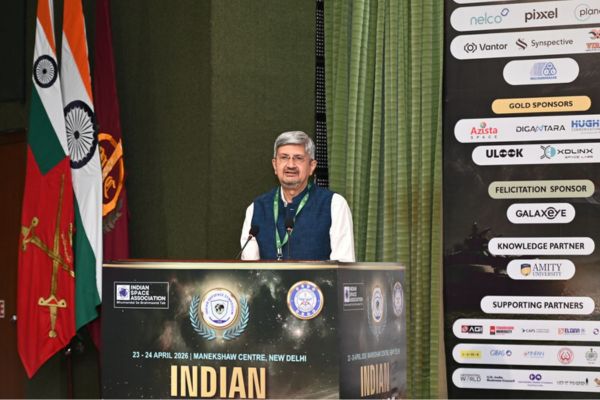
Amid rising geopolitical tensions and the increasing centrality of Space in modern warfare, India’s top defence and space leadership underscored the urgent need to build resilient, sovereign, and integrated space capabilities at the Indian Defence Space Symposium (IDS) 2026, organised by the Indian Space Association (ISpA). The two-day forum kicked off today in New Delhi, anchored around strengthening synergy between India’s defence and space ecosystems, bringing together officials from Ministry of Defence, Armed Forces, Defence Space Agency, policymakers, PSUs, start-ups, and industry leaders.
The inaugural session featured a virtual address by General Anil Chauhan, Chief of Defence Staff, Indian Armed Forces, along with the presence of key defence officials including Air Chief Marshal RKS Bhadauria (Retd), Former Chief of the Air Staff; Dr. Samir V Kamat, Secretary, Department of Defence R&D and Chairman, DRDO; Lt. Gen. Zubin A Minwalla, Deputy Chief of Integrated Defence Staff (Operations), HQ IDS; Rahul Vatts, Chief Regulatory Officer, Bharti Airtel & Vice Chairman, ISpA and Lt. Gen. A.K. Bhatt, Director General, ISpA, among other distinguished dignitaries.

In his virtual address, General Anil Chauhan, Chief of Defence Staff, Indian Armed Forces said, “We must target towards distributed, resilient, and proliferated architectures with redundancy, inter-satellite links, and rapid replenishment capability. Future space capability will not be built by government agencies alone. It will be co-developed with industry, start-ups and technology innovators. We must move from using space as a program to treating it as a continuous operational asset. Our objective is not merely to access space, but to secure operational advantage through space. We must pursue strategic partnerships without compromising our strategic autonomy. We must build space architecture that is resilient, artificial intelligence enabled, quantum secure, cyber hardened, rapidly replenishable, and unquestionably sovereign to us. Anything less will leave us in a reactive mode.”
The first day of the symposium, themed “Commercial Space Operations: Navigating Threats and Military Employment,” examined the evolving threat landscape, including global conflicts and adversarial space capabilities, while exploring how commercial space is shaping military outcomes. Also, discussions focused on the role of space in modern conflicts, strategic communications and network-centric operations, and space-based intelligence, surveillance and reconnaissance (ISR) in contested environments.
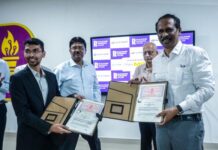
Additionally, three publications were released at the symposium, including a report by OrbitAID and the ISpA on In-Space Servicing, Assembly and Manufacturing (ISAM), highlighting its role in enabling the future space economy and India’s opportunity to build leadership in in-orbit services through stronger policy alignment and industry collaboration. Another report by SatSure and ISpA on Geospatial Foundation Models outlines how AI-driven, reusable intelligence layers can unlock large-scale impact from Earth Observation data, enabling faster, scalable, and decision-ready insights across sectors. A third report by Amity University captures key discussions and strategic takeaways from the ISpA India International Space Conclave 2025, outlining priorities across policy, industry growth, technology development, and international collaboration in the space sector.
Dr. Samir V Kamat, Secretary, DD(R&D) and Chairman, DRDO said, “Space is no longer just an enabler. It is the dominant domain which is going to decide the outcome of future battles. For DRDO and the country to catch up, it is going to be a challenge, and this can be done only if we work in a whole-of-nation approach. There are areas where technologies can be sourced externally, but there are other areas where sovereign capabilities are essential, and these are the areas where DRDO is focusing. Today, we spend only 0.65% of our GDP on R&D and only 5% of our defence budget on R&D. What we need is to invest much more in our R&D efforts. We definitely need to scale this up if we have to catch up with our rivals.”
Lt. Gen. Zubin A Minwalla, Deputy Chief of Integrated Defence Staff, (Operations), HQ IDS said, “India must chart its own path, based on speed, agility and intelligent integration of private industry. Relying solely on one agency would be suboptimal. We must build an ecosystem where all stakeholders complement each other. The Defence Space Agency has articulated the joint military space doctrine and a long-term roadmap under Defence Vision 2047. The Defence Space Agency has grown into a fully operational tri-service entity and in the future will be a fully operational space command. We continue to face dependencies in critical technologies and gaps in high-end indigenous systems. The focus must remain on indigenous development aligned with operational timelines.”
Air Chief Marshal RKS Bhadauria (Retd), Former Chief of Air Staff said, “It is time to think big, act big, and change the norms. We need to redraw the landscape if we are serious about achieving meaningful outcomes. Three years down the line, we must ask ourselves what have we achieved. The key lesson is technological sovereignty in critical areas essential for military operations, and this can only be achieved by designing and developing systems within the country. The challenge is not technology, but how we are attempting to implement change using legacy processes. We cannot continue to approach space capability development using traditional methods. Time is no longer a luxury.”
Rahul Vatts, Chief Regulatory Officer, Bharti Airtel & Vice Chairman, ISpA said, “The Indian DefSpace Symposium has become an important forum for understanding defence requirements, industry capabilities, and the convergence between the two. This is where satellite communications become critical. India is now at the cusp of launching satellite communication services. There are also important considerations around reliability, security, and supply chains. As an Indian, I believe we should develop our own satellite communication systems. Satellite communications can play a critical role in enabling this, contributing not just to defence capabilities but also to economic growth. The road ahead is significant, and we are entering a phase where discussions and planning must translate into execution.”
Lt. Gen. AK Bhatt, Director General, ISpA said, “The Defence Space Symposium has evolved into a key platform for advancing India’s defence space discourse, bringing together operational communities, policymakers, and industry. Achieving this synergy requires deep integration between the armed forces and a capable and responsive industrial base. India’s private sector today is a vital pillar of national capability. However, we must reduce dependence on critical imports and build indigenous capabilities aligned with operational requirements.”
Over the next two days, IDS 2026 will host a series of high-level sessions, panel discussions, and industry engagements, including the Industry Showcase, fireside conversations, and dedicated forums for interaction between the armed forces and private sector. The symposium will also feature participation from global stakeholders, enabling dialogue on emerging trends and collaboration opportunities, while continuing to serve as a key platform for aligning operational requirements with industry capabilities.