

AI Is Turning Data Center Cooling Into a Strategic Infrastructure Priority
The artificial intelligence boom is creating an infrastructure challenge that cannot be solved by purchasing more GPUs alone.
As technology companies deploy increasingly powerful AI accelerators, high-bandwidth memory systems and dense computing clusters, data centers must remove unprecedented concentrations of heat while maintaining operational reliability.
This is transforming the role of cooling infrastructure.
Historically, data center cooling was primarily considered a facility-management function. Its purpose was to maintain suitable operating temperatures for servers, networking equipment and storage systems.
Today, cooling capacity can directly influence how much AI computing infrastructure a facility can accommodate.
A data center may have sufficient floor space for additional servers but lack the thermal-management capability required to operate them safely and efficiently.
This is creating demand for advanced cooling architectures, including direct-to-chip liquid cooling, immersion cooling, coolant distribution units and intelligent thermal-management software.
According to Acumen Research and Consulting, the global Data Center Cooling Market was valued at USD 20.60 billion in 2025 and is projected to reach USD 106.72 billion by 2035, expanding at a 17.8% CAGR during 2026–2035.
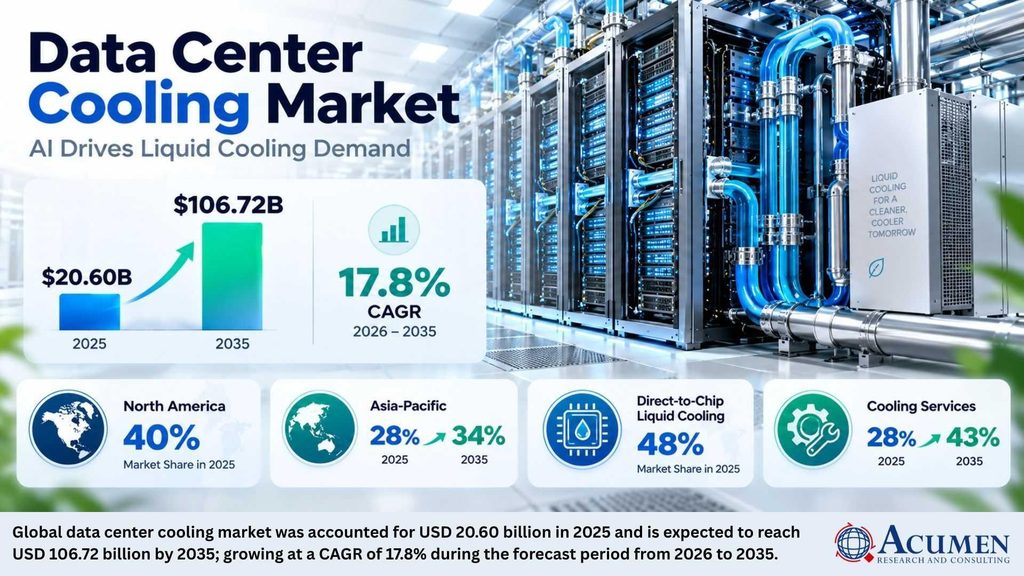
The forecast reflects growing investment in AI-ready data centers, hyperscale computing facilities and high-density server infrastructure.
However, the opportunity extends beyond cooling equipment.
Engineering services, installation, monitoring, maintenance and cooling optimization are becoming increasingly important parts of the industry.
The next phase of AI infrastructure expansion could be determined as much by the ability to remove heat as by the availability of advanced computing processors.
Data Center Cooling Market Could Exceed USD 106 Billion by 2035
The Data Center Cooling Market is projected to expand more than fivefold between 2025 and 2035.
Acumen Research and Consulting estimates that market revenue will increase from USD 20.60 billion in 2025 to USD 106.72 billion by 2035.
The data center cooling market is also estimated to reach USD 24.42 billion in 2026.
Data Center Cooling Market Statistics
| Market indicator | Statistics |
| Global market size, 2025 | USD 20.60 billion |
| Estimated market size, 2026 | USD 24.42 billion |
| Global market forecast, 2035 | USD 106.72 billion |
| CAGR, 2026–2035 | 17.8% |
| North America share, 2025 | 40% |
| North America share, 2035 | 35% |
| Asia-Pacific share | 28% (2025) → 34% (2035) |
| Asia-Pacific CAGR | 20.4% |
| Cooling solutions share | 72% (2025) → 57% (2035) |
| Cooling services share | 28% (2025) → 43% (2035) |
| Direct-to-chip cooling share, 2025 | 48% |
| Immersion cooling share, 2025 | 27% |
| Rear-door heat exchanger cooling share, 2025 | 18% |
| Single-phase liquid cooling share, 2025 | 64% |
| Hyperscale and cloud data centers share, 2025 | 41% |
| Colocation data centers share, 2025 | 30% |
| 50 to below 100 kW/rack share, 2025 | 31% |
| 100 to below 200 kW/rack share, 2025 | 23% |
| New-build data centers share, 2025 | 58% |
| Retrofit data centers share, 2025 | 42% |
| IT and telecommunications share, 2025 | 41% |
Several structural developments are supporting this expansion.
First, artificial intelligence is increasing the computational intensity of modern data centers.
Second, hyperscale cloud providers are expanding infrastructure capacity to support generative AI, enterprise applications and high-performance computing.
Third, rising rack power densities are encouraging the adoption of more advanced thermal-management technologies.
Fourth, operators are prioritizing energy efficiency, water conservation and infrastructure reliability.
Together, these factors are creating opportunities across cooling equipment, fluid-handling systems, thermal-management software and specialized engineering services.
The market is also evolving from conventional air-based cooling toward hybrid architectures that combine air and liquid technologies.
Importantly, the overall Data Center Cooling Market includes both air and liquid cooling infrastructure. Liquid cooling represents an increasingly important technology category within that broader industry.
Why AI Is Changing Data Center Cooling Requirements
Traditional enterprise data centers were designed primarily for general-purpose computing workloads.
These environments typically supported servers with comparatively moderate power requirements.
Modern AI computing systems operate differently.
Advanced GPUs and specialized AI accelerators consume substantial electrical power and generate concentrated heat.
When multiple high-performance processors are installed within the same rack, the resulting thermal load can become difficult to manage using conventional air cooling alone.
The challenge is particularly significant for large AI training clusters.
These systems may operate continuously at high utilization while processing computationally intensive workloads.
AI inference is also creating growing demand for computing capacity.
As generative AI becomes embedded in enterprise software, search applications and autonomous AI agents, data centers must support increasingly large volumes of inference requests.
This creates a need for cooling systems that can respond to changing workloads without compromising efficiency.
The relationship is becoming increasingly clear:
More AI Computing → Higher Rack Power Density → Greater Heat Generation → Advanced Cooling Infrastructure
Cooling is therefore emerging as a strategic component of AI infrastructure design.
Rising Rack Power Density Is Accelerating Cooling Innovation
Rack power density is one of the most important indicators of changing data center cooling requirements.
It measures the electrical power consumed by computing equipment installed within a server rack.
As power density increases, more heat must be removed from a relatively small physical space.
According to Acumen Research and Consulting, the 50 to below 100 kW per rack segment accounted for 31% of the Data Center Cooling Market in 2025.
The 20 to below 50 kW per rack category represented approximately 27%.
Meanwhile, the 100 to below 200 kW per rack segment accounted for another 23%.
These figures highlight the growing importance of cooling systems designed for concentrated computing loads.
However, rack power density varies considerably between facilities.
A conventional enterprise data center may operate at much lower densities than a purpose-built AI training facility.
Cooling technology selection must therefore reflect actual workload requirements rather than assuming that every data center needs the most advanced liquid cooling system.
For high-density environments, direct-to-chip cooling and other liquid-based technologies can provide advantages by transferring heat closer to its source.
Direct-to-Chip Liquid Cooling Leads Advanced Cooling Technologies
Direct-to-chip liquid cooling is becoming one of the most important technologies supporting high-performance AI infrastructure.
According to Acumen’s technology segmentation, direct-to-chip liquid cooling accounted for 48% of the reported cooling-technology category in 2025.
The technology removes heat directly from processors and other high-power components using liquid-cooled cold plates.
Coolant circulates through these components, absorbing heat before transferring it to a broader cooling system.
This approach can reduce reliance on moving large volumes of air through densely packed server racks.
It is particularly relevant for GPUs, CPUs and other high-performance computing components.
Direct-to-chip systems can also be integrated with existing facility cooling infrastructure through coolant distribution units.
However, implementation requires compatible server designs, reliable fluid connections and appropriate maintenance procedures.
The technology’s growing importance reflects the need to improve thermal performance without excessively increasing data center space requirements.
Immersion Cooling Could Unlock New Levels of Computing Density
Immersion cooling represents another important technology within the Data Center Cooling Market.
The technology accounted for approximately 27% of the report’s cooling-technology segment in 2025.
Unlike direct-to-chip cooling, immersion systems place electronic components within specially engineered dielectric fluids.
These fluids transfer heat while allowing compatible electronics to operate safely within the cooling environment.
Immersion cooling can reduce the need for conventional server fans and enable efficient heat transfer in suitable system designs.
It is particularly attractive for certain high-density computing applications.
However, immersion cooling also introduces engineering and operational considerations.
Operators must evaluate equipment compatibility, maintenance access, fluid management and infrastructure integration.
There are also differences between single-phase and two-phase immersion technologies.
Single-phase systems circulate liquid coolant without relying on boiling during normal operation.
Two-phase systems use phase changes to transfer heat.
Each approach offers different engineering characteristics and commercial considerations.
The adoption of immersion cooling will therefore depend on application requirements, operating costs and infrastructure design.
Single-Phase Liquid Cooling Dominates With 64% Share
Single-phase liquid cooling accounted for approximately 64% of the cooling-mechanism segment in 2025.
Its leading position reflects established engineering practices and relatively straightforward fluid-management requirements.
Single-phase systems transfer heat through circulating liquid while keeping the coolant in its liquid state.
This approach can be used in direct-to-chip cooling and certain immersion cooling configurations.
It is particularly attractive where operators require predictable thermal performance and manageable maintenance procedures.
Two-phase liquid cooling offers alternative heat-transfer characteristics but introduces additional design considerations.
The appropriate mechanism depends on the cooling architecture, equipment compatibility and operating requirements.
As AI computing systems become more powerful, both approaches may continue to evolve.
Coolant Distribution Units Are Becoming Critical AI Infrastructure Components
Coolant distribution units, commonly known as CDUs, are becoming increasingly important in high-density data centers.
These systems help manage coolant circulation, temperature, pressure and heat exchange between IT equipment and facility cooling infrastructure.
They play a central role in many direct-to-chip liquid cooling installations.
As computing density increases, CDU capacity and reliability become important design considerations.
In September 2026, Schneider Electric introduced its WCDU coolant distribution unit for high-density AI data centers.
According to the company information referenced by Acumen Research and Consulting, the system supports cooling capacity of up to 3.5 megawatts per unit.
This development illustrates the scale of emerging thermal-management requirements.
Large AI facilities increasingly need cooling infrastructure capable of supporting multiple high-density racks and substantial computing clusters.
However, cooling capacity alone does not determine system performance.
Operators must also consider redundancy, flow control, temperature management, integration and maintenance.
Cooling Services Could Capture 43% of Market Revenue by 2035
One of the most significant developments in the Data Center Cooling Market is the increasing importance of services.
Cooling solutions accounted for approximately 72% of market revenue in 2025.
Services represented the remaining 28%.
By 2035, Acumen projects that the services segment will increase to 43% of total market revenue.
This reflects the growing complexity of modern data center cooling infrastructure.
Advanced cooling systems require specialized engineering, installation, commissioning and maintenance.
Operators may also need ongoing monitoring to optimize performance and identify potential problems before they affect computing availability.
The transition creates opportunities for cooling service providers.
These include system design, installation, retrofitting, maintenance, coolant management and managed thermal services.
As AI data centers become more complex, cooling expertise could become a source of competitive differentiation.
The industry’s commercial opportunity is expanding from selling cooling equipment toward delivering cooling performance as an ongoing service.
Hyperscale and Cloud Data Centers Account for 41% of Demand
Hyperscale and cloud data centers represented approximately 41% of the Data Center Cooling Market in 2025, making them the largest data center category.
Their leadership reflects substantial investment in cloud computing, artificial intelligence and large-scale digital infrastructure.
Hyperscale operators manage extensive computing environments that require reliable thermal management.
The expansion of AI training and inference workloads is increasing the need for high-density cooling solutions.
Colocation data centers accounted for approximately 30% of the market.
These facilities serve multiple customers with different infrastructure requirements.
As enterprise customers deploy AI workloads, colocation operators may need to accommodate a wider range of rack power densities.
Enterprise data centers represented approximately 18% of the market.
These facilities continue to require cooling modernization as organizations upgrade computing infrastructure and deploy new applications.
The diversity of customer requirements creates opportunities for modular and flexible cooling architectures.
New-Build Data Centers Lead With 58% Market Share
New-build data centers accounted for approximately 58% of market revenue in 2025.
New facilities offer operators the opportunity to integrate cooling architecture into the initial design.
This can simplify the installation of liquid cooling systems, coolant distribution equipment and high-density server layouts.
Purpose-built AI data centers can also coordinate cooling with electrical infrastructure and workload requirements.
However, new construction is not the only growth opportunity.
Retrofit and existing data centers accounted for approximately 42% of the market in 2025.
Retrofitting allows operators to increase cooling capacity without constructing entirely new facilities.
This can be commercially attractive where existing buildings, power connections and network infrastructure remain valuable.
However, retrofits can be technically challenging.
Older facilities may lack suitable piping layouts, equipment space or structural provisions.
Operators must also manage the risk of disrupting existing computing operations.
These challenges create demand for specialized retrofit engineering and modular cooling technologies.
Rear-Door Heat Exchangers Offer a Practical Retrofit Option
Rear-door heat exchangers represent an important technology for operators seeking to manage higher rack densities.
According to Acumen, the technology accounted for approximately 18% of the reported cooling-technology category in 2025.
Rear-door heat exchangers capture heat from server exhaust air using heat-exchange equipment installed at the back of a rack.
This approach can reduce the amount of heat released into the surrounding data center environment.
It may be particularly useful for facilities that cannot immediately transition to direct-to-chip liquid cooling.
However, rear-door heat exchangers do not eliminate every cooling challenge.
Their performance depends on rack configuration, airflow, coolant supply and facility infrastructure.
They are best understood as one option within a broader thermal-management strategy.
Energy Efficiency Is Becoming a Competitive Advantage
Cooling systems contribute significantly to data center energy consumption.
As AI infrastructure expands, operators are under increasing pressure to improve energy efficiency.
Power Usage Effectiveness, or PUE, is commonly used to evaluate the relationship between total facility energy consumption and energy delivered to IT equipment.
A lower PUE generally indicates less facility energy overhead relative to IT consumption.
However, PUE does not measure every aspect of sustainability.
A facility may achieve a relatively low PUE while still consuming substantial electricity overall.
Operators must therefore consider cooling efficiency alongside total energy demand, electricity sourcing and infrastructure utilization.
Advanced cooling technologies can help reduce certain cooling-related energy requirements.
However, their actual performance depends on system design, operating conditions and the broader facility architecture.
Intelligent cooling controls, efficient chillers and heat-recovery systems can also contribute to improved performance.
Water Efficiency Is Emerging as a Major Cooling Technology Consideration
Water consumption is becoming an increasingly important consideration in data center development.
Some cooling systems use evaporative processes to reject heat.
These approaches can provide energy-efficiency benefits under suitable conditions but may require substantial water consumption.
In water-stressed regions, operators may prioritize technologies that reduce dependence on evaporative cooling.
Closed-loop liquid cooling, dry cooling and alternative heat-rejection systems can offer different trade-offs.
However, it is important to distinguish between the liquid used to cool IT equipment and the water consumed by a facility’s heat-rejection system.
A closed-loop direct-to-chip cooling system can circulate coolant repeatedly while still transferring heat to an external cooling system that may use water.
Water efficiency therefore depends on the complete facility architecture.
As environmental scrutiny increases, operators will need to evaluate both energy and water performance.
AI-Driven Cooling Controls Could Reduce Operating Costs
Artificial intelligence is not only increasing cooling demand.
It can also help operators manage cooling infrastructure more efficiently.
AI-enabled monitoring systems can analyze temperature, equipment performance, workload patterns and environmental conditions.
These systems may identify opportunities to adjust cooling output without compromising reliability.
Predictive analytics can also help identify developing equipment problems.
For example, unusual temperature or flow patterns may indicate a need for maintenance.
Automated control systems can potentially respond to changes in computing demand more rapidly than manually managed infrastructure.
However, deployment requires reliable sensor data, validated control strategies and appropriate operational safeguards.
AI-driven cooling optimization should therefore complement established engineering controls rather than replace them without adequate testing.
The growing complexity of AI data centers could make intelligent thermal-management software an increasingly valuable market segment.
Waste Heat Recovery Could Create New Value From Data Centers
Data centers convert most of the electricity consumed by computing equipment into heat.
Traditionally, this heat has been rejected into the surrounding environment.
However, operators are increasingly exploring opportunities to recover and reuse thermal energy.
Potential applications include district heating, commercial buildings and selected industrial processes.
Liquid cooling can facilitate heat recovery by transferring thermal energy through controlled fluid circuits.
However, recovered heat may require additional temperature upgrading before it becomes useful.
Heat pumps and heat exchangers can support this process.
The commercial viability of heat recovery depends on local demand, infrastructure availability and operating economics.
For example, a data center located near a district heating network may have more practical opportunities than an isolated facility.
Waste heat recovery could become an important differentiator for selected data center developments.
North America Leads With 40% Market Share
North America accounted for approximately 40% of the global Data Center Cooling Market in 2025, equivalent to USD 8.24 billion.
The region benefits from a concentration of hyperscale cloud providers, AI infrastructure developers and established data center operators.
The United States represents the largest national opportunity within the region.
Investment in AI computing is increasing demand for advanced thermal-management systems.
North America also has an established ecosystem of cooling equipment manufacturers, engineering firms and infrastructure service providers.
However, the region faces challenges involving electricity availability, construction costs and environmental requirements.
Acumen projects that North America’s global market share will decline to approximately 35% by 2035.
This does not necessarily imply declining market revenue.
Instead, it reflects faster expected expansion in other regions.
Asia-Pacific Could Reach 34% Market Share by 2035
Asia-Pacific accounted for approximately 28% of global data center cooling market revenue in 2025.
Its share is projected to increase to 34% by 2035.
Acumen expects the region to expand at a 20.4% CAGR during 2026–2035, making it the fastest-growing regional market.
The report projects Asia-Pacific market revenue of approximately USD 36.28 billion by 2035.
Growth is supported by cloud computing investment, enterprise digitalization and expanding AI infrastructure.
China is an important contributor through large-scale data center development.
Japan and Singapore also represent significant markets for advanced cooling technologies.
Southeast Asian economies are attracting investment in cloud and colocation infrastructure.
As regional data center capacity expands, demand for reliable and energy-efficient cooling systems is expected to increase.
India’s Data Center Cooling Opportunity Is Expanding
India represents an important emerging opportunity within the Asia-Pacific Data Center Cooling Market.
Demand for cloud computing, digital services and AI infrastructure is supporting data center investment.
Major data center development activity is concentrated in established and emerging infrastructure hubs.
As operators deploy more powerful computing systems, cooling requirements are becoming increasingly complex.
India’s climatic conditions also influence cooling technology decisions.
High ambient temperatures and seasonal humidity can affect the performance of conventional cooling systems.
Water availability is another important consideration in selected locations.
These factors create opportunities for efficient chillers, liquid cooling, hybrid cooling architectures and intelligent monitoring systems.
Domestic engineering companies and international cooling technology providers may benefit from increasing demand.
However, adoption will depend on project economics, technical expertise and infrastructure availability.
IT and Telecommunications Account for 41% of Market Demand
IT and telecommunications represented approximately 41% of the Data Center Cooling Market in 2025.
The sector’s leadership reflects substantial computing requirements associated with cloud services, digital platforms and telecommunications infrastructure.
Banking, financial services and insurance accounted for approximately 16%.
These organizations require dependable computing systems for transactions, analytics and digital banking services.
Healthcare and life sciences represented approximately 11%.
The sector increasingly relies on digital health platforms, medical data storage and research computing.
Other important applications include government, manufacturing, retail and energy infrastructure.
Across these industries, cooling reliability is essential for maintaining computing availability.
Leading Companies in the Data Center Cooling Market
The Data Center Cooling Market includes established HVAC manufacturers, specialized thermal-management companies and infrastructure service providers.
Schneider Electric supplies precision cooling, liquid cooling systems and coolant distribution technologies, including its Motivair portfolio.
Vertiv provides thermal-management infrastructure, coolant distribution units and integrated cooling systems for high-density data centers.
STULZ specializes in precision cooling equipment for mission-critical computing environments.
Johnson Controls supplies chillers, building-management systems and related cooling infrastructure.
Daikin Industries provides commercial and industrial cooling technologies.
Mitsubishi Electric participates through air conditioning, chillers and energy-efficient thermal-management systems.
Carrier Global supplies commercial cooling equipment and HVAC technologies.
Trane Technologies offers large-scale thermal-management systems and participates in liquid cooling through LiquidStack.
Rittal provides rack-based cooling and infrastructure solutions.
Competition increasingly involves the ability to deliver integrated cooling systems rather than individual equipment components.
Manufacturers capable of combining hardware, monitoring software and specialized services may gain a competitive advantage.
Where Are the Most Attractive Data Center Cooling Investment Opportunities?
The data center cooling market’s projected expansion creates opportunities across several categories.
1. Direct-to-Chip Liquid Cooling
Increasing AI accelerator power density is supporting demand for cold plates, coolant distribution equipment and associated liquid cooling systems.
2. Coolant Distribution Infrastructure
Large AI computing facilities require reliable coolant circulation, heat exchange and temperature management.
3. Cooling Services
The services segment is projected to increase from 28% to 43% of market revenue by 2035, creating opportunities in engineering, installation and maintenance.
4. Retrofit Cooling Solutions
Existing facilities require practical approaches to increasing rack density without complete reconstruction.
5. Intelligent Thermal-Management Software
Predictive monitoring and automated controls could improve cooling efficiency and operational reliability.
6. Water-Efficient Cooling
Environmental requirements are encouraging the development of technologies that reduce water consumption while maintaining acceptable thermal performance.
Each opportunity has different technical and commercial characteristics.
Equipment manufacturers face product-development and manufacturing requirements.
Service providers depend on specialized expertise and long-term customer relationships.
Software suppliers must demonstrate measurable improvements in operating performance.
Investors and industry participants should therefore evaluate these opportunities independently.
What Could Slow Data Center Cooling Market Growth?
Despite the positive outlook, several challenges could affect market development.
High installation costs: Advanced cooling systems require specialized equipment and engineering.
Retrofit complexity: Existing facilities may lack suitable space or infrastructure.
Technology compatibility: Server hardware and cooling architectures must be designed to work together.
Maintenance requirements: Liquid cooling introduces specialized fluid-management and servicing needs.
Water and energy constraints: Environmental requirements can influence cooling technology selection.
Standardization challenges: Differences in equipment designs can complicate deployment.
Project delays: Data center construction and electrical infrastructure constraints may postpone cooling investments.
These challenges create opportunities for innovation but also introduce commercial risks.
Data Center Cooling Market Outlook: Cooling Will Shape the Next AI Infrastructure Cycle
The Data Center Cooling Market is projected to expand from USD 20.60 billion in 2025 to USD 106.72 billion by 2035, reflecting a 17.8% CAGR.
The forecast is supported by rising AI workloads, hyperscale infrastructure expansion and increasing demand for high-density computing.
However, the industry’s most important transformation may be structural.
Cooling is evolving from a supporting facility function into a core component of computing infrastructure.
Several transitions are becoming increasingly important.
Air cooling to hybrid thermal architectures: Liquid cooling is gaining importance as AI computing density increases.
Equipment sales to specialized cooling services: Installation, monitoring and maintenance are becoming larger parts of the market.
Conventional racks to high-density AI systems: Advanced thermal management is enabling more concentrated computing capacity.
Cooling performance to energy and water efficiency: Operators are evaluating the environmental and operating implications of different technologies.
Standalone cooling equipment to integrated infrastructure platforms: Cooling, electrical power, server design and workload management are becoming more closely connected.
These developments suggest that cooling infrastructure will increasingly influence the economics of AI computing.
For data center operators, this means selecting cooling systems based on long-term computing requirements.
For equipment manufacturers, it means developing integrated, scalable and reliable thermal-management solutions.
For investors, it means identifying opportunities across cooling hardware, services, software and energy infrastructure.
The next generation of AI data centers will not be defined by computing power alone. Their competitiveness will also depend on how efficiently they can remove the heat that computing generates.
Frequently Asked Questions
What is the Data Center Cooling Market?
The Data Center Cooling Market includes systems, equipment and services used to remove heat generated by servers, storage devices and networking infrastructure. It covers air cooling, liquid cooling, chillers, heat exchangers and advanced thermal-management technologies.
How big is the global Data Center Cooling Market?
The global data center cooling market was valued at USD 20.60 billion in 2025 and is projected to reach USD 106.72 billion by 2035, expanding at a 17.8% CAGR.
Why is AI increasing demand for data center cooling?
AI accelerators and high-performance computing systems generate substantial heat. As computing density increases, operators require more advanced cooling technologies to maintain equipment performance and reliability.
What is direct-to-chip liquid cooling?
Direct-to-chip liquid cooling removes heat from processors and other high-power components using liquid-cooled cold plates and associated fluid-handling systems.
What is the difference between direct-to-chip and immersion cooling?
Direct-to-chip cooling transfers heat through cold plates attached to selected components. Immersion cooling places compatible electronic equipment in dielectric fluid to facilitate heat transfer.
Which region dominates the Data Center Cooling Market?
North America led the market with approximately 40% share in 2025. Asia-Pacific is projected to be the fastest-growing region.
Which data center category generates the most cooling demand?
Hyperscale and cloud data centers accounted for approximately 41% of market revenue in 2025.
What are the main opportunities in data center cooling?
Important opportunities include liquid cooling equipment, coolant distribution units, retrofit services, intelligent cooling controls, thermal-management software and water-efficient cooling systems.